
Essential Guide to Avocado Tree Trimming
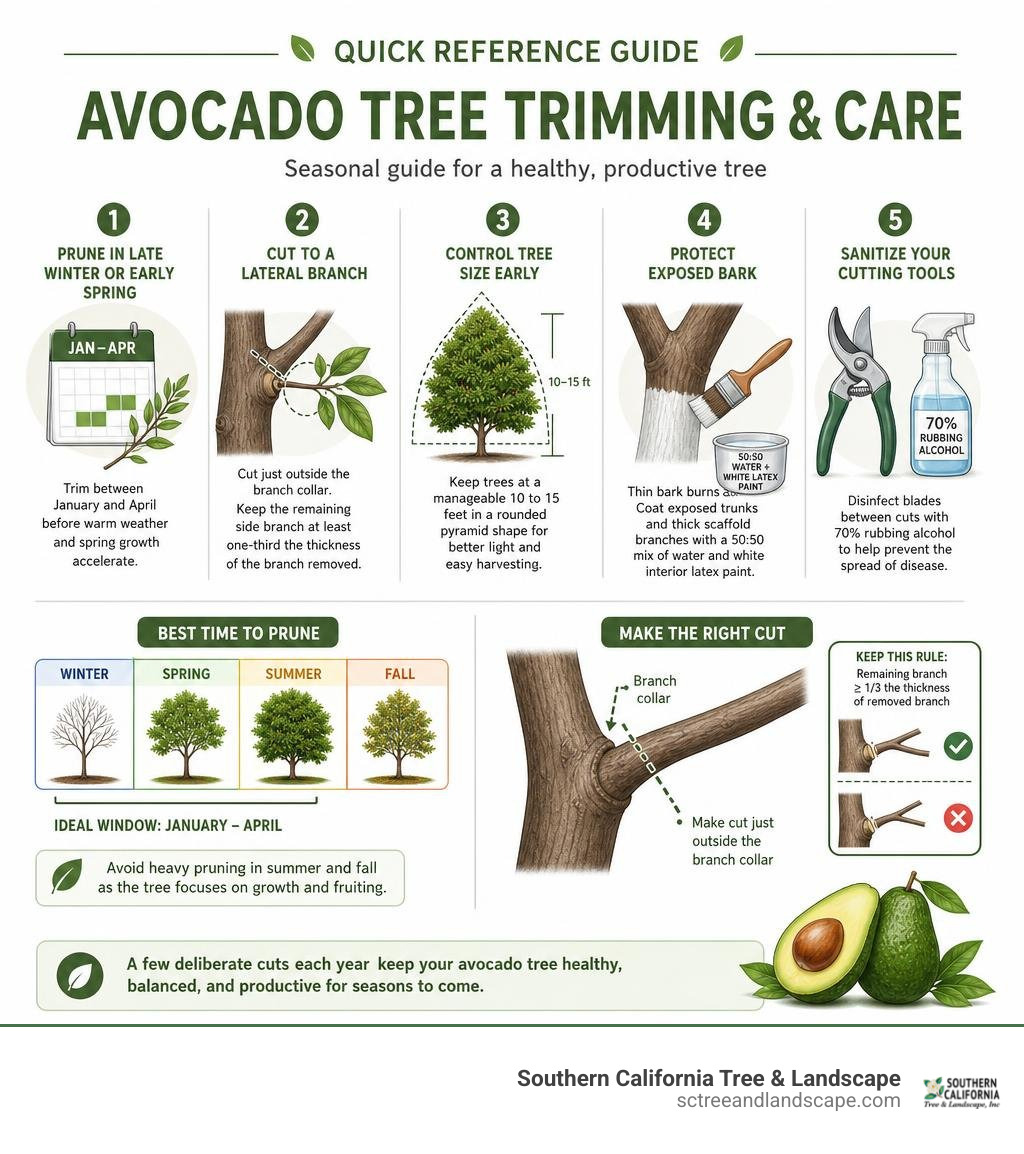
Proper avocado tree trimming comes down to timing, tool cleanliness, and precise branch cuts. To keep your tree healthy, productive, and easy to harvest, follow these core rules:
- Prune in late winter or early spring: Trim between January and April before warm summer heat arrives and spring growth accelerates.
- Cut to a lateral branch: Always cut just outside the branch collar. Ensure the remaining side branch is at least one-third the thickness of the branch you remove.
- Control tree size early: Keep backyard trees at a manageable height of 10 to 15 feet in a rounded pyramid shape to allow sunlight into the canopy.
- Protect exposed bark: Thin avocado bark burns easily. Coat newly exposed trunks and thick scaffold branches with a 50:50 mix of water and white interior latex paint.
- Sanitize your cutting tools: Disinfect blades between cuts with 70% rubbing alcohol to stop the spread of fungal cankers and viroids.
Left unmanaged, standard avocado trees can easily top 30 to 40 feet, concentrating fruit high out of reach while shading out lower limbs. A few deliberate thinning cuts each year maintain tree balance, improve fruit quality, and prevent wind damage.
I’m Troy Basmajian, President of Southern California Tree & Landscape, where our teams have spent over a decade guiding homeowners and property managers through safe, effective avocado tree trimming. Let’s explore the exact seasonal schedules, tools, and cut mechanics you need to protect your harvest and keep your trees thriving.
Why and When to Prune: Essential Avocado Tree Trimming Schedules
Avocado trees are vigorous growers with broad-spreading canopies. Left to their own devices, they naturally turn into shaded “caverns,” shedding their interior leaves and producing fruit exclusively on the upper exterior canopy. Pruning maintains structural balance, allows light interception into the lower limbs, makes harvesting reachable without commercial ladders, and clears low foliage away from irrigation systems. Following science-backed cultural care guidelines from UC IPM ensures your tree receives adequate water, food, and sunlight without unnecessary stress.
Best Time of Year for Avocado Tree Trimming
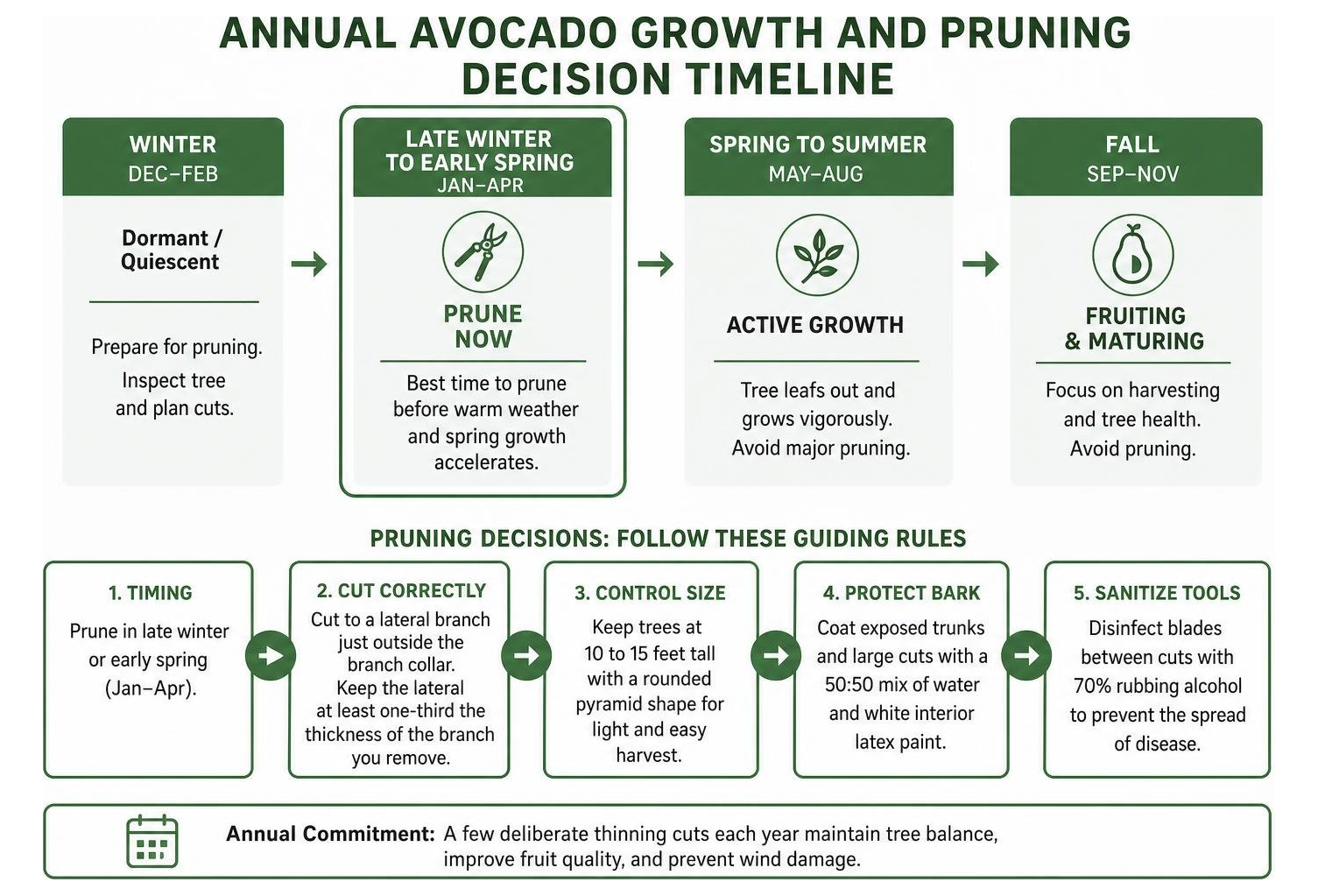
The optimal window for pruning avocado trees in Southern California—from Torrance and the South Bay across to Covina—is late winter to early spring (January through April). During this period, trees transition out of winter quiescence just before the spring bloom accelerates.
Pruning during this cool window offers several distinct advantages:
- Frost avoidance: The threat of severe winter freezing temperatures has largely passed.
- Sunburn prevention: The tree has time to push out protective new foliage before hot summer heat waves strike.
- Calm regrowth: Removing unwanted branches right before bloom directs stored energy into setting flowers and fruit rather than wild, excessive water sprouts.
If you are new to tree care, reviewing proven tree trimming practices will help you understand branch structure, safety fundamentals, and basic cutting principles before you pick up your tools.
Seasonal Hazards: Summer and Fall Trimming Risks
Trimming an avocado tree at the wrong time of year can significantly hurt fruit yields and damage structural wood. Summer and autumn trimming introduce severe biological hazards:
- Summer Sunburn: Pruning heavily in June or July suddenly exposes sensitive interior branches to intense UV radiation. Avocado wood has thin green bark that scalds quickly, causing cambium death and fungal infections.
- Loss of Flower Buds: Flower buds for next year’s crop differentiate during late summer. Cutting back branches after early July removes this wood, preventing flower bud initiation and eliminating the following spring’s harvest.
- Fall Frost Sensitivity: Trimming in autumn stimulates late flushes of tender green growth. Unlike mature wood, tender new growth cannot tolerate cold snaps and will suffer severe frost damage during winter nights.
Heeding clear UC ANR pruning timeline warnings prevents costly mistakes and ensures you never compromise your tree’s seasonal cold tolerance.
Step-by-Step Pruning Mechanics and Disease Prevention

Avocados have soft, brittle wood that requires deliberate, clean cuts to seal properly. Making rough tears or leaving protruding branch stubs invites wood-decaying fungi and structural rot.
Making Proper Branch Collar and Lateral Cuts
Whenever you shorten or remove a branch, follow strict anatomical guidelines:
- Locate the Branch Collar: Look for the wrinkled ring of bark where the branch joins the main trunk or larger scaffold limb. Always cut just to the outside edge of this collar. Never make a flush cut against the trunk, as this destroys the tree’s natural healing zone.
- Follow the One-Third Rule: When shortening a main stem or large branch, make your cut back to a healthy lateral (side) branch that is at least one-third the diameter of the portion being removed. This lateral branch will maintain sap flow, suppress erratic water sprout formation, and encourage calm wound closure.
- Avoid Leaving Stubs: Leaving branch stubs prevents the bark from rolling over the wound. Stubs inevitably die back, creating direct conduits for wood rot and boring insects.
- Skip Pruning Paints and Wound Dressings: Never apply petroleum-based wound paints or sealers to pruning wounds. Sealers trap moisture and bacterial spores against open wood; avocado cuts compartmentalize fastest when allowed to dry naturally in open air.
For larger canopies that need structural height reduction, using professional crown reduction methods preserves the natural canopy shape without the damaging shock caused by indiscriminate topping.
Tool Sanitation and Pathogen Control
Avocado trees are vulnerable to communicable diseases transmitted directly through trimming tools, including branch canker fungi, Phytophthora, and Avocado Sunblotch Viroid (ASBVd).
- Select the Right Cutting Tools: Use clean, sharp bypass pruners for branches under 0.5 inches in diameter to make crisp slices without crushing vascular tissue. For limbs between 0.5 and 2 inches, use heavy-duty loppers. Use sharp hand saws or pole saws for larger scaffold limbs. Avoid anvil-style pruners, which crush delicate plant tissue.
- Disinfect Between Cuts: Keep a spray bottle of 70% isopropyl alcohol or a 25% household bleach solution on hand. Spray tool blades thoroughly between trees, and wipe sap off blades between large cuts.
- Prune in Dry Weather: Never prune during damp, rainy, or humid conditions when airborne fungal spores spread easily to open wood wounds.
- Dispose of Infested Wood: If you remove wood displaying dieback or sunken dark lesions, haul it off the property or dispose of it safely. Knowing the steps for identifying and treating tree diseases keeps your backyard orchard protected throughout the entire growing season.
Pruning by Tree Life Stage: Seedlings to Mature Trees
Every stage of an avocado tree’s development requires a different pruning approach to build strong scaffold branching, manage height, and support bountiful fruit production.
| Life Stage | Primary Height / Dimension | Pruning Objectives | Recommended Technique |
|---|---|---|---|
| Young Seedling / Sapling | 8 to 12 inches (20–30 cm) | Encourage trunk thickening and lateral branching; overcome leggy apical dominance | Heading cut halfway down the stem, 1/4 inch above an active node |
| Indoor / Potted Avocado | 3 to 7 feet | Control vertical stretching; stimulate sturdy trunk development; shape for indoor light | Nip terminal buds in mid-spring; prune 1/4 inch above a healthy outward-facing leaf |
| Young In-Ground Tree (Years 2–5) | 6 to 10 feet | Establish 3 to 4 primary scaffold limbs spaced 3–4 feet apart; eliminate weak V-crotches | Thin competing central leaders; remove low horizontal branches dragging on soil |
| Mature Fruiting Tree (Years 6+) | 10 to 16 feet | Size control; maximize light penetration; skirt lower canopy; remove 3 Ds (Dead, Damaged, Diseased) | Thinning cuts back to lateral branches; skirt pruning up to knee height; window thinning |
How to Prune Young Avocado Seedlings and Saplings
When starting an avocado tree from seed—whether using the classic toothpick-and-water method or planting directly in soil—seedlings naturally tend to produce a single, tall, skinny stem with sparse foliage.
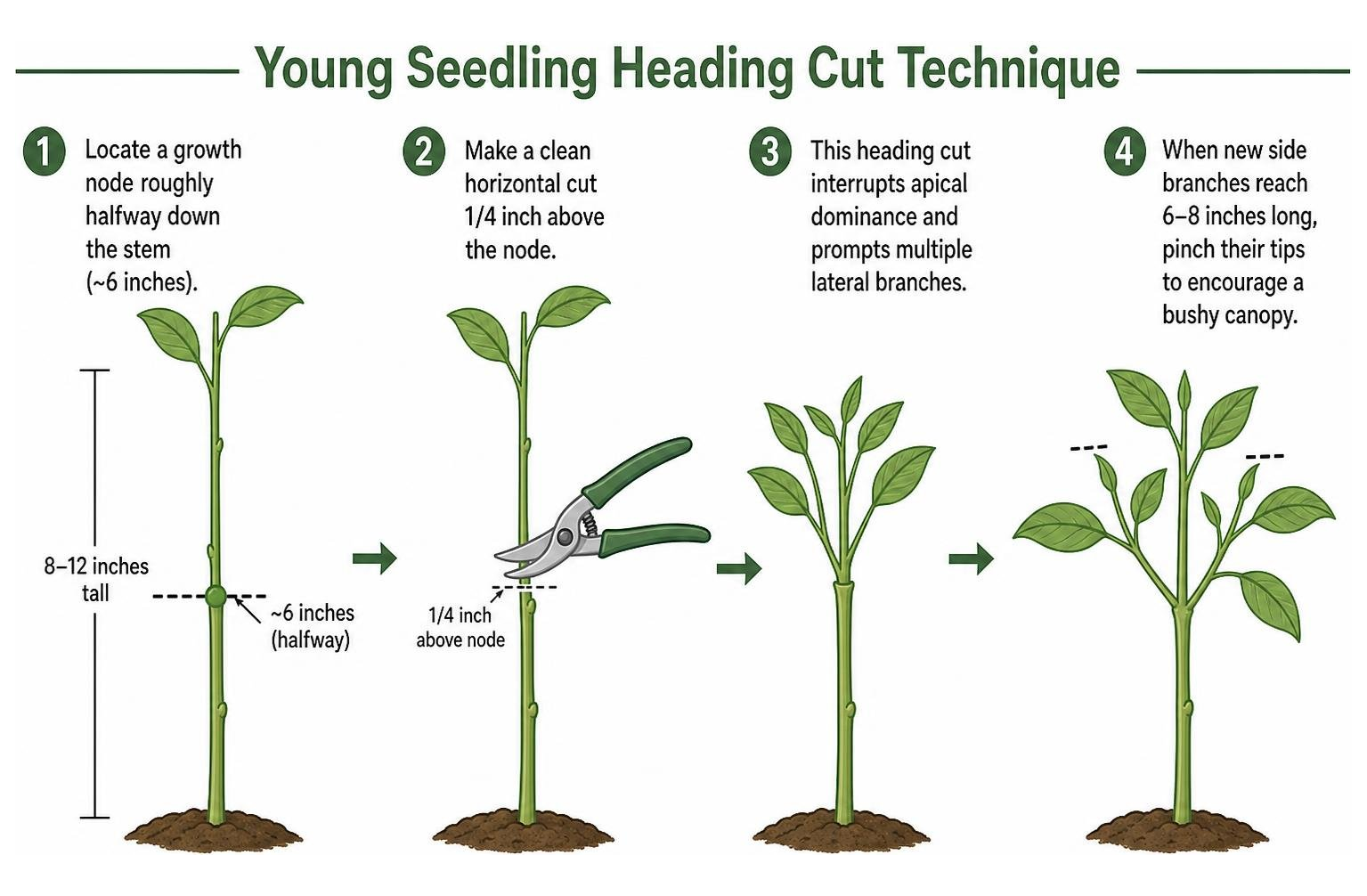
When your young sapling reaches 8 to 12 inches (20 to 30 cm) tall, make your first structural cut:
- Locate a prominent growth node roughly halfway down the stem (around the 6-inch mark). Nodes contain active meristematic cells capable of generating branches and leaves.
- Using sterilized bypass snips, make a clean horizontal cut approximately 1/4 inch above that node.
- This heading cut interrupts apical dominance, prompting the young seedling to thicken its trunk diameter and sprout multiple lateral side branches.
- Once new side branches reach 6 to 8 inches in length, you can pinch their tips to encourage a bushy, well-rounded canopy.
Indoor and Potted Avocado Tree Trimming
Potted avocado plants grown inside often become leggy and structurally weak due to still indoor air and light coming from only one direction. In natural outdoor environments, wind movement triggers a biological strengthening process known as thigmomorphogenesis, which signals the plant to build a sturdy, thick trunk.
To keep an indoor potted avocado compact, balanced, and upright:
- Trim the plant in mid-to-late spring when ambient sunlight levels increase.
- If your indoor tree has grown 6 to 7 feet tall and is bending under its own weight, cut the central stem back by one-third to one-half of its height, slicing 1/4 inch above a healthy, outward-pointing leaf or dormant bud.
- Rotate the container a quarter-turn each week so all sides receive balanced light.
- Lightly shake the potted trunk for 30 seconds a few times a week or run an oscillating fan nearby to simulate natural wind and stimulate thicker wood growth.
Managing Mature Trees and Structural Thinning
Once an avocado tree is established in your landscape, annual maintenance pruning shifts toward preserving canopy health, light distribution, and harvesting clearance.
- Skirt Pruning: Trim lower-hanging horizontal branches so the bottom edge of the canopy sits 2 to 3 feet (knee height) off the ground. This prevents irrigation micro-sprinklers from being blocked, keeps fruit from rotting against the soil, and eliminates easy pathways for crawling pests.
- Eliminate Competing V-Crotches: Avocado wood splits easily under heavy fruit loads or high winds. Remove secondary stems that form tight “V-shaped” angles with the main trunk, preserving wide “U-shaped” attachments with strong branch collars.
- Remove Crossing and Dead Wood: Remove dead, broken, or rubbing branches from the inside out to maintain clear air circulation and prevent fungal outbreaks like anthracnose.
- Manage Water Sprouts: Vigorously growing vertical shoots (water sprouts) draw energy away from fruiting wood. Prune unwanted sprouts flush with their base, or nip them back early in summer to force horizontal, fruit-bearing lateral growth.
If your mature canopy has become an impenetrable thicket, practicing proper canopy thinning techniques lets sunlight reach interior branches. You can also review commercial canopy management research for insights into how commercial growers maintain open canopies for maximum yields.
Renovating Overgrown Trees: Stumping and Sunburn Protection
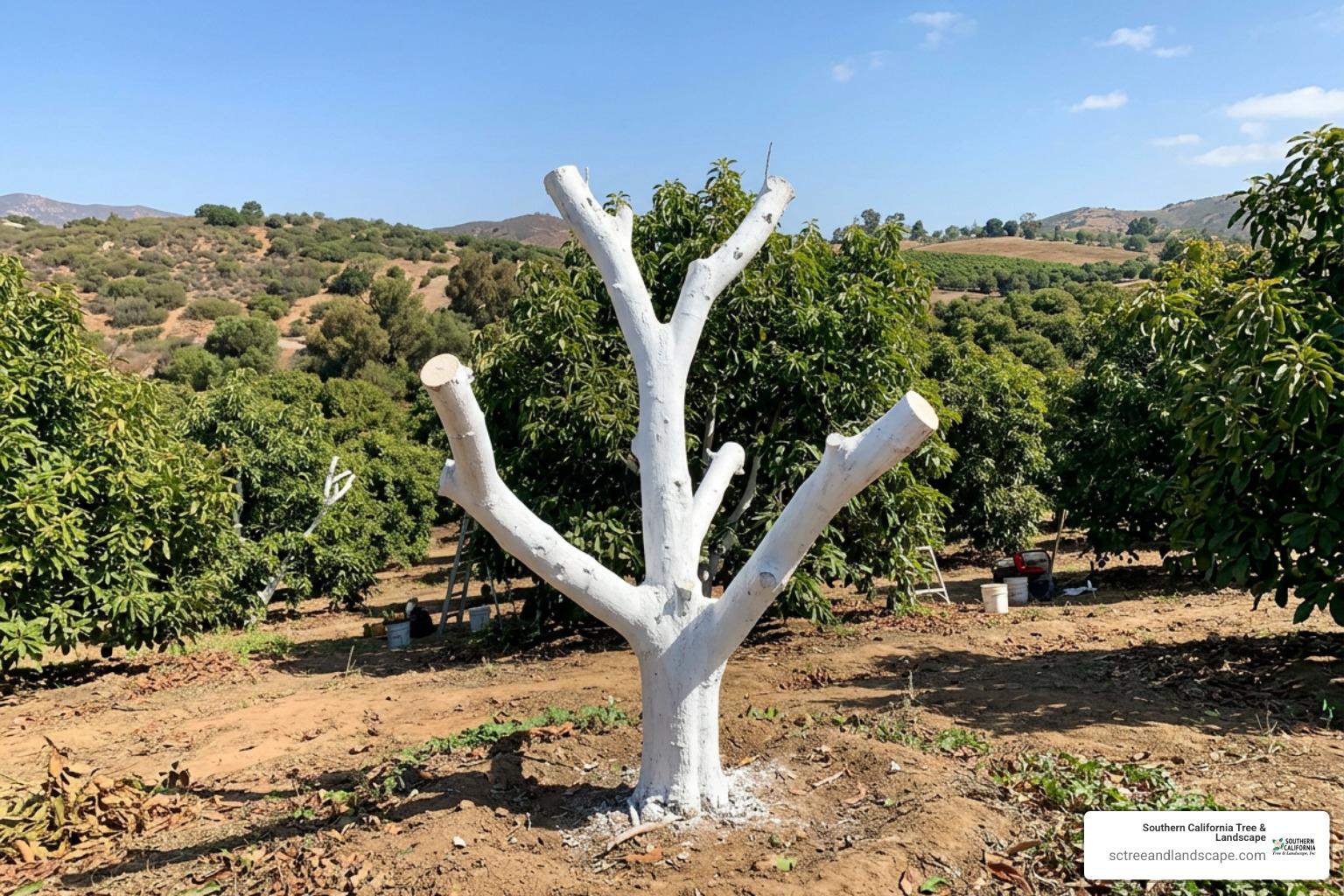
Many residential properties in Southern California feature decades-old avocado trees that have grown 30 to 40 feet high. These towering giants consume valuable yard space, shade out gardens, and drop fruit from heights that leave them bruised and unusable. Fortunately, mature avocado trees possess incredible regenerative vigor and can be safely brought down to a manageable size.
Staged Limb Reduction vs. Rejuvenation Stumping
When addressing a massive, overgrown avocado tree, you have two primary approaches:
1. The 3-Year Staged Reduction (Recommended for Homeowners): Rather than shocking the tree by removing its entire canopy at once, reduce its height gradually over three years.
- Year 1: Cut the single tallest central scaffold limb back to an 8-foot lateral branch in late winter. Leave the remaining canopy intact to provide energy and shade.
- Year 2: Remove the second tallest major limb, painting exposed bark as you go.
- Year 3: Trim the final high limb, bringing the entire tree into a balanced 12-to-15-foot globe or pyramidal shape.
- Benefit: This staged method keeps the root system healthy, prevents sunburn shock, and maintains a partial avocado harvest every single year.
2. Rejuvenation Stumping (“Stag-Horning”): Stumping involves cutting the entire tree down to a single 4-to-5-foot trunk or leaving 3 to 4 short, 5-foot scaffold stubs in late winter (January–February).
- While stumping resets an overgrown tree completely, it will eliminate fruit production for at least two full seasons while the tree regrows vegetative wood.
- Warning: Never stump a tree that is struggling with Phytophthora root rot or severe water stress; depleting the canopy of a sick tree will often kill the root system entirely.
Sunburn Prevention and Whitewashing Exposed Bark
Because avocado trees naturally produce dense outer foliage that shades their own branches, their bark remains exceptionally thin and sensitive to sunlight. Opening the canopy through heavy thinning or stumping exposes this bark to direct sun, which can cook and destroy the vascular cambium within days.
To prevent destructive sunscald:
- Mix 1 part water-based interior white latex paint with 1 part clean water (a 50:50 ratio). Never use oil-based or exterior paints containing harsh chemical solvents.
- Using a paintbrush or garden sprayer, generously coat all exposed trunks, major crotches, and south- or west-facing scaffold branches immediately after cutting.
- As the tree pushes vigorous new leafy shoots over spring and summer, thin out excess sprouts to select new permanent scaffolding, and reapply whitewash to any patches that remain directly exposed to the sun.
Frequently Asked Questions About Avocado Tree Trimming
Can you prune an older avocado tree that has never been pruned?
Yes, older avocado trees that have never been shaped can be pruned successfully, but the work should be done with care. Avoid removing more than 20% to 25% of the total green canopy in a single season. Start by removing dead or crossing wood from the interior, and lower the height over a multi-year phased schedule. If you are dealing with a massive tree near rooflines, utility drops, or property borders, consulting certified arborists in Torrance guarantees the work is performed safely without compromising tree health or structural stability.
Should you prune an avocado tree before or after planting it in the ground?
Wait until after the tree is planted and has had time to settle before doing any structural pruning. When transplanting a container-grown or bare-root avocado into your landscape, the tree undergoes transplant stress while establishing feeder roots in the top 6 to 8 inches of native soil.
- Allow the newly planted tree to establish undisturbed for at least 30 to 60 days.
- The only cuts you should make during planting are removing dead, broken twigs or trimming off root suckers growing below the nursery graft union.
- Begin light structural training during the tree’s second growing season.
What is the best shape and height for a productive avocado tree?
The most productive shape for a backyard avocado tree is a rounded pyramid (conical shape) or modified globe maintained at a height of 10 to 15 feet. Because avocado trees bear fruit peripherally along the outer shell of green growth, a conical structure—where the top of the canopy is narrower than the base—ensures direct sunlight reaches the lowest scaffold branches. This prevents the bottom limbs from defoliating, keeping your fruit accessible from ground level without needing dangerous ladders.
Conclusion
Pruning avocado trees doesn’t have to be intimidating. By scheduling your primary trimming between January and April, making clean cuts outside the branch collar to healthy lateral limbs, and painting exposed wood with diluted white latex paint, you will enjoy a healthy tree that produces delicious fruit year after year.
Whether you need help shaping a young sapling, thinning a dense residential canopy, or safely reducing a massive 40-foot tree, our team at Southern California Tree & Landscape is here to help. With ISA-certified arborists and experienced local crews serving Torrance, South Bay, Harbor City, Covina, and surrounding communities, we provide complete care to keep your landscape thriving.