
Why Tree Trimming Belongs at the Top of Every Property Maintenance List
Tree trimming is the regular removal of overgrown, dead, or structurally weak branches to keep trees healthy, safe, and looking their best. Here’s a quick overview of what you need to know:
- What it does: Removes problem branches to improve tree structure, health, and appearance
- When to do it: Late winter to early spring for most species; avoid trimming oaks in summer
- Who should do it: A licensed, ISA-certified arborist for anything near structures or power lines
- Why it matters: Prevents storm damage, protects property, and extends the life of your trees
- How often: Most trees benefit from trimming every 3–5 years, some faster-growing species every 2–3 years
Trees are one of the most valuable assets on any property — but only when they’re properly maintained. Overgrown canopies can block sunlight, damage roofs, interfere with power lines, and become serious safety hazards after a storm. According to Unitil, falling limbs and tree damage are the primary causes of power outages, usually triggered by heavy wind, snow, or ice.
The good news: routine trimming prevents most of these problems before they start. Proper pruning creates healthier, more beautiful trees and can significantly extend their lifespan — whether you’re managing a residential estate, an HOA community, or a commercial property.
I’m Troy Basmajian, President of Southern California Tree & Landscape, and over the past decade I’ve helped hundreds of property owners across Southern California protect and maintain their trees through smart, consistent tree trimming programs. In the sections below, I’ll walk you through everything you need to know — from timing and technique to costs and safety.
What is Tree Trimming and Why Does It Matter?

To the untrained eye, a tree might look like a self-sustaining giant that requires zero human intervention. But in urban and suburban landscapes like Torrance, Covina, and the South Bay, trees don’t grow in isolation. They share space with homes, driveways, sidewalks, and utility lines.
Without regular maintenance, a tree’s natural growth pattern can lead to structural defects. Overloaded branches can snap under their own weight, overgrown canopies can block essential sunlight from reaching your lawn, and low-hanging limbs can obstruct walkways or damage passing vehicles.
Investing in professional care is about more than just keeping up appearances; it is a fundamental part of property protection. Neglecting your canopy can lead to costly structural damage if a major limb crashes onto your roof or garage. By proactively managing your trees, you ensure they remain a beautiful, functional asset rather than a ticking liability. For a deeper dive into how professional care preserves your landscape, check out our guide on Tree Service: Essential Care for Your Property’s Green Giants.
Tree Trimming vs. Tree Pruning: What is the Difference?
While many homeowners use these terms interchangeably, arborists draw a clear distinction between the two. Think of tree trimming as a trip to the salon for an aesthetic grooming and shape-up, whereas tree pruning is more akin to a medical checkup and targeted treatment for plant health.
Here is a quick breakdown to help you understand how they differ:
| Feature | Tree Trimming | Tree Pruning |
|---|---|---|
| Primary Goal | Aesthetic grooming, shaping, and spatial clearance | Plant health, structural integrity, and disease control |
| Target Areas | Overgrown exterior branches, low-hanging limbs, and crowded canopies | Dead, diseased, weak, crossing, or infested wood |
| Frequency | Typically 1–2 times a year depending on growth rate | Cyclical (often every 3–5 years) or as needed for health |
| Tools Used | Hedge trimmers, hand shears, and light pole saws | Pruning saws, loppers, hand shears, and chainsaws |
When you look for local tree trimming, you want a team that understands both sides of the coin. Whether you are in the South Bay, Torrance, or Harbor City, CA, working with experienced, local crews ensures your trees receive the highest standard of care. The goal is always to balance beautiful aesthetics with biological health.
The Core Benefits of Regular Maintenance
Routine maintenance acts as a preventative health plan for your trees. When a canopy becomes too dense, it acts like a giant sail in the wind, catching strong gusts and putting immense physical stress on the trunk and root system. By thinning out select branches, we improve airflow through the canopy, allowing wind to pass through safely.
Furthermore, proper thinning enhances sunlight penetration. When sunlight can reach the inner branches and the ground below, it prevents the damp, shaded conditions that fungal pathogens love. This active disease control and pest prevention are crucial for keeping your trees thriving for decades. If you want to learn the art of thinning without stripping away your tree’s natural beauty, read The Ultimate Guide to Thinning Your Tree Without Losing Your Mind.
When and How to Trim Your Trees Safely

Working with mature trees requires specialized tools, heavy safety gear, and a deep understanding of tree biology. Making the wrong cut at the wrong time of year can leave a tree vulnerable to pests, diseases, or structural decay. That is why expert tree care is always recommended for major projects. Homeowners who want to understand the basics can also review the International Society of Arboriculture’s homeowner guidance on pruning trees, but large limbs, tall trees, and any work near structures should still be handled by qualified professionals.
Best Seasons for Tree Trimming by Species
Timing is everything in arboriculture. For the vast majority of deciduous trees (those that drop their leaves in autumn), the absolute best window for trimming is during the dormant season-typically late winter from January to March. During this period, sap flow is minimal, which reduces stress on the tree. Plus, without leaves in the way, it is much easier to evaluate the tree’s overall structure and spot hidden defects.
Evergreen trees, on the other hand, are best trimmed in the late dormant season, right before their spring growth spurt begins.
In Southern California, we also have to be highly mindful of specific local species. For instance, eucalyptus trees require very precise timing to avoid attracting pests or causing structural stress. You can read up on these unique requirements in our Don’t Branch Out Too Far: The Ultimate Eucalyptus Pruning Guide.
Additionally, if you have oak trees, avoid trimming them during the warm spring and summer months when oak wilt pathogens and boring beetles are most active. Following proper regional guidelines and consulting with certified professionals ensures your trees remain protected year-round.
Common Signs Your Tree Needs Immediate Attention
How do you know when your tree is practically begging for a trim? Keep an eye out for these clear warning signs:
- Dead, dying, or hanging branches: These are immediate safety hazards that can fall without warning.
- Crossing or rubbing limbs: When two branches rub together, they wear away their protective bark, leaving open wounds for pests to enter.
- Structural weakness: V-shaped crotches (where two main trunks grow close together) are highly prone to splitting.
- Roof or structure contact: Branches scraping against your shingles, siding, or chimney can cause serious property damage over time.
If a storm rolls through and leaves you with hanging, broken limbs over your driveway, do not wait. You will need to bring in professionals quickly. For guidance on handling these urgent situations, check out our advice on Branching Out: What to Do When You Need an Emergency Tree Removal Company.
How Professional Arborists Assess and Cut Branches
When our ISA-certified arborists step up to a tree, we don’t just start sawing wildly. Every cut is calculated.
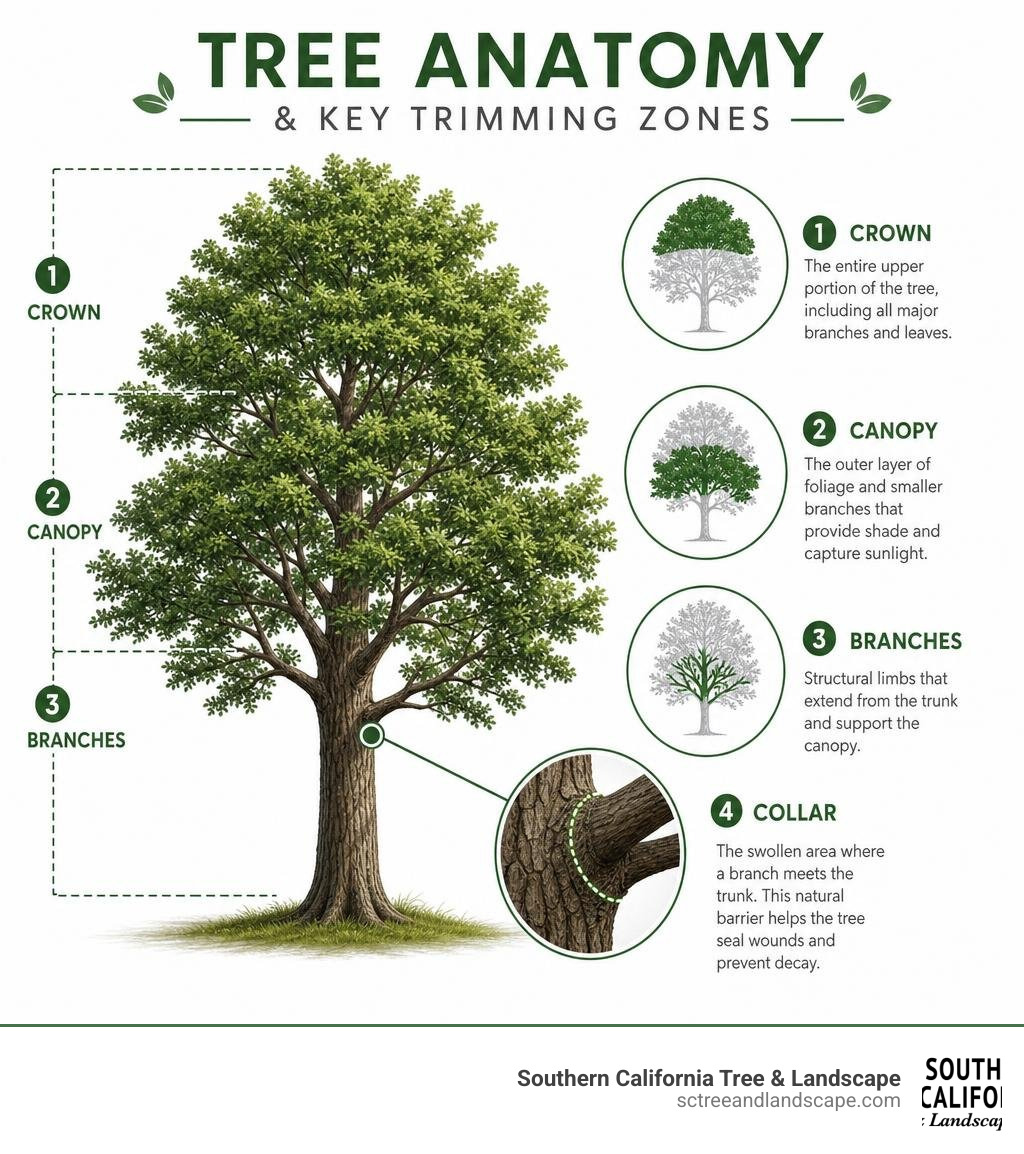
First, we identify the branch collar-the swollen area of tissue where the branch connects to the main trunk. A proper cut must always be made just outside this collar. If you cut flush against the trunk (a flush cut), you destroy the tree’s natural defense zone, making it incredibly difficult for the wound to close. If you leave too much of a stub, the wood will decay and invite pests.
For large, heavy limbs, we always utilize the three-cut method to prevent the weight of the falling branch from ripping the bark down the side of the trunk:
- The Undercut: A small relief cut made on the underside of the limb, a few inches away from the trunk.
- The Top Cut: A cut made further out on the limb to remove the bulk of the branch’s weight.
- The Final Cut: A clean, precise cut just outside the branch collar to remove the remaining stub.
Depending on the tree’s condition, we may employ crown reduction (reducing the overall height or spread of the canopy) or crown thinning (removing select inner branches to improve light and air movement). To learn the secrets behind safely reducing a tree’s size without ruining its health, read our guide Honey, I Shrunk the Tree and Other Crown Reduction Secrets.
The Risks of Improper Cuts and Utility Line Hazards
Many well-meaning homeowners try to save a few dollars by tackling tree work themselves, only to realize too late that tree care is highly technical. Improper cuts can permanently disfigure a tree, stunt its growth, or even kill it outright.
One of the most destructive practices we see is “topping”—the indiscriminate hacking off of large upper limbs to reduce a tree’s height. Topped trees react by rapidly producing weak, vertical shoots called water sprouts. These shoots are structurally weak, highly susceptible to wind damage, and create a massive safety hazard down the road.
Preventing Storm Damage and Power Outages
Southern California might be famous for sunshine, but when winter storms or high winds strike, poorly maintained trees pay the price. Dense, overgrown canopies act like sails, catching the wind and putting immense strain on the root system.
By investing in professional tree trimming, you dramatically reduce wind resistance. Thinning out the canopy allows high winds to pass safely through the branches rather than pushing the entire tree over. Removing deadwood and weak limbs before storm season is the ultimate form of emergency prevention, keeping your family safe and your power running.
Municipal and Utility Line Clearance Protocols
Trees growing near utility poles and high-voltage electrical lines require specialized management. This is not a DIY job. In fact, safety standards dictate that homeowners and unauthorized contractors must stay at least ten feet away from energized service lines.
Utility companies and municipalities manage these areas using a system called Integrated Vegetation Management (IVM). They routinely clear rights-of-way to ensure that trees do not touch power lines, which can cause spark-induced wildfires or widespread blackouts. If a tree on your property is encroaching on municipal utility lines, contact your local utility provider or a certified utility arborist to handle the clearance safely.
Frequently Asked Questions About Tree Maintenance
Navigating tree care can bring up a lot of questions. Here are some of the most common inquiries we receive from property owners in Southern California:
How much does professional tree trimming cost?
The cost of professional tree care depends on several key pricing factors:
- Tree Size: Trimming a small ornamental tree (under 25 feet) is much less labor-intensive than working on a towering 70-foot pine.
- Accessibility: Can our crew easily position a bucket truck near the tree, or do we need to utilize specialized climbing gear to access a tight backyard?
- Tree Condition: A tree that hasn’t been maintained in a decade will require significantly more time, safety rigging, and debris cleanup than one on a regular maintenance cycle.
On average, residential tree trimming can range from $150 to $300 for small trees, $300 to $550 for medium trees, and $550 to $950+ for very large, complex jobs.
Can I trim trees near power lines myself?
No. You should never, under any circumstances, attempt to trim branches near power lines yourself. The risk of electrocution, severe injury, or death is incredibly high. Always respect the ten-foot safety rule. If branches are touching or growing dangerously close to utility lines, contact your local power utility company. They are responsible for managing vegetation within the utility easement to keep the community safe.
What are the risks of over-trimming or topping a tree?
Over-trimming (removing more than 25% to 30% of a tree’s living canopy at one time) severely stresses the tree. It deprives the plant of the foliage it needs to produce food through photosynthesis. This stress often triggers the rapid growth of weak shoots, leaves the bark vulnerable to sunburn, and invites pest infestations. In the worst cases, over-trimmed or topped trees suffer complete structural failure and must be removed entirely. If you find yourself dealing with a tree that is beyond saving, you can learn about the final steps of the process in our guide Wood You Believe It: Finding the Best Stump Removal & Grinding Service.
Conclusion
Your trees are a vital, living part of your property’s ecosystem, contributing to your home’s curb appeal, providing cooling shade, and raising your overall property value. But to keep them safe, healthy, and beautiful, they require professional, consistent care.
At Southern California Tree & Landscape, we have been family-owned and operated since 1991. Serving Torrance, Covina, Harbor City, and the wider South Bay region, our teams include ISA-certified arborists and highly trained crews equipped to handle everything from routine aesthetic trims to rapid emergency storm response.
Ready to give your trees the expert care they deserve? Explore Our Services: Tree Service and contact us today to schedule a professional consultation for your property.