
Why Finding an Arborist Certified in South Bay CA Is Worth It
If you manage a property in the South Bay area, finding an arborist certified South Bay CA is one of the smartest moves you can make for your trees, your safety, and your property value.
Here are the top certified arborist options and what to look for in South Bay, CA:
| What to Look For | Why It Matters |
|---|---|
| ISA Certified Arborist on staff | Proves passing of rigorous exams and ongoing education |
| CA State Contractor’s License | Required for legal tree work in California |
| Liability + workers’ comp insurance | Protects you if something goes wrong on your property |
| Local South Bay experience | Knowledge of regional pests, soil, and climate |
| 24/7 emergency availability | Critical for storm damage and hazardous trees |
South Bay — covering cities like Torrance, Lomita, Redondo Beach, Palos Verdes, and Gardena — has a diverse mix of tree species, coastal microclimates, and local municipal codes that make tree care more complex than it looks. A general landscaper with a chainsaw is not the same thing as a credentialed tree professional.
The difference can mean healthy trees that last decades — or a costly mistake that damages your property or triggers a permit violation.
This guide breaks down exactly who to hire, what services they should offer, and how to verify their credentials before you sign anything.
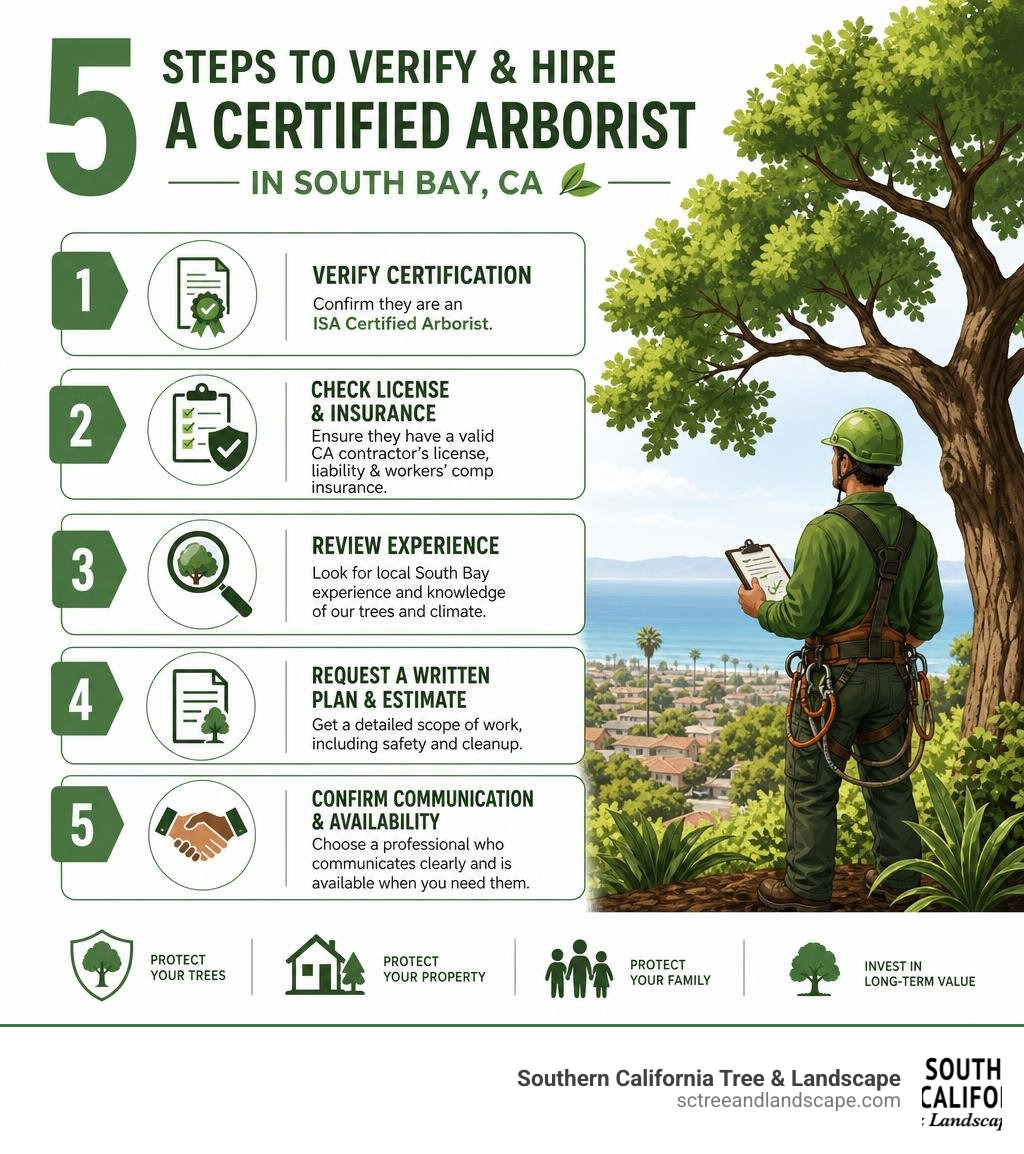
What is an ISA Certified Arborist and Why Do They Matter?
An ISA Certified Arborist is a tree care professional who has earned a credential from the International Society of Arboriculture, commonly called ISA. This certification shows that the arborist has demonstrated knowledge in tree biology, diagnosis, pruning, safety, soil care, planting, risk management, and long-term tree preservation.
In simple terms: an ISA Certified Arborist is a tree doctor, not just someone who trims branches.
Trees in Torrance, Harbor City, Covina, and the greater South Bay are living systems. Their roots, soil, canopy, trunk, irrigation, pests, and nearby hardscape all affect their health. A certified arborist understands how these parts work together.
That matters because tree work can go wrong quickly. Over-pruning can weaken a tree. Removing the wrong limb can create structural imbalance. Ignoring root problems can lead to failure. Treating the wrong pest wastes money and time. And removing a protected or regulated tree without checking local rules can create municipal headaches.
You can learn more about the ISA Certified Arborist credential directly from ISA.

Here is what certification usually tells you:
- The arborist has passed a professional exam.
- They understand tree care beyond basic cutting.
- They must maintain the credential through continuing education.
- They are expected to follow professional standards and ethics.
- They can help determine whether a tree should be pruned, treated, supported, monitored, or removed.
At Southern California Tree & Landscape, we use certified arborist knowledge to help property owners make practical decisions. Sometimes that means saving a mature tree. Sometimes it means removing a dangerous one. The goal is not to sell the biggest job. The goal is to recommend the right work.
The Rigorous Standards of an Arborist Certified South Bay CA
When you search for an arborist certified South Bay CA, you are looking for more than a business card with the word “tree” on it.
ISA certification is built around real arboricultural knowledge, including:
- Tree identification
- Tree biology
- Soil and water relationships
- Proper pruning methods
- Tree risk assessment basics
- Pest and disease recognition
- Planting and establishment
- Tree preservation during construction
- Worker and property safety
Certified arborists are also expected to follow a code of ethics. That matters because professional tree care often involves judgment calls. A certified arborist should explain why a cut is needed, why a treatment is recommended, or why removal may be the safest option.
South Bay tree care also benefits from local experience. Coastal air, wind exposure, clay or sandy soils, compacted urban lots, drought stress, and irrigation problems all change how trees behave. A pruning method that works inland may not be ideal near the coast. A tree that looks fine from the street may have root or decay problems that require closer inspection.
Before hiring, you can find an ISA-credentialed arborist through the TreesAreGood directory.
Key Services Provided by an Arborist Certified South Bay CA
A certified arborist does much more than “trim trees.” The best tree care starts with diagnosis, then moves into a plan.
For South Bay homes, HOAs, commercial sites, and property managers, certified arborist services often include:
- Tree health assessments
- Structural inspections
- Professional pruning and trimming
- Crown reduction and canopy balancing
- Tree removal recommendations
- Cabling and bracing for weak limbs
- Pest and disease diagnosis
- Soil management and fertilization
- Irrigation and drought stress evaluation
- Stump grinding recommendations
- Emergency tree response
- Tree preservation planning
- Permit and compliance support
For a broader look at property safety and maintenance, see our guide to essential tree services for property safety.
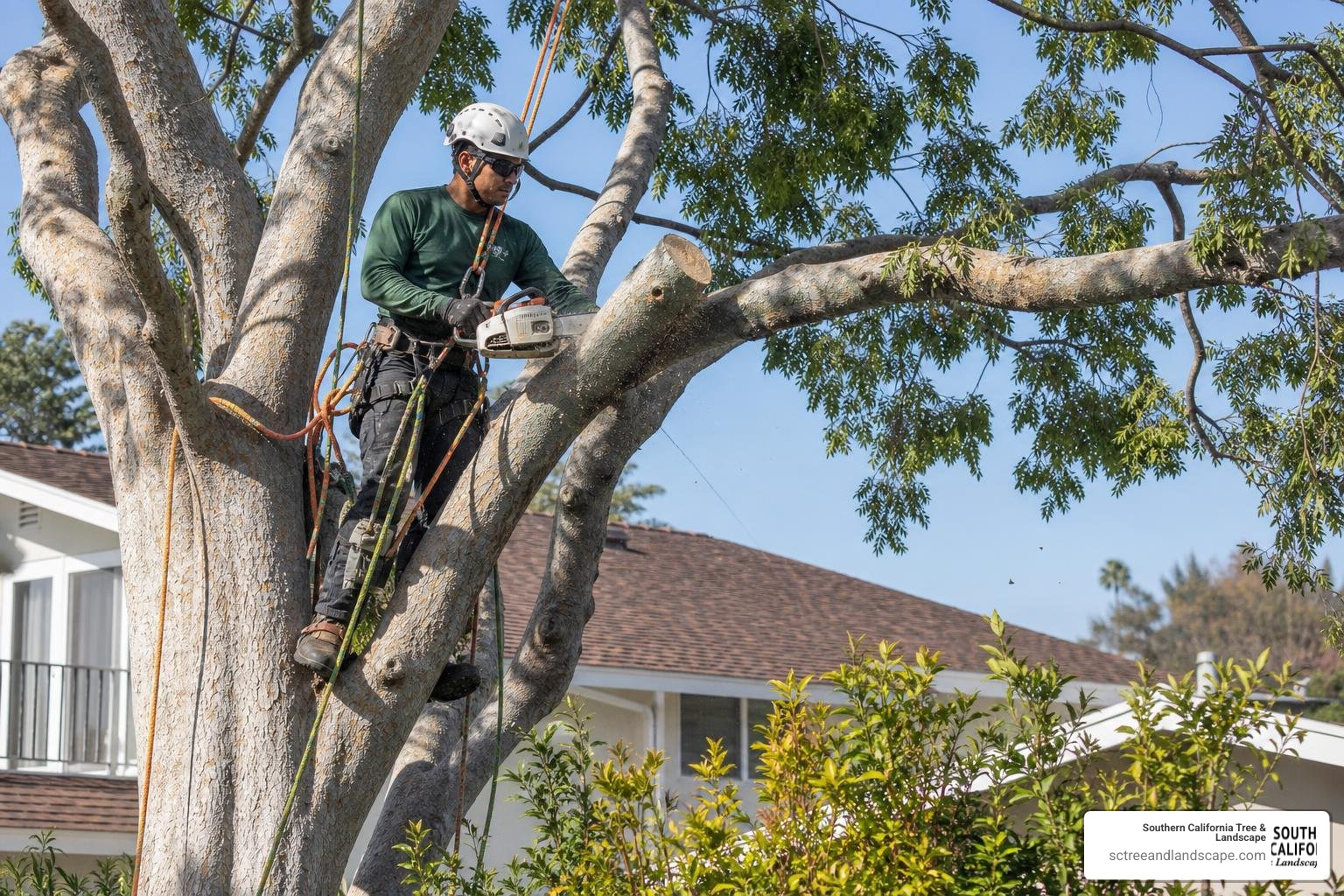
A good arborist does not look only at the branches. We look at the whole tree system:
| Tree Area | What We Check |
|---|---|
| Canopy | Deadwood, thinning, discoloration, broken limbs, poor structure |
| Trunk | Cracks, cavities, decay, bark loss, fungal growth |
| Root zone | Soil compaction, girdling roots, grade changes, irrigation problems |
| Surroundings | Buildings, sidewalks, driveways, utilities, people, vehicles |
| Soil | Drainage, moisture, nutrient availability, mulch depth |
| History | Past pruning, construction damage, drought stress, pest activity |
That full-picture approach helps prevent the classic “looks fine until it falls” problem. Trees are sneaky like that.
Tree Pruning, Trimming, and Crown Reduction
Pruning is one of the most common reasons people call a tree company, but it is also one of the easiest services to get wrong.
Proper pruning can:
- Improve tree structure
- Remove dead, diseased, or rubbing branches
- Reduce end weight on heavy limbs
- Improve clearance over roofs, driveways, and walkways
- Help young trees develop strong form
- Reduce risk during wind events
- Improve sunlight and airflow
- Maintain beauty without harming long-term health
Poor pruning can do the opposite. Topping, lion-tailing, flush cuts, and excessive thinning can stress a tree, invite decay, trigger weak regrowth, and make future failures more likely.
Crown reduction is especially important in South Bay neighborhoods where mature trees grow near homes, fences, streets, and utility lines. Unlike topping, proper crown reduction selectively shortens branches back to appropriate lateral growth points. The goal is to reduce height or spread while maintaining the tree’s natural form.
For more on this topic, read our guide to crown reduction secrets for healthy trees.
Palm care is another common South Bay need. Palm tree skinning, dead frond removal, and fruit stalk removal can improve appearance and reduce debris. But palms should not be over-trimmed into a “hurricane cut.” Removing too many green fronds can weaken the palm and reduce its ability to produce energy.
Safe Tree Removal and Stump Grinding
Tree removal is sometimes necessary, especially when a tree is dead, severely diseased, structurally unstable, storm-damaged, or growing in a location where preservation is no longer practical.
A certified arborist can help determine whether removal is truly needed. We often evaluate:
- Severe trunk decay
- Root damage or root plate movement
- Sudden leaning
- Large dead limbs
- Fungal growth near the base
- Cracks or included bark
- Construction-related root loss
- Fire, wind, or vehicle damage
- Pest or disease issues beyond recovery
Emergency tree removal is a different category. When a tree has fallen onto a structure, is blocking access, or is hanging dangerously, speed and safety both matter. Southern California Tree & Landscape is family-owned and has served Southern California since 1991, and our experienced crews understand how to respond quickly when a hazardous tree becomes an urgent problem.
If you are facing an urgent situation, review what to do when you need emergency tree removal.
After removal, stump grinding may be recommended to:
- Remove trip hazards
- Improve curb appeal
- Free up planting space
- Reduce pest habitat
- Make mowing and landscape maintenance easier
- Prevent unwanted regrowth in some species
Learn more about finding the best stump removal and grinding services.
South Bay Climate, Pests, and Plant Health Care (PHC)
South Bay tree care is not one-size-fits-all. Torrance, Harbor City, and nearby communities have coastal influence, urban heat, compacted soils, varied irrigation habits, and a wide range of ornamental and native trees.
Common local stress factors include:
- Drought stress
- Overwatering from lawns or sprinklers
- Poor drainage
- Sandy or compacted soil
- Salt air exposure near coastal areas
- Heat reflected from pavement and walls
- Root restriction from sidewalks and driveways
- Improper pruning history
- Pest pressure
- Soil nutrient deficiencies
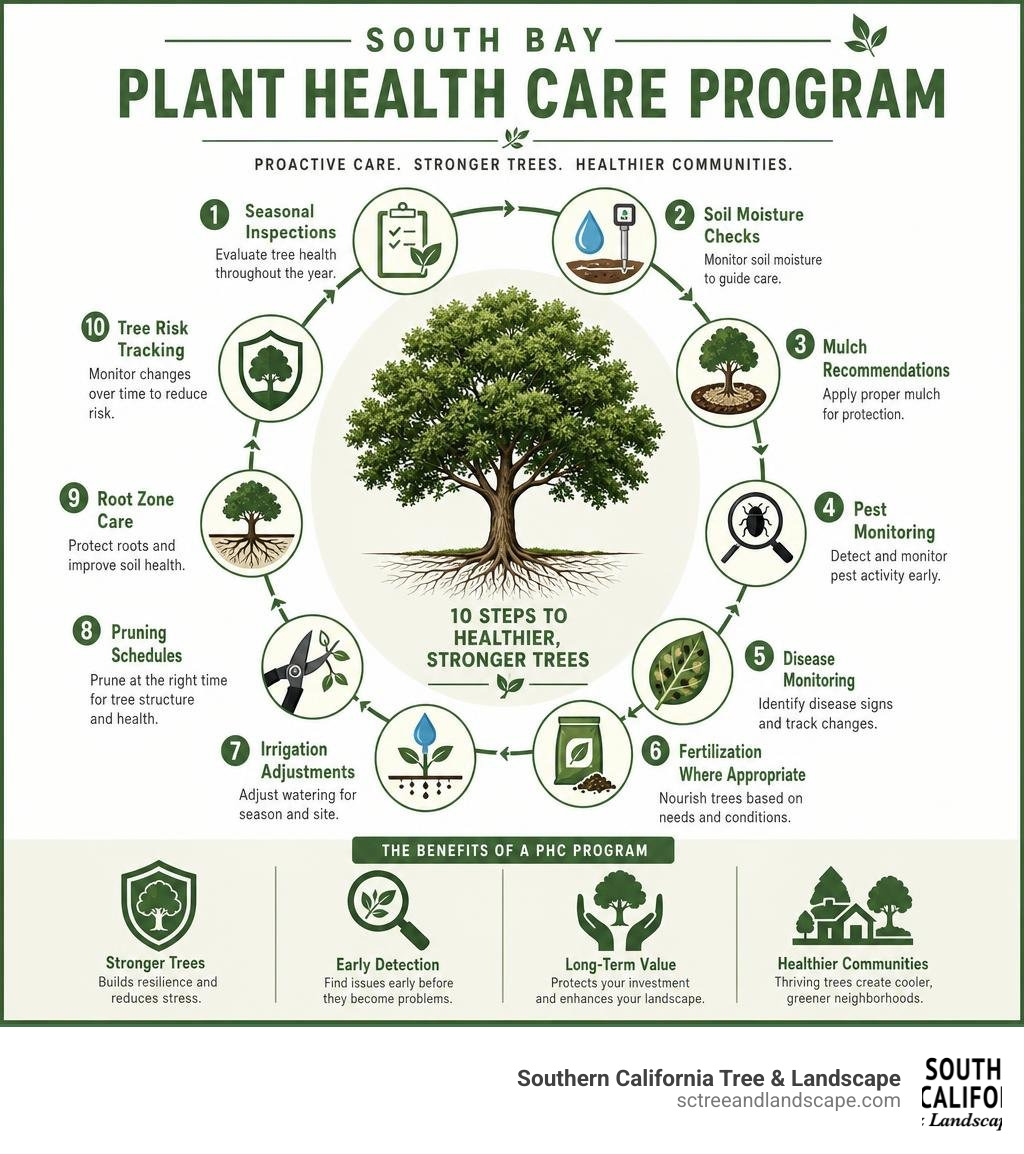
A Plant Health Care program, often shortened to PHC, is a proactive plan for keeping trees healthy instead of waiting for visible decline. Think of it as routine healthcare for trees: checkups, prevention, early detection, and targeted treatment.
A PHC plan may include:
- Seasonal inspections
- Soil moisture checks
- Mulch recommendations
- Pest monitoring
- Disease monitoring
- Fertilization where appropriate
- Irrigation adjustments
- Pruning schedules
- Root zone care
- Tree risk tracking over time
Mulching is one of the simplest and most effective tree care practices. A 2 to 3 inch layer of organic mulch can help regulate soil temperature, retain moisture, reduce weeds, and improve soil quality as it breaks down. Just keep mulch a few inches away from the trunk. No mulch volcanoes, please. Trees do not enjoy wearing turtlenecks made of wet bark.
Subsurface watering can also help drought-stressed trees, especially during hot, dry periods. The key is deep, slow watering in the root zone rather than shallow sprinkler spray that only wets the surface.
| Common South Bay Tree Pest or Issue | Typical Symptoms | How a Certified Arborist Helps |
|---|---|---|
| Whitefly | Yellowing leaves, sticky residue, leaf drop | Identifies infestation level and recommends targeted control |
| Thrips | Silvery or speckled leaves, distorted growth | Confirms pest activity and supports plant recovery |
| Scale insects | Small bumps on stems or leaves, canopy thinning, branch dieback | Determines scale type and treatment timing |
| Drought stress | Wilting, browning leaf edges, early leaf drop | Evaluates irrigation, soil moisture, and root health |
| Root rot | Decline despite watering, fungal growth, weak anchorage | Checks drainage, soil conditions, and structural risk |
| Bark loss or cracking | Exposed wood, peeling bark, possible decay | Determines whether shedding is normal or a warning sign |
Managing Local Pests and Sudden Oak Death
Whitefly, thrips, and scale insects are common pest concerns in many Southern California landscapes. They can weaken trees and shrubs by feeding on plant tissue, reducing vigor, and creating openings for secondary problems.
Scale insects are especially easy to miss because they often look like part of the plant. By the time branch dieback appears, the infestation may already be advanced.
Coast live oak and other valuable mature trees deserve special attention. Oak decline can be caused by drought stress, root disturbance, soil compaction, improper pruning, pathogens, boring insects, or a combination of stressors. Sudden Oak Death is a serious disease concern in parts of California, and while local risk and host presence should be evaluated carefully, any rapid oak decline should be inspected by a knowledgeable arborist.
Monterey pine, palms, ficus, eucalyptus, sycamore, jacaranda, olive, and citrus can also develop issues based on site conditions. The right diagnosis matters because pest symptoms, water stress, nutrient problems, and root damage can look similar from a distance.
For local tree care support, visit our page for professional tree care in Harbor City and South Bay.
Certified Arborist vs. General Tree Service: Making the Right Choice
A general tree service may be able to cut, haul, and clean up. A certified arborist brings the science of tree care into the decision.
That distinction matters when a tree is valuable, mature, close to a structure, possibly protected, or showing signs of decline.
Here is the practical difference:
| Certified Arborist | General Tree Cutter |
|---|---|
| Focuses on tree health, structure, and preservation | Often focuses mainly on cutting or removal |
| Uses professional pruning standards | May trim for appearance only |
| Can diagnose pests, disease, soil, and watering issues | May not provide detailed diagnosis |
| Helps decide whether to prune, treat, support, monitor, or remove | May recommend removal without exploring alternatives |
| Understands risk factors and tree biology | May rely mostly on field experience |
| Can support permit and report needs | May not understand municipal requirements |
| Prioritizes long-term health and safety | May prioritize fast completion |
This does not mean every non-certified worker is unskilled. Many experienced crew members are excellent at climbing, rigging, pruning, and removals. The point is that certification adds a layer of professional judgment.
The best results often come from combining both: ISA-certified arborist oversight with experienced crews who know how to perform the work safely.
When choosing a tree care provider in South Bay, look for:
- ISA Certified Arborist involvement
- Proper California contractor licensing when required
- Liability insurance
- Workers’ compensation insurance
- Written scope of work
- Clear safety procedures
- Local experience
- Emergency response capability
- No pressure tactics
- A willingness to explain the “why” behind the work
Certified Treecare Safety Professional, or CTSP, is another safety-related credential you may see in the industry. It focuses on safety culture and jobsite practices. While not the same as ISA arborist certification, safety credentials can be a positive sign when paired with proper licensing, insurance, and experience.
Navigating Permits, Risk Assessments, and Municipal Compliance
Tree work in South Bay can involve more than tools and trucks. Some cities regulate protected trees, street trees, parkway trees, heritage trees, view-related pruning, or removals on certain properties.
Rules can vary by municipality, neighborhood, and property type. A tree that is easy to remove on one private lot may require review or permission on another. HOAs and commercial properties may have additional requirements.
A certified arborist can help with:
- Tree condition documentation
- Risk assessment reports
- Species identification
- Diameter measurements
- Health and structural evaluations
- Photos and site notes
- Permit support
- Replacement planting recommendations
- Construction impact evaluations
- Preservation plans
In Torrance and nearby South Bay communities, it is wise to check municipal requirements before major pruning or removal, especially for large, mature, street-facing, or potentially protected trees. Palos Verdes-area properties can also involve strict local tree and view considerations, so professional guidance is especially useful before work begins.
Risk assessments are also important for property managers, HOAs, commercial sites, schools, apartment communities, and retail centers. If a tree has a defect and there are people, cars, buildings, or walkways nearby, the question is not just “Is the tree alive?” The better question is: “What is the likelihood of failure, and what would it hit?”
That is where arborist judgment becomes valuable.
For help with local planning, pruning, removals, and compliance-sensitive tree work, see our Torrance and Lomita area tree care solutions.
Frequently Asked Questions About South Bay Tree Care
South Bay property owners ask us a lot of smart questions. Here are the big ones we hear most often.
How do I verify if an arborist certified South Bay CA is legitimate?
Start by asking for the arborist’s ISA certification information. A legitimate professional should be able to provide a name and credential number or enough information for you to verify the credential.
You can verify credentials on TreesAreGood.
Also ask for:
- Proof of liability insurance
- Proof of workers’ compensation insurance
- California contractor license information when required
- Written estimate or proposal
- Scope of work in plain language
- Safety plan for complex removals or pruning near structures
- Local references or examples of similar work, when appropriate
For California tree work, licensing is especially important for larger jobs. In general, contractor licensing requirements can apply when the total project cost meets the state threshold. Do not rely on a handshake for high-risk tree work. Trees are heavy. Gravity is undefeated.
Red flags include:
- “We can do it today for cash only”
- No insurance documentation
- No written scope
- Door-to-door pressure after storms
- Refusal to discuss certification
- Suggesting tree topping as routine care
- Recommending removal without inspection
- No clear cleanup plan
- No discussion of permits when a large or regulated tree is involved
When should I hire a certified arborist instead of doing it myself?
DIY tree care is fine for light, ground-level tasks such as watering, adding mulch correctly, removing small dead twigs, or monitoring for visible changes.
Hire a certified arborist when:
- Branches are large or overhead
- Climbing is required
- Work is near power lines
- The tree is leaning
- You see cracks, cavities, or fungal growth
- Large limbs are dead or broken
- The tree is close to a roof, fence, car, or walkway
- You suspect pests or disease
- Roots are lifting hardscape
- Construction is planned near the tree
- A permit may be required
- The tree is mature, valuable, or protected
- Storm or wind damage has occurred
Power line clearance should always be handled by properly qualified professionals and utility-approved crews where applicable. Never attempt to prune near energized lines.
For large limbs, the danger is not just the chainsaw. It is the weight, tension, fall path, and movement of the branch after the cut. A branch can swing, split, barber-chair, or pull other limbs with it. Professional crews use rigging, ropes, lowering devices, lifts, and safe cutting techniques for a reason.
What is a Plant Health Care (PHC) program?
A Plant Health Care program is an ongoing plan designed to keep trees and landscapes healthy through monitoring, prevention, and early treatment.
Instead of waiting until a tree is in visible decline, PHC asks:
- Is the soil healthy?
- Is the tree getting the right amount of water?
- Are pests present?
- Are diseases developing?
- Is the mulch correct?
- Are roots compacted or damaged?
- Does the tree need pruning?
- Is the tree becoming a safety risk?
- Are nearby landscape practices helping or hurting?
A PHC program may include seasonal inspections, soil care, pest management, pruning schedules, irrigation recommendations, and long-term tracking.
This is especially helpful for:
- Mature trees
- Commercial properties
- HOAs
- Apartment communities
- Properties with valuable shade trees
- Newly planted trees
- Drought-stressed landscapes
- Trees near construction zones
- Palms and ornamentals with recurring pest issues
- Properties where safety and curb appeal both matter
The biggest benefit is early action. It is usually easier and less expensive to correct watering, soil, pruning, or pest problems early than to rescue a severely declining tree later.
Conclusion
As of June 2026, the standard for quality tree care in South Bay is clear: property owners should look for certified knowledge, proper insurance, safe crews, local experience, and honest recommendations.
A true arborist certified South Bay CA does more than cut branches. They help protect your trees, your property, your tenants, your customers, your family, and your long-term landscape investment.
At Southern California Tree & Landscape, we are a family-owned Southern California company serving the region since 1991. We provide landscape design, installation, maintenance, irrigation repair, and professional tree services with ISA-certified arborist support, experienced crews, and rapid emergency response.
Whether you need a tree health assessment in Torrance, pruning in Harbor City, emergency tree removal, stump grinding, or a long-term Plant Health Care plan, we are here to help you make the right call.
Schedule a consultation with Southern California Tree & Landscape