
What Every Property Owner Needs to Know About Tree Disease Treatment
Tree disease treatment starts with knowing what you’re dealing with — fast. Here’s a quick overview:
How to treat a tree disease (quick answer):
- Identify the problem — Look for discolored leaves, thinning canopy, bark damage, or unusual growths.
- Diagnose the cause — Determine if it’s fungal (e.g., anthracnose, root rot), bacterial (e.g., fire blight), or environmental (e.g., drought stress, poor drainage).
- Remove infected material — Prune diseased branches, dispose of fallen leaves, and sterilize tools between cuts.
- Apply targeted treatment — Use fungicides, bactericides, or trunk injections matched to the specific pathogen.
- Correct site conditions — Improve drainage, airflow, and soil health to stop the disease from returning.
- Call a certified arborist — For advanced disease, vascular infections, or structural concerns, professional diagnosis is essential.
What starts as a few discolored leaves can quietly turn into something that threatens the entire tree — and sometimes the safety of your property. Tree diseases spread quickly under the right conditions, and by the time most property owners notice something is wrong, the problem has often been developing for weeks or even months.
The good news? Most tree diseases are manageable when caught early. The challenge is knowing what to look for and acting before the window for treatment closes.
I’m Troy Basmajian, President of Southern California Tree & Landscape, and over the past decade leading our team of tree care professionals across Southern California, I’ve seen how the right tree disease treatment approach — applied at the right time — can save trees that most people would have given up on. Let’s walk through exactly how to do that.
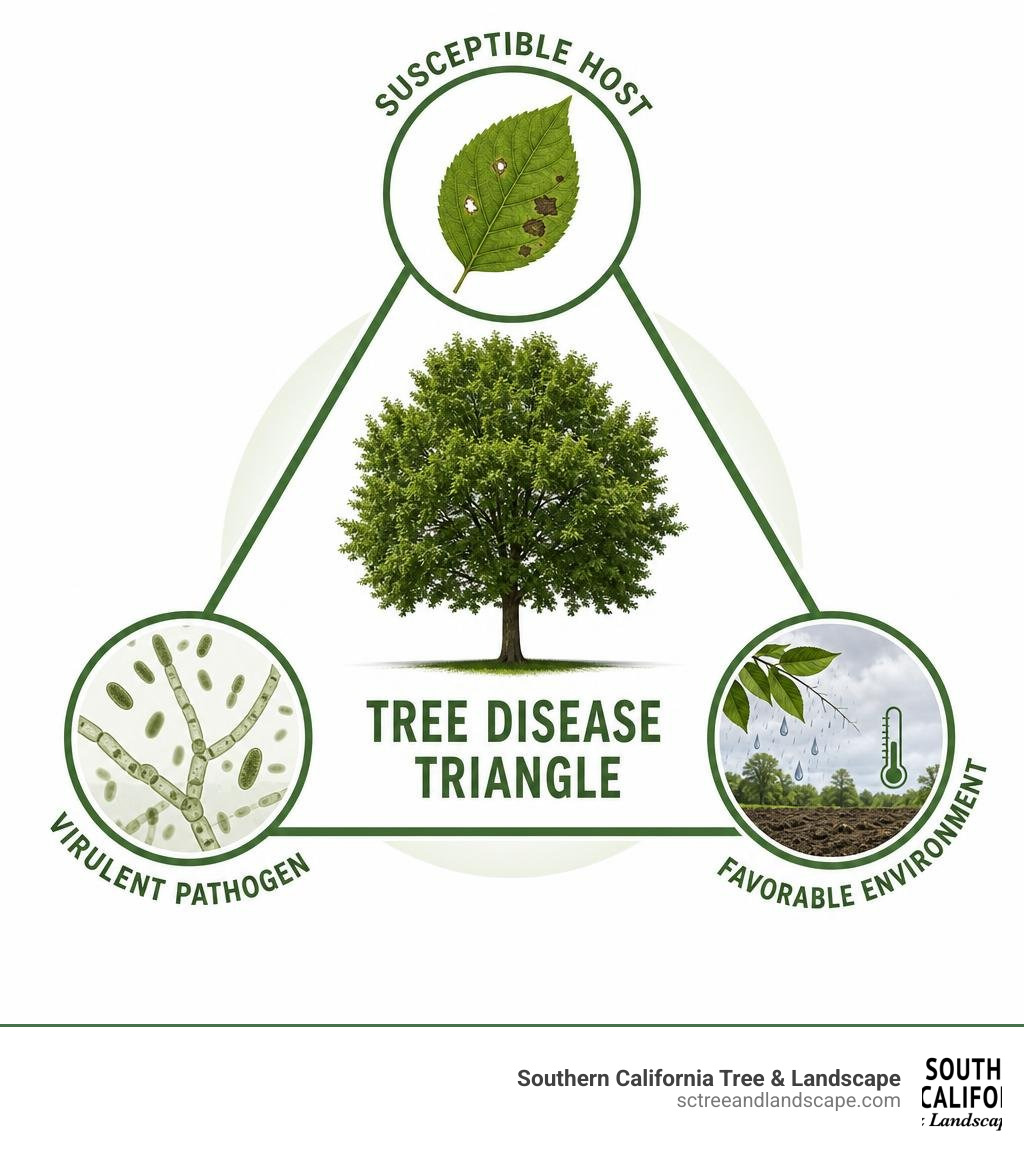
Tree disease treatment word roundup:
The Core Principles of Effective Tree Disease Treatment
When we think about curing a sick tree, many of us picture spraying chemicals onto the leaves. But in reality, tree disease treatment is a lot like human medicine: you cannot cure a patient simply by masking their symptoms. You must address the underlying environment that allowed them to get sick in the first place.

Trees are incredibly resilient, but they become highly vulnerable to disease when they are water-stressed, nutrient-deficient, or growing in compacted soil. In the urban and suburban landscapes of Southern California—from the coastal breezes of the South Bay to the warmer valleys of Covina—trees face unique environmental pressures.
To give your trees the best chance of survival, you must implement essential tree care practices that build up their natural immune systems. A holistic approach, such as the famous Sick Tree Treatment protocol, focuses on restoring the soil’s natural biology rather than relying solely on synthetic chemical inputs. When we expose covered root flares, aerate compacted dirt, and feed the underground fungal networks (mycorrhizae), we give the tree the strength it needs to fight off pathogens naturally.
Abiotic vs. Biotic Stressors
To treat a tree successfully, we first have to figure out if the tree is suffering from a biotic stressor (a living pathogen like a fungus, bacterium, virus, or pest) or an abiotic stressor (a non-living environmental issue like drought, soil compaction, or nutrient deficiencies).
Often, a tree is first weakened by an abiotic stressor, which then opens the door for a biotic disease to take hold. For example, a Coast Live Oak suffering from severe water stress is a prime target for wood-boring beetles and fungal pathogens.
| Symptom | Abiotic Cause (Non-Living) | Biotic Cause (Living Pathogen/Pest) |
|---|---|---|
| Leaf Yellowing (Chlorosis) | Nutrient deficiency (e.g., iron), overwatering, or soil compaction | Root rot fungi, vascular wilt diseases, or sucking insects |
| Branch Dieback | Severe drought, root damage from construction, or chemical burn | Canker-causing fungi, bark beetles, or bacterial blight |
| Leaf Scorching / Spots | Windburn, salt damage, or intense heat reflection | Anthracnose, leaf spot fungi, or bacterial leaf scorch |
| Trunk / Bark Damage | Lawn mower wounds, sunburn, or frost cracking | Phytophthora cankers, wood decay fungi, or boring insects |
Early Detection and Diagnosis
How do you know when a tree is starting to struggle? The secret is regular inspection. You don’t need to be a scientist to notice when something is off. Keep an eye out for:
- A thinning canopy where leaves are smaller or fewer than usual.
- Discolored, spotted, or prematurely dropping leaves.
- Sawdust-like powder (frass) on the bark or around the base of the trunk.
- Small, neat holes in the bark, which are classic signs of bark beetles.
If bark beetles or wood borers have already invaded, time is of the essence. You will need to implement effective treatments for bark beetles immediately to protect the tree’s vascular system before the damage becomes irreversible.
How to Treat Common Tree Diseases: A Step-by-Step Guide
If you have confirmed that your tree is dealing with an active pathogen, it is time to take action. This step-by-step guide outlines the standard protocol for managing active infections.

Step 1: Sanitation and Tool Sterilization
Never skip this step! Pruning a diseased tree with dirty tools is the fastest way to spread the infection to every other healthy tree on your property.
- Sterilize your tools between every single cut using a 10% bleach solution, 70% isopropyl alcohol, or a specialized disinfectant spray.
- Collect and dispose of all fallen leaves, twigs, and bark around the base of the infected tree. Fungal spores overwinter in this debris, waiting to reinfect the tree next spring. Do not compost this material; bag it and dispose of it off-site.
Step 2: Strategic Pruning
Carefully prune away infected branches. For fungal infections like black knot (which affects stone fruits and ornamental cherries), you must cut at least 4 inches (10 cm) below the visible edge of the infection to ensure you have reached healthy, pathogen-free wood.
To improve sunlight penetration and air circulation throughout the canopy—which naturally dries out foliage and prevents fungal spores from germinating—employ proper tree thinning techniques. Keeping the canopy open is one of the easiest ways to keep foliar diseases at bay.
Step 3: Targeted Treatment Application
Depending on the pathogen, apply a targeted chemical or organic treatment. This may include copper-based fungicides for leaf spots, systemic trunk injections for vascular wilts, or biological soil drenches to combat root rot.
Managing Foliar and Vascular Pathogens
Different tree diseases require highly specific treatment strategies. Let’s look at how we manage some of the most destructive foliar and vascular pathogens:
Anthracnose and Leaf Spots
Anthracnose is a group of fungal diseases that thrive during cool, wet spring weather, causing unsightly brown blotches, leaf distortion, and premature defoliation. While a single infection is mostly cosmetic, repeated annual infections weaken the tree, leading to limb dieback. Treat early in the season with preventive copper fungicides, and ensure the canopy is thinned to maximize airflow.
Beech Leaf Disease (BLD)
An emerging threat caused by a microscopic, foliar-feeding nematode (Litylenchus crenatae subsp. mccannii), beech leaf disease can kill young saplings in 1 to 2 years and mature trees in 6 to 10 years. For those managing susceptible species, staying updated on the latest research on beech leaf disease management is critical. Treatments like systemic applications of phosphite fertilizers or micro-injections of thiabendazole have shown promising results in protecting valuable specimen trees.
Laurel Wilt
This lethal vascular disease is caused by the fungus Harringtonia lauricola, which is carried by the invasive redbay ambrosia beetle. It blocks the water-transporting vessels of trees in the Lauraceae family (like sassafras and avocado). A landmark study on propiconazole for laurel wilt demonstrated that preventive micro-infusions of propiconazole can achieve up to an 86% survival rate in treated trees compared to just 11% in untreated controls. The treatment must be applied preventively to allow the fungicide to translocate throughout the vascular system before beetles attack.
Sudden Oak Death (SOD) and Phytophthora
Caused by the water mold Phytophthora ramorum, SOD has devastated oak populations across California. To save high-value oaks, property owners often utilize a specialized Sudden Oak Death treatment package, which combines a systemic phosphite fungicide (like Agri-Fos or Reliant) with a specialized organosilicone surfactant (like Pentra-Bark). This surfactant allows the treatment to penetrate directly through the tree’s bark without requiring drilling, making it an incredibly effective, non-invasive way to boost the tree’s chemical defenses.
When to Seek Professional Tree Disease Treatment
While minor leaf spots and basic canopy pruning can often be handled by an active homeowner, many tree diseases require professional intervention.
An ISA-certified arborist has the specialized diagnostic tools and training required to identify subtle symptoms before they become fatal. Furthermore, advanced treatments like systemic micro-injections—where highly concentrated fungicides or insecticides are injected directly into the tree’s active xylem—require specialized equipment and precise dosing to avoid damaging the tree.
If a tree has declined to the point where it poses a safety hazard to your home, family, or neighboring properties, a professional must perform a structural hazard assessment. In cases where the tree cannot be saved, you should immediately contact emergency tree removal services to safely dismantle the tree before it falls.
Eco-Friendly and Organic Alternatives for Tree Care
For property owners who prefer to avoid synthetic chemical sprays, there are many highly effective, environmentally friendly alternatives that work with nature rather than against it.
Preventive Tree Disease Treatment and Maintenance
The absolute best eco-friendly tree disease treatment is prevention. A healthy tree living in its ideal conditions rarely succumbs to pests or pathogens.
- Watering: Always water deeply and infrequently at the drip line of the tree, rather than spraying the trunk or leaves with overhead sprinklers. Wet foliage is an open invitation for fungal spores.
- Mulching: Apply a 2-to-3-inch layer of organic wood mulch over the root zone to retain moisture and regulate soil temperature. However, never pile mulch against the trunk (the notorious “mulch volcano”).
- Root Flare Exposure: The root flare (where the trunk widens as it meets the soil) must always be visible and exposed to the air. If soil or mulch covers the root flare, it traps moisture against the bark, leading to collar rot and girdling roots.
- Proper Pruning: Certain species require highly specific care. For example, following proper eucalyptus pruning guidelines ensures that these fast-growing trees maintain structural integrity and are pruned only during dry periods to prevent the spread of fungal pathogens.
Soil Biology and Natural Amendments
We can also use natural compounds to stimulate a tree’s internal defense systems and improve soil microbiology:
- Cornmeal: Whole ground cornmeal is a natural disease fighter. It stimulates Trichoderma, a beneficial soil fungus that naturally feeds on and destroys pathogenic fungi like Phytophthora and Pythium.
- Compost Tea: Drenching the root zone with aerated compost tea introduces billions of beneficial bacteria and fungi that crowd out harmful pathogens.
- Methyl Jasmonate: This naturally occurring plant hormone acts as a distress signal. Groundbreaking research on methyl jasmonate sprays has shown that applying a 1 mM spray to broad-leaf seedlings can trigger their systemic acquired resistance (SAR), reducing mortality from root-rotting pathogens like Phytophthora cinnamomi by up to 62% without harming beneficial mycorrhizal fungi.
- Natural Mudpacks: For specific historical diseases like chestnut blight, researchers have found success in protecting chestnut trees from blight by applying simple mudpacks made of untreated forest soil directly over the active cankers. The natural microbes in the soil attack and break down the blight fungus, allowing the tree’s bark to heal over.
Frequently Asked Questions About Tree Diseases
How do I know if my tree is too diseased to save?
A tree is usually past the point of saving if more than 50% of its canopy is dead, or if there is extensive decay within the main trunk. Look for “conks” (shelf-like mushrooms) growing directly on the trunk or major root flares—these are the fruiting bodies of internal wood-decay fungi, meaning the inside of the tree is rotting away.
If a tree has died or become structurally unstable, it must be removed. Once the tree is down, don’t forget to schedule stump removal and grinding to eliminate the remaining underground wood, which can otherwise serve as a breeding ground for wood-decay fungi and termites for years to come.
Can tree diseases spread to other plants in my yard?
Yes, many pathogens are highly contagious. They can spread through:
- Root Grafts: Trees of the same species planted close together often fuse their roots underground, allowing vascular pathogens like oak wilt to pass directly from tree to tree.
- Windborne Spores: Fungal spores can travel on the breeze or splash from leaf to leaf during rainstorms.
- Insect Vectors: Pests like bark beetles, aphids, and leafhoppers carry bacterial and fungal pathogens from infected trees to healthy ones.
What is the best time of year to treat tree diseases?
The ideal timing depends on the treatment type:
- Systemic Trunk Injections: Best applied in late spring or early summer when the tree is actively transpiring (drawing up water), which ensures rapid distribution of the treatment throughout the canopy.
- Preventive Foliar Sprays: Must be applied early in the season, just as new leaves are emerging (bud break). If you wait until you see severe spots on mature leaves, it is often too late to treat that season.
- Structural Pruning: Best performed during the dormant season (late fall or winter) when fungal spores and insect pests are inactive. If a tree’s crown has become too heavy or dense, performing a professional crown reduction secrets session during the dormant season will reduce wind resistance and minimize the risk of branch failure during winter storms.
Conclusion
Curing a sick tree doesn’t have to be a mystery. By focusing on early detection, sanitizing your tools, correcting poor soil conditions, and utilizing targeted tree disease treatment methods, you can protect your property’s green giants and keep your landscape beautiful for decades to come.
At Southern California Tree & Landscape, we have been family-owned and operated right here in Southern California since 1991. Our experienced crews and ISA-certified arborists serve communities across Torrance, the South Bay, Covina, Harbor City, and beyond. Whether you need a comprehensive tree health assessment, targeted disease management, or rapid emergency response, we are here to help.
Don’t wait until those minor spots turn into a major liability. Contact us today to explore our professional tree services and keep your trees thriving!