
Drought Resistant Plants for a Southern California Garden
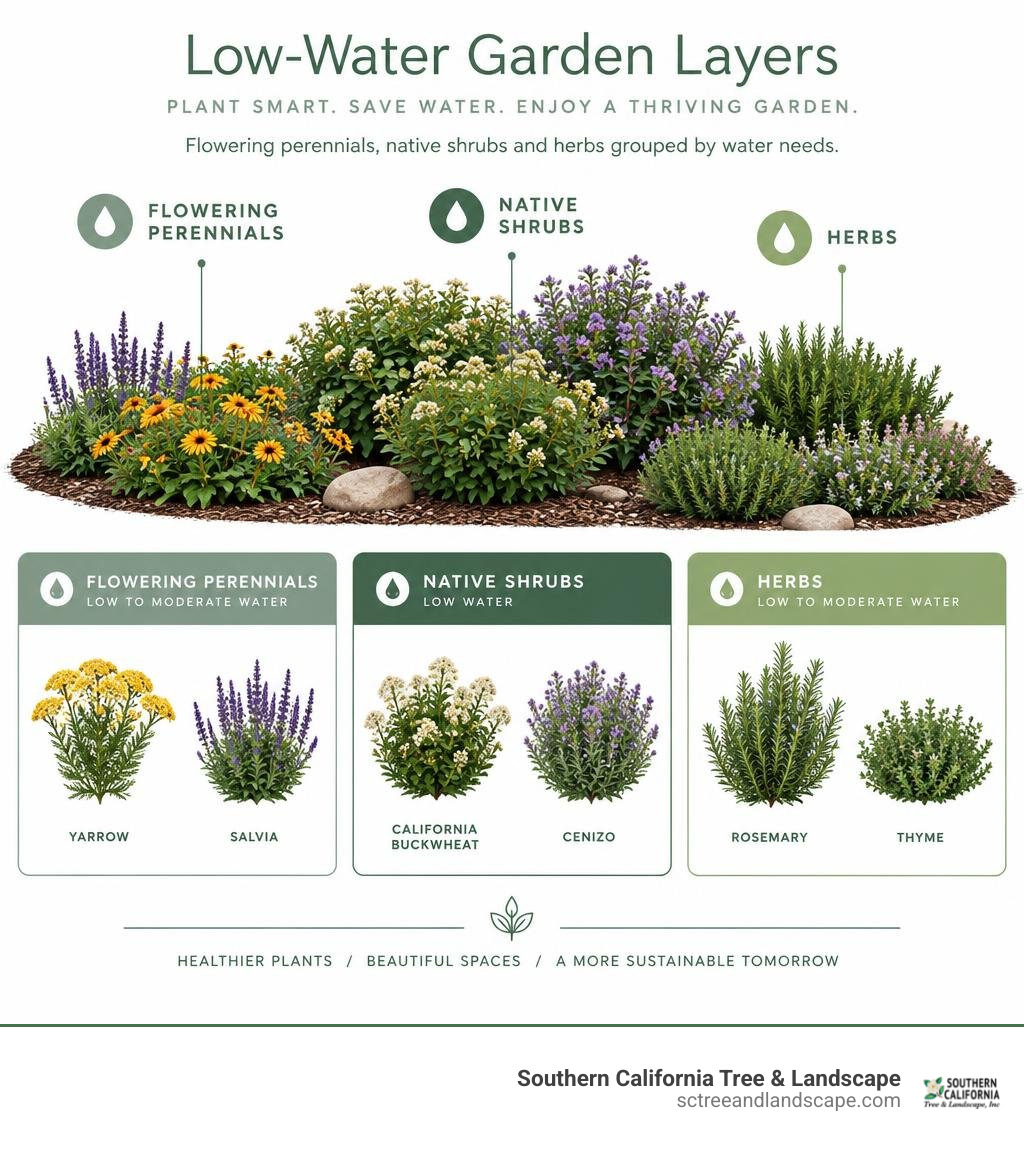
Start with plants that fit each part of your garden: California buckwheat and cenizo for sunny shrub beds, yarrow and salvia for flowers, and rosemary and thyme for herbs. Okra and tepary beans can handle heat, but they still need regular water to produce a crop. Choose plants for your soil and sun, then group them by water needs so irrigation reaches each area without soaking the rest.
I’m Troy Basmajian, President of Southern California Tree & Landscape. Over the past decade, I’ve helped guide landscape and irrigation services across the region, including work where choosing drought resistant plants is part of keeping properties healthy and attractive.
Drought resistant plants terms simplified:
Top Drought Resistant Plants for Every Garden Layer

Creating a water-wise yard across Southern California—whether in Torrance, the South Bay, Covina, or Harbor City—relies on garden layering. Grouping species with matching hydration requirements into distinct hydrozones prevents overwatering native roots while keeping moisture-loving specimens nourished.
Organizing root zones by depth stabilizes slopes, encourages deep moisture penetration, and establishes microclimates where delicate plantings find natural shelter beneath sturdy canopy shrubs.
| Plant Type | Common Name | Botanical Name | Water Needs | Sun Exposure | Bloom Period |
|---|---|---|---|---|---|
| Perennial Flower | Moonshine Yarrow | Achillea ‘Moonshine’ | Very Low | Full Sun | Late Spring to Fall |
| Perennial Flower | Purple Coneflower | Echinacea purpurea | Low | Full to Part Sun | Summer |
| Perennial Flower | Autumn Sage | Salvia greggii | Low | Full Sun | Spring through Autumn |
| Perennial Flower | Stonecrop | Sedum spp. | Very Low | Full to Part Sun | Summer to Autumn |
| Herb / Edible | Culinary Rosemary | Salvia rosmarinus | Very Low | Full Sun | Winter to Spring |
| Herb / Edible | Garden Thyme | Thymus vulgaris | Low | Full Sun | Spring to Summer |
| Shrub | Cenizo / Texas Sage | Leucophyllum frutescens | Very Low | Full Sun | Intermittent (Year-Round) |
| Shrub | California Buckwheat | Eriogonum fasciculatum | Very Low | Full Sun | May to October |
Vibrant Flowers and Perennial Drought Resistant Plants
Flowering perennials bring dynamic color, pollinator activity, and texture to landscapes without demanding constant sprinkler cycles. A standout performer across coastal and inland zones is Moonshine Yarrow, which produces bright sulfur-yellow flower clusters above aromatic, silvery-gray foliage. It tolerates coastal salt air, resists deer and gophers, and offers natural fire-retardant qualities when well-maintained.
Complementing yarrow, species like purple coneflower (Echinacea purpurea) and black-eyed Susan (Rudbeckia) develop taproots that anchor into subsoil moisture layers. Drought-hardy Sedum varieties store water within thick leaves, thriving in shallow soil alongside hardy Salvia varieties and catmint (Nepeta). These choices combine long flowering windows with low maintenance requirements.
Savory Herbs and Edible Drought Resistant Plants
Mediterranean herbs thrive under hot sun and limited rainfall because their aromatic essential oils reduce surface moisture evaporation:
- Culinary Sage (Salvia officinalis): Velvety, textured foliage built to deflect harsh midday rays.
- Upright and Trailing Rosemary (Salvia rosmarinus): Deeply rooted perennial that tolerates poor, gravelly soils.
- Thyme (Thymus vulgaris): Dense mat-forming groundcover that withstands dry conditions once established.
For low-water edible gardens, annuals like grain amaranth, okra, and native desert tepary beans withstand extreme summer heat waves thanks to deep rooting habits. Although edible crops need supplemental water during fruit and pod set, their overall water consumption remains well below traditional garden vegetables.
Architectural Native Shrubs and Groundcovers
Dwarf shrubs, sculptural agaves, and spreading groundcovers establish durable visual structure throughout garden beds. Using these architectural species simplifies regular upkeep—a core principle explored in our guide to low-maintenance garden design.
Agave, dudleya, and low-growing groundcovers like creeping thyme or sedum stabilize slopes and curb weed emergence across open gravel patches.
Keystone Native Shrubs for Arid and Mediterranean Landscapes

Native shrubs form the ecological backbone of Southern California gardens. These species sustain local biodiversity corridors, support native pollinators, and protect topsoil from erosion.
California Buckwheat and Sulfur Buckwheat Varieties
Buckwheats (Eriogonum) are among the most valuable habitat plants in the West. The USDA plant release ‘Duro’ California buckwheat (Eriogonum fasciculatum) produces approximately 740,000 seeds per pound with an average 25% germination rate. Adapted to annual precipitation ranges between 7 and 20 inches, it thrives in sandy, decomposed granite, and clay-loam soils.
For rock gardens and borders, Sulfur Buckwheat (Eriogonum umbellatum) acts as a compact, golden-flowered groundcover. Buckwheats provide essential ecological services:
- Larval Host: Supports at least eight western butterfly species.
- Specialist Pollinators: Provides vital pollen for four mining bee species (Andrena) and two specialist bee species (Perdita).
- Seasonal Color: Flowers transition from vivid yellow or creamy white to rust-orange seedheads in autumn.
Desert Honeysuckle, Cenizo, and Creosote Bush
- Desert Honeysuckle (Anisacanthus thurberi): Documented in this Desert Honeysuckle ecological profile, this shrub blooms from March through May and again from August to November, offering essential nectar for migrating hummingbirds. Its exploding seed capsules aid natural colonization on rocky banks.
- Cenizo (Leucophyllum frutescens): Detailed in the Cenizo growing guide, this silvery shrub is known as the “barometer bush” because its purple blooms emerge shortly after seasonal rain or shifts in ambient humidity.
- Creosote Bush (Larrea tridentata): Highlighted in this Creosotebush native shrub details guide, creosote is an iconic survivor. Mojave Desert clonal rings like “King Clone” are estimated to be over 11,000 years old. Over 60 insect species and 22 native bee species rely on its flowers.
Soil Conditioning and Water-Wise Planting Techniques
Proper soil structure and planting depth are critical to ensuring plants withstand prolonged dry periods.
Enhancing Moisture Retention Through Soil and Mulch
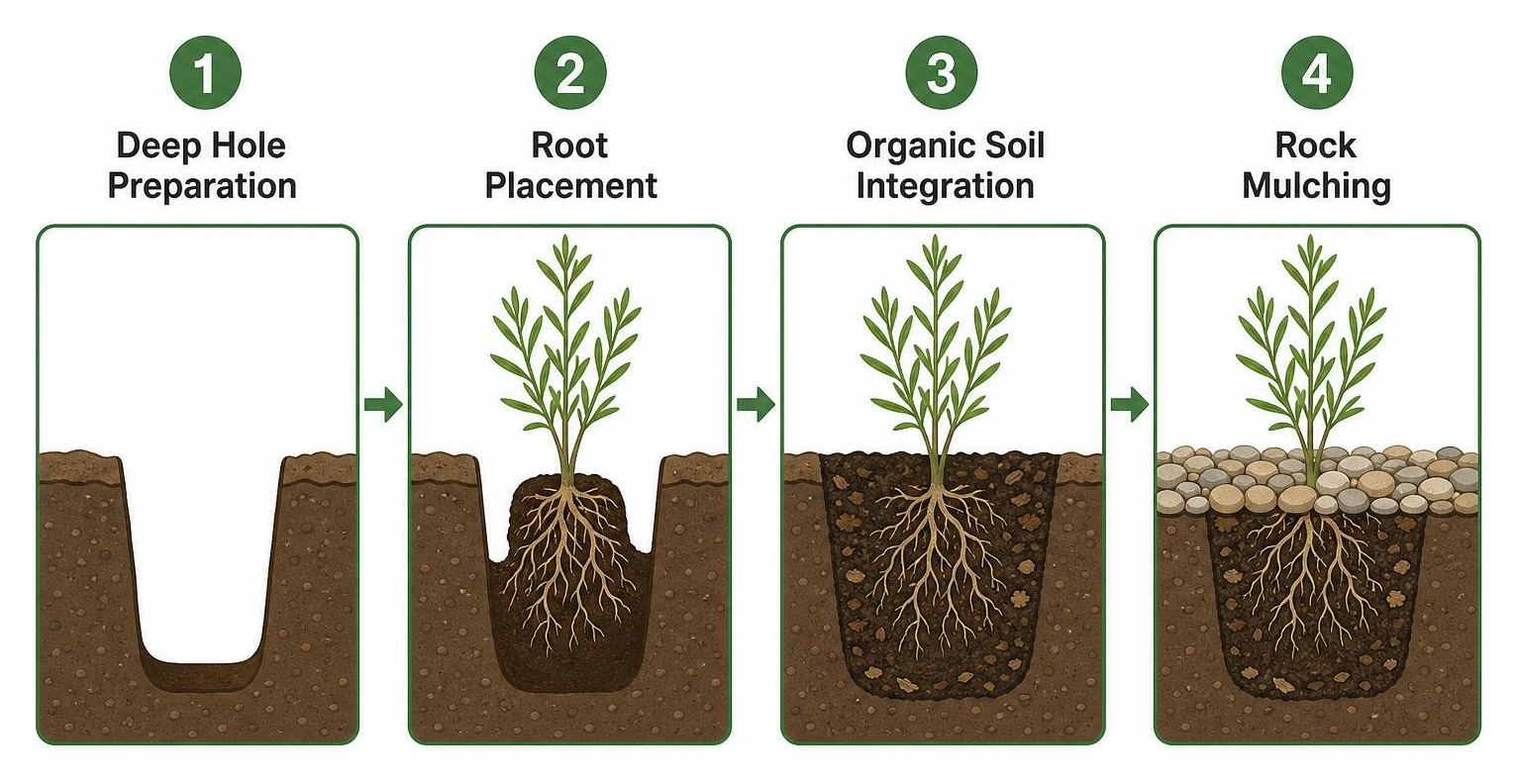
Heavy clay soils hold water but can suffocate native roots, while sandy soils drain before roots absorb hydration. Working organic compost into topsoil balances these extremes by expanding water-holding pores and aerating the root zone.
Topping beds with mineral mulches—such as decomposed granite or river gravel—shields root zones without trapping fungal moisture around stems. We discuss this dynamic further when balancing rock mulch and plantings.
Deep Planting and Smart Irrigation Strategies
Adopting the ancient Hopi deep-planting method—setting root balls slightly below standard grade or planting seeds two to three times their width—insulates tender root systems from surface heat. In-ground plantings remain naturally cooler and hold moisture longer than above-ground pots or raised planters.
Modern irrigation upgrades help maintain proper moisture levels efficiently:
- Targeted Drip Irrigation: Delivers gallons per hour directly to root flares, eliminating overspray waste. Upgrading your setup is easy with professional drip irrigation installation.
- Weather-Adjusted Watering: Installing smart irrigation controllers automatically adjusts watering schedules based on local rainfall and temperature shifts.
Garden Safety: Managing Toxicity in Drought-Tolerant Landscaping
While water-wise landscaping offers clear sustainability benefits, plant toxicity requires careful consideration. A prime example is Euphorbia tirucalli (commonly known as Fire Sticks or Pencil Cactus). When cut or bruised, this succulent exudes a caustic, milky white latex sap.
Direct skin contact with euphorbia sap can trigger severe contact dermatitis, while contact with the eyes risks chemical burns. When pruning or transplanting sap-bearing succulents, always wear personal protective equipment (PPE), including thick gloves and eye protection. For households with curious pets or young children, consider non-toxic alternatives like Dudleya, Echeveria, California lilacs (Ceanothus), or culinary salvias.
Frequently Asked Questions About Low-Water Gardening
How often should newly planted drought-tolerant shrubs be watered?
During their first 6 to 12 months, new shrubs require a deep soak every 7 to 14 days depending on inland heat and soil type. This establishment watering helps young roots expand into surrounding soil. Once established, watering frequency should be reduced to monthly deep soaks or seasonal rainfall.
Which drought-tolerant plants are safest for yards with pets and children?
Non-toxic choices include California buckwheat (Eriogonum fasciculatum), culinary rosemary, garden thyme, lavender, purple coneflower (Echinacea), and thornless native succulents such as Dudleya. Avoid toxic euphorbias, oleander, and sharp-spined desert agaves near walkways and play lawns.
Can drought-resistant native plants survive in heavy clay soil?
Yes, provided water drains away from the crown. Heavy clay soils can hold moisture too close to sensitive stems, leading to root rot. To protect native species like cenizo or sulfur buckwheat, install plants atop raised planting berms amended with coarse granite, or integrate sloped swales that redirect excess runoff.
Conclusion
Selecting well-adapted plant varieties transforms drought-prone yards into resilient landscapes filled with hummingbirds, native bees, and seasonal color. From coast-hugging buckwheats to vibrant salvias and long-lived desert shrubs, water-wise plant combinations keep landscapes green through high summer temperatures.
At Southern California Tree & Landscape, our ISA-certified arborists and experienced crews design and install sustainable irrigation networks and drought-hardy plantings tailored to local soils. If you are planning an outdoor update, explore our complete guide to backyard oasis design in Torrance to see how low-water design creates functional, enduring outdoor spaces.