
When a Pine Tree Borer Is Killing Your Trees From the Inside Out
A pine tree borer can silently destroy a healthy pine before you ever notice something is wrong. If you’re seeing any of the signs below, your tree may already be under attack:
Quick answer — signs your pine has borers:
- Reddish-brown dust (frass) in bark crevices or at the base of the trunk
- Small, round entry or exit holes scattered randomly across the bark
- White or yellowish pitch tubes (globs of sap) on the trunk
- Needles fading from green to yellow to reddish-brown
- Branches dying back from the top down, or a “shepherd’s crook” curve in new growth
What to do right now:
- Don’t remove or cut the tree yet — act-first, diagnose-second mistakes can spread beetles to nearby healthy trees
- Stop watering errors — drought-stressed pines are the #1 target; deep, slow watering helps trees fight back
- Call an ISA-certified arborist to confirm the species and recommend the right treatment before the infestation spreads
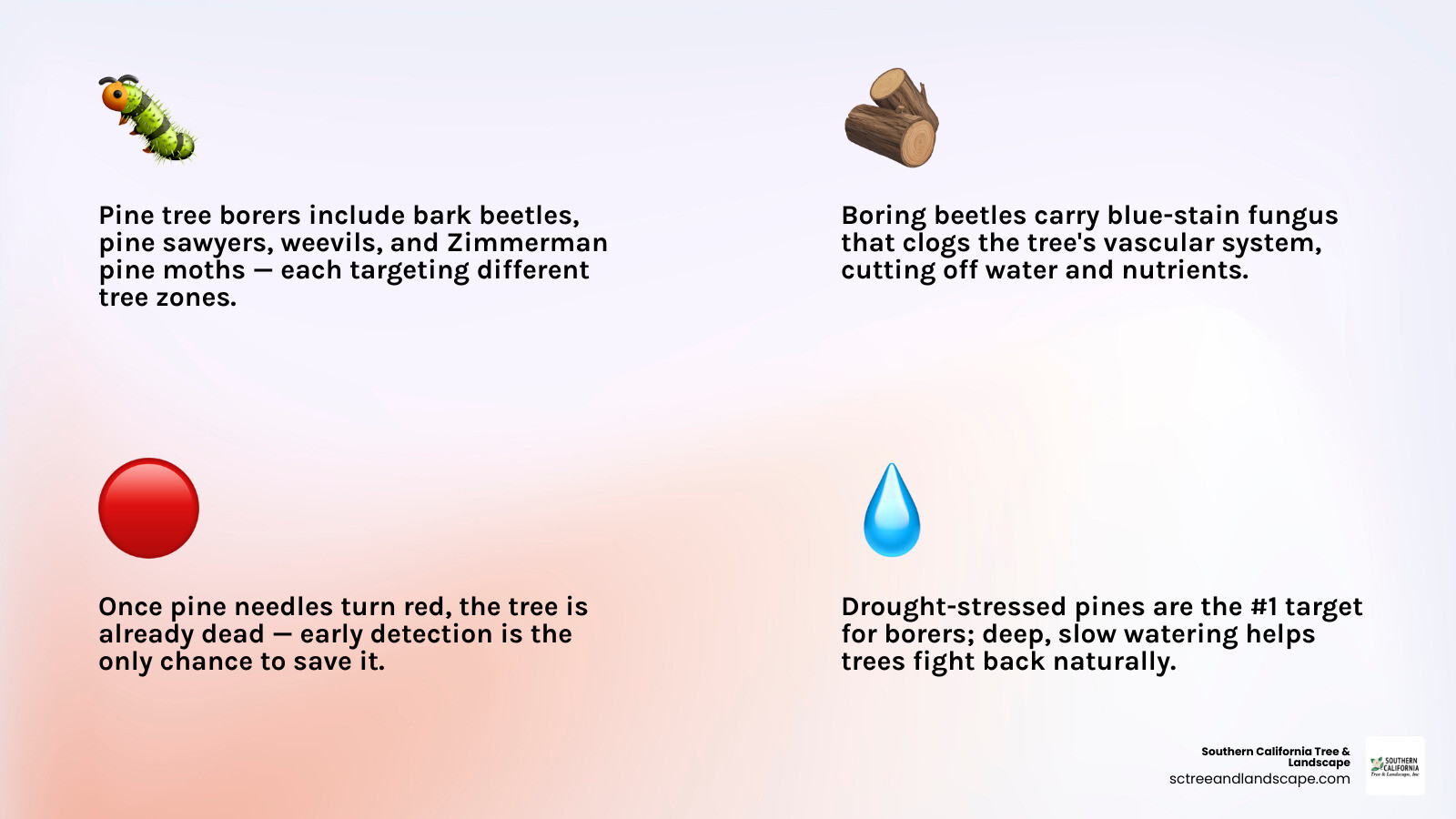
Pines, spruces, and firs are among the most beautiful trees in any Southern California landscape. But when they are stressed — by drought, root damage, or poor soil — they become easy targets for boring insects that attack from the inside out. These pests don’t just damage the wood. Many carry deadly fungi that collapse the tree’s vascular system, cutting off water and nutrients entirely. Once a tree’s needles turn red, it is already dead. That’s why early identification and fast action are everything.
I’m Troy Basmajian, President of Southern California Tree & Landscape, and over the past decade leading our team of tree care professionals across Southern California, I’ve seen pine tree borer damage devastate otherwise healthy properties — damage that could have been prevented with the right knowledge and timely care. In this guide, I’ll walk you through exactly how to identify, treat, and protect your pines before it’s too late.
Meet the Enemy: Common Types of the Pine Tree Borer
To fight back effectively, we first have to understand exactly what kind of pest we are dealing with. The term “borer” is actually a broad category that includes several species of beetles, moths, and weevils. Each has its own favorite target zones and destructive habits.

| Borer Group | Primary Species | Target Zone on Tree | Key Damage Patterns |
|---|---|---|---|
| Bark Beetles & Engravers | Ips Beetles, Western Pine Beetle | Inner bark, cambium layer of trunk and upper canopy | S-shaped or Y-shaped galleries; “popcorn” pitch tubes |
| Longhorn Borers | Pine Sawyer Beetles, Lesser Pine Borer | Deep wood, heartwood of stressed or dying trees | Large round exit holes; loud, audible chewing noises |
| Weevils | White Pine Weevil, Pales Weevil | Terminal shoot leaders, root collars, and young stems | “Shepherd’s crook” branch curling; girdling of young stems |
| Boring Moths | Zimmerman Pine Moth | Branch whorls, trunk junctions | Heavy, gummy resin masses mixed with frass |
Bark Beetles and Pine Engravers (Ips)
Bark beetles are incredibly small—often no larger than a grain of rice—but what they lack in size, they make up for in sheer numbers. In declining trees, more than 100 beetles per square foot of bark can emerge to find new hosts. In the warm, Mediterranean climate of Southern California, these pests are active for most of the year. Bark beetles on evergreens have several generations of adults that fly from mid-April through mid-September.
During the hot summer months, when daily temperatures consistently reach the 90s in inland areas like Covina CA, their development accelerates rapidly. The time from an egg becoming a new adult beetle may be as short as 21 days!
These beetles chew through the outer bark and lay eggs in the cambium layer. As the larvae hatch, they feed on the phloem and xylem, excavating distinct gallery patterns. Ips engraver beetles leave behind dry, clean Y-, H-, or star-shaped galleries under the bark, whereas other species create S-shaped winding paths. They also introduce blue-stain fungi, which clog the tree’s vascular system and accelerate its death.
While we occasionally monitor invasive threats like the Tomicus piniperda (common pine shoot beetle) , our local battles in the South Bay CA and Torrance CA are most frequently fought against native bark beetles and Ips engravers that take advantage of our dry summers.
Pine Sawyer Beetles and Longhorn Borers
If you have ever stood next to a struggling white pine or Monterey pine in July and heard a distinct, rhythmic clicking or crunching sound coming from inside the trunk, you have met the larvae of the pine sawyer beetle. These larvae are known as roundheaded borers due to the enlarged, fleshy segment just behind their heads.
Adult pine sawyers belong to the family Cerambycidae, characterized by elegant, swept-back antennae that are often much longer than their bodies. For example, the native Species Acanthocinus nodosus – Lesser Pine Borer – BugGuide.Net boasts male antennae that are up to three times its body length!
While the lesser pine borer larvae primarily feed on the phloem of dead or dying pines—sometimes acting as accidental biological control agents by competing with bark beetle broods—larger pine sawyer species can cause severe structural damage. They bore deep into the heartwood, leaving exit holes that measure up to 3/8 inches wide.
Furthermore, pine sawyers are notorious vectors for the pine wilt nematode, a microscopic roundworm that multiplies inside the tree’s water-transporting vessels, causing rapid wilt and death. You can read more about their biology in this resource on Pine Sawyers in Virginia , though their destructive behavior remains highly consistent when they find stressed hosts in our Southern California neighborhoods.
Weevils and the Invasive Pine Tree Borer
Weevils represent another major threat, particularly to young pines and the tender terminal leaders of mature trees. The white pine weevil is famous for attacking the very top shoot of the tree. As the larvae feed beneath the bark of the leader, they girdle it, cutting off water. This causes the top branch to wilt, turn brown, and bend over into a highly characteristic “shepherd’s crook” shape.
Other weevils, like the pales weevil, are attracted to the smell of freshly cut pine stumps and resin. They feed on the tender bark of young seedlings, making it risky to replant new pines near old stumps for at least two years unless those stumps are properly managed.
We also keep a close eye on the invasive Tomicus piniperda , also known simply as the Pine shoot beetle . This invasive pest performs “maturation feeding” by boring directly into the living shoots of healthy pines. A single adult can destroy up to six healthy shoots before overwintering, drastically thinning the tree’s canopy and leaving it vulnerable to secondary pathogens.
Spotting the Threat: Early Signs of a Pine Tree Borer Infestation
Because a pine tree borer feeds hidden beneath the bark, homeowners often miss the early stages of an invasion. By the time the entire canopy turns red, the tree’s vascular system has already collapsed. Spotting the subtle, early clues is your only window for successful intervention.
How to Diagnose an Active Pine Tree Borer Attack
When a borer attempts to chew its way into a healthy pine, the tree’s natural defense is to flood the wound with sticky, pressurized sap. This results in “pitch tubes”—whitish or yellow-red globs of resin that look like miniature pieces of popcorn clinging to the bark.
However, if your tree is suffering from severe drought stress, it won’t have the water reserves needed to produce sap. In these cases, you won’t see pitch tubes at all. Instead, the only clue will be dry, reddish-brown boring dust (known as frass) settling in the bark crevices and around the base of the trunk.
As the beetles mature and escape, they leave behind tiny, perfectly round exit holes that look as though someone has peppered the trunk with miniature drill bits or birdshot. If you suspect your trees are showing these signs, check out our guide on Wood You Believe It Effective Treatments for Bark and Leaf Beetles for a deeper dive into diagnostic steps.
Distinguishing Beetle Damage from Woodpeckers and Disease
We frequently receive calls from worried homeowners in Torrance CA and Harbor City CA who mistake sapsucker or woodpecker damage for a devastating borer attack. Fortunately, telling them apart is quite simple once you know what to look for:
- Bird Damage (Sapsuckers): These birds drill clean, uniform holes in neat, horizontal or vertical straight lines. They do this to trap sap and insects.
- Borer Damage: Boring insects do not care about geometry. Their entry and exit holes are scattered completely at random across the trunk and branches.
It is also important to distinguish pest damage from natural seasonal changes. Pines naturally shed their oldest, innermost needles every autumn—a process called “flagging.” If the outer tips of your branches remain green while only the inner needles turn yellow and drop, your tree is likely just going through its natural cycle.
However, if the branch tips are dying, curling, or turning a uniform reddish-brown, you are likely dealing with a disease or a borer. To learn how to tell the difference quickly, read The Secret to Curing Common Tree Diseases Fast and consult our guide on How to Keep Your Torrance Trees Healthy and Legal.
Why Pines Fall Victim: Environmental Stressors and Tree Vulnerability
The single most important concept to understand about pine borers is that most of them are secondary pests. They do not actively choose to attack strong, vigorous trees because healthy pines can easily defend themselves.
When a pine is healthy, its vascular system is highly pressurized. If a beetle tries to bore into the bark, the tree literally “pitches” the insect out, drowning it in a flood of sticky sap. Healthy trees also produce natural chemical compounds that inhibit the growth of the fungi carried by the beetles.
However, when a tree is stressed, its defenses drop. Common culprits in urban landscapes include:
- Drought Stress: In our warm Southern California climate, prolonged dry spells drain the tree’s water pressure, leaving it unable to produce sap.
- Soil Compaction & Construction: Heavy equipment driving over root zones during home renovations crushes the fine feeder roots that absorb water.
- Over-Mulching: Piling mulch higher than four inches or burying the tree’s root flare cuts off oxygen to the roots, stressing the tree and releasing stress scents (monoterpenes) that act as a beacon for beetles.
- Mechanical Wounds: Lawnmowers or weed-whackers nicking the trunk release resin scents that draw beetles from miles away.
How to Treat and Prevent Pine Borers: Actionable Control Strategies
Preventative care is always the most effective cure. Once a borer has successfully colonized a tree and disrupted its vascular flow, saving it becomes incredibly difficult.
Chemical Treatments: Systemic Injections and Protective Bark Sprays
For high-value landscape trees, chemical protectants can provide an excellent shield. These are applied in two primary ways:
- Systemic Soil Drenches & Trunk Injections: Systemic insecticides (such as imidacloprid or emamectin benzoate) are absorbed by the roots or injected directly into the trunk. The tree transports the chemical upward through its vascular system, poisoning any larvae that attempt to feed. Crucial Note: Systemic treatments do not work on already dying trees. If the vascular system is already damaged by borers or fungi, the tree cannot transport the chemical.
- Preventative Bark Sprays: Applying a protective barrier of permethrin or carbaryl to the trunk and lower branches can stop beetles before they ever bite. These sprays must be applied in early spring before the adult beetle flight begins.
Because applying these chemicals requires specialized equipment and precise timing, it is always best to work with professionals. You can find more information on choosing the right team in The Homeowner Guide to Local Tree Service Companies and Arborists and connect with our specialists via South Bay’s Best Tree Doctors Certified Arborists in Torrance and Beyond.
The Critical Role of Winter Sanitation and Wood Disposal
If you have a pine that is heavily infested—meaning more than 50% of its canopy has turned brown or red—the best thing you can do for the rest of your landscape is practice strict sanitation.
Dying trees act as massive breeding grounds. If left standing, thousands of adult beetles will emerge in the spring to attack your neighboring healthy trees.
- Sanitation Window: Remove and destroy heavily infested pines during the winter months (between October 1 and April 1) while the beetles are overwintering inside the wood.
- Proper Disposal: Do not simply fell the tree and leave the logs on your property. You must chip, debark, or burn the wood to destroy the larvae.
- Stump Management: Grinding the stump down is highly recommended, as fresh stumps attract root-collar weevils and other pests.
If you have an emergency situation with a dying, hazardous pine, our team is ready to help. Learn more about your options through our emergency resources:
- Branching Out What to Do When You Need an Emergency Tree Removal Company
- Finding the Best 24 Hour Emergency Tree Removal for Your Property
- Wood You Believe It Finding the Best Stump Removal Grinding Service
Frequently Asked Questions About Pine Borers
Can a pine tree infested with borers be saved?
If the infestation is caught very early—when only a few branches are affected or when the tree is successfully “pitching out” the invaders—it can often be saved. This is achieved by pruning out the infested branches, correcting watering habits to relieve drought stress, and applying preventative systemic treatments. However, once the needles across the entire crown have faded to red, the vascular system has collapsed, and the tree cannot be saved.
Why shouldn’t I keep infested pine wood as firewood?
Storing infested pine logs as firewood is one of the most common ways homeowners accidentally spread beetle outbreaks. As the cut wood dries out, it becomes uninhabitable for the larvae. This forces the emerging adult beetles to fly out in search of the nearest living host—which is usually the healthy pine tree standing right next to your woodpile! If you must keep the wood, debark it entirely first to destroy the larval habitat.
Can you actually hear borers chewing inside a tree?
Yes! If you stand quietly next to a heavily infested white pine or Monterey pine on a warm summer afternoon, you can actually hear a distinct, rhythmic clicking or crunching sound. This is the sound of large pine sawyer beetle larvae using their powerful mandibles to chew deep tunnels through the wood.
Conclusion
Protecting your property’s majestic pines from the destructive pine tree borer requires vigilance, proper cultural care, and rapid response when trouble strikes. By keeping your trees well-watered, avoiding root stress, and practicing clean sanitation, you can ensure your evergreens remain beautiful, healthy, and resilient for decades to come.
As a family-owned business serving Southern California since 1991, Southern California Tree & Landscape is dedicated to protecting our region’s urban canopy. Our ISA-certified arborists, experienced crews, and rapid emergency response teams are always here to help you diagnose, treat, and care for your trees.
Whether you need a preventative health assessment in Torrance CA, deep-root watering advice in Covina CA, or professional tree care in the South Bay CA, we have you covered. Explore our professional Tree Service options and read Tree Service Essential Care for Your Property’s Green Giants to keep your landscape thriving. Reach out to us today to schedule your consultation!