
When Every Minute Counts: Choosing 24 Hour Emergency Tree Removal in Southern California
24 hour emergency tree removal is a professional service that responds immediately — day or night — to trees that are actively threatening your home, vehicles, or safety. Here’s a quick overview of what to look for when evaluating your options:
Top factors for choosing an emergency tree service:
- Response time — The best services arrive on-site within 1–3 hours
- ISA-certified arborists — Credentials matter, especially for complex or high-risk removals
- Full insurance — General liability and workers’ compensation are non-negotiable
- 24/7 availability — Including nights, weekends, and holidays
- Insurance claim support — Documentation, photos, and itemized invoices provided
- Complete cleanup — Debris hauling, chipping, and optional stump grinding included
Southern California sees its share of dangerous weather. Santa Ana winds, heavy winter rains, and saturated soil can turn a healthy-looking tree into a serious hazard overnight. A large branch hanging over your roof isn’t just an inconvenience — it’s a liability.
For HOA managers and property owners, the stakes are even higher. One delayed call can mean the difference between a manageable cleanup and a six-figure structural repair.
The challenge is that not every company advertising emergency tree services is actually equipped to handle them safely and quickly. This guide helps you evaluate your real options — so you can make a confident decision before (or during) a crisis.
Identifying a True 24 Hour Emergency Tree Removal Situation
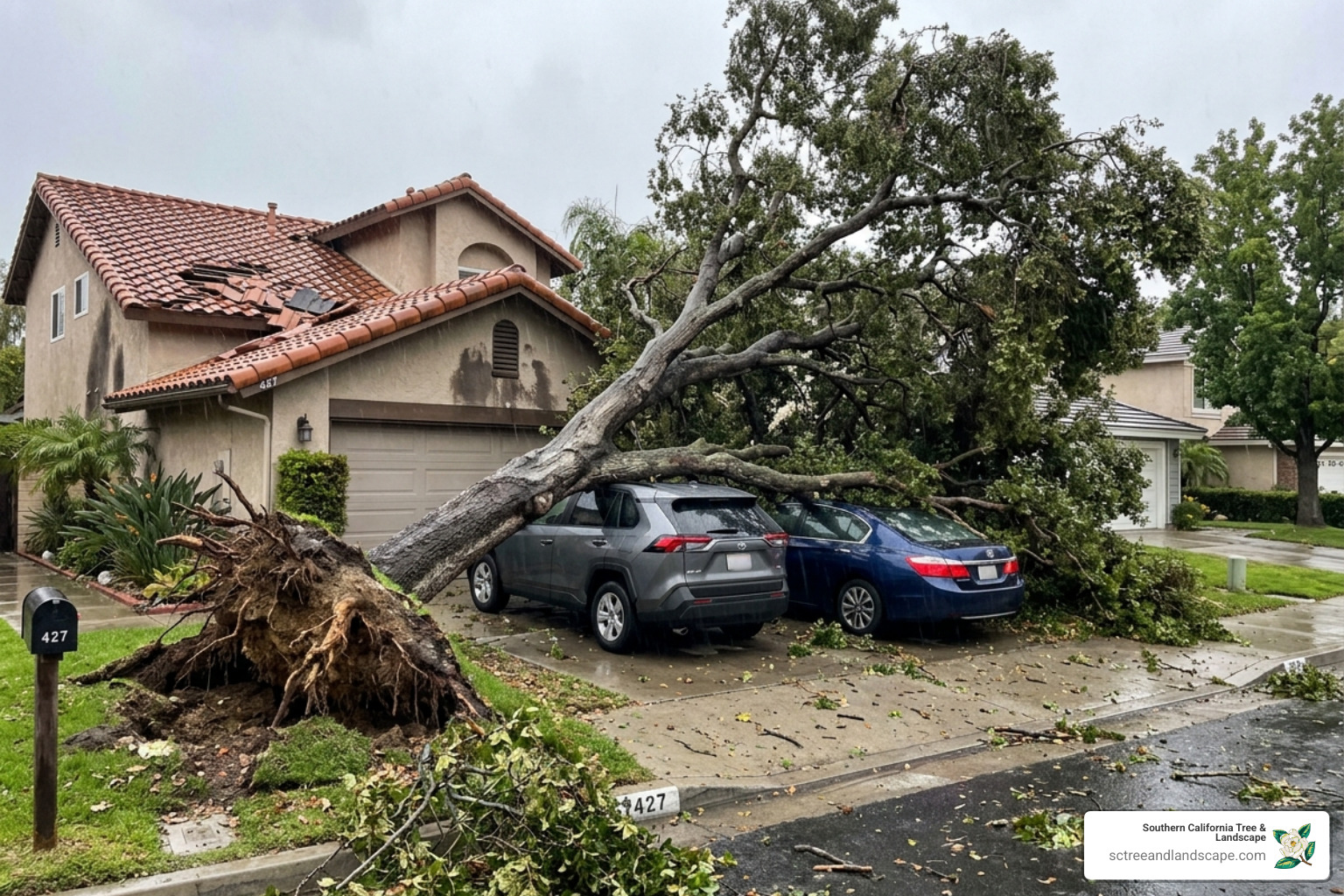
Not every tree issue requires a midnight phone call, but when a situation turns hazardous, waiting until business hours can be a costly mistake. In Southern California, from Torrance to Covina, we often see “sudden limb drop” or uprooting during heavy rain events. But how do you know if you are facing a genuine emergency?
Structural Damage to Buildings
If a tree or a heavy limb has already made contact with your home, garage, or any covered structure, it is a primary emergency. The weight of a fallen tree can compromise the structural integrity of your roof. Interestingly, the tree might actually be holding the structure together in some places; removing it incorrectly could cause a secondary collapse.
Leaning Trees and Uprooted Root Balls
A tree that was straight yesterday but is leaning today is a disaster waiting to happen. Look at the ground around the base of the trunk. If you see “heaving” soil or exposed roots that were previously underground, the tree has lost its anchor. This is especially common in the South Bay after periods of heavy soil saturation. These trees are incredibly unpredictable and can fall at any moment without further wind.
Storm Damage and Cracked Trunks
High winds, like our famous Santa Ana gusts, can cause “stress cracks” or “vertical splits” in the trunk. If you see a deep crack or a “V-shaped” split where two major stems meet, the tree is no longer structurally sound. For professional intervention, a Tree Service expert should be called immediately to assess if the tree can be braced or if it must be removed to protect the property.
Power Line Interference
Trees touching or leaning near power lines are life-threatening. Never approach these yourself. In these cases, we coordinate with local utility companies to ensure the area is de-energized before work begins. If a tree has pulled down lines, stay at least 30 feet away and call 911 first, then contact a 24 hour emergency tree removal specialist.
Blocking Essential Access
If a fallen tree is blocking your driveway, preventing you from leaving your home or emergency vehicles from entering, it qualifies as an urgent hazard. We prioritize these “blocked access” calls to restore your mobility as quickly as possible.
The Professional Emergency Response Protocol
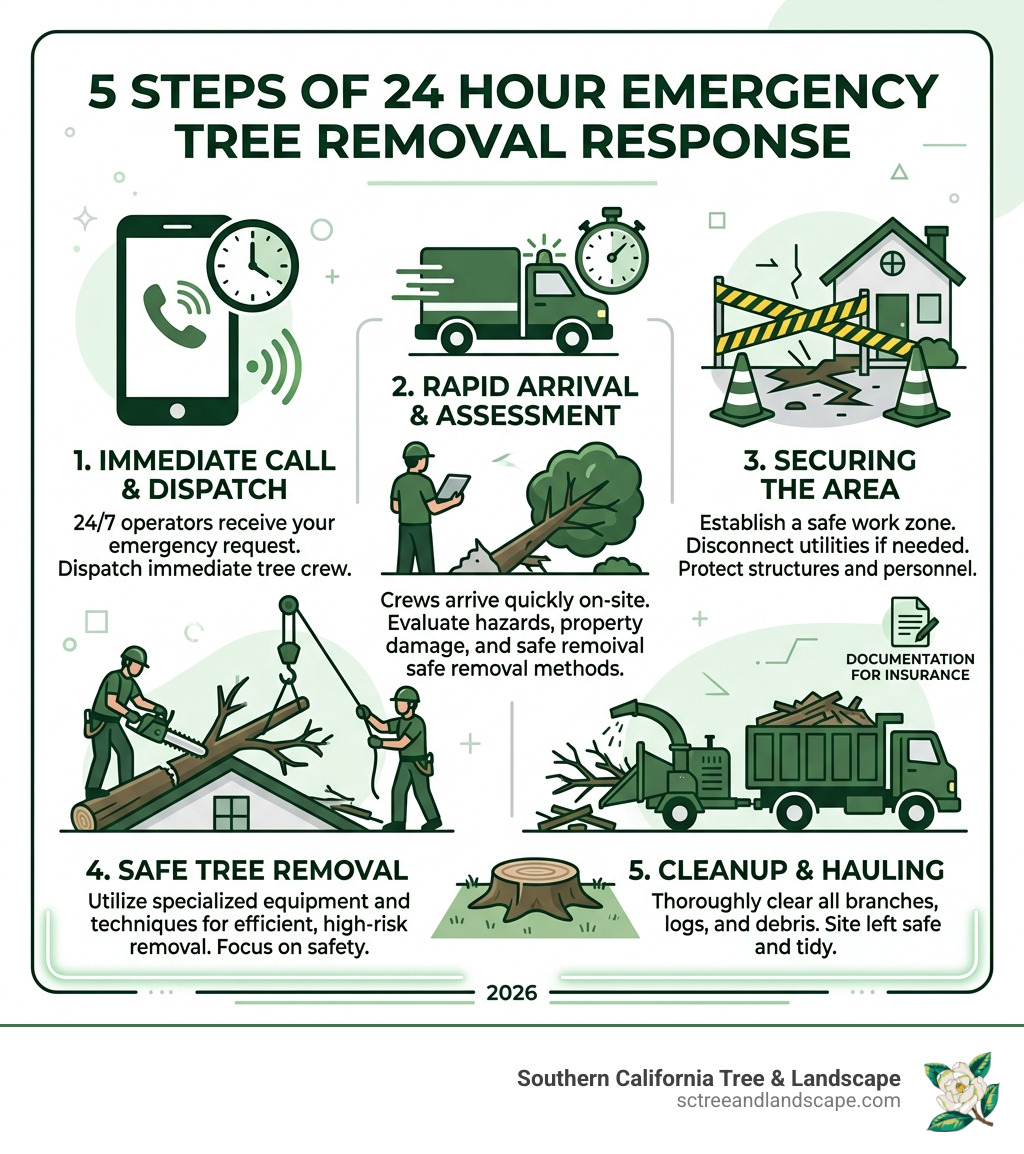
When you call for 24 hour emergency tree removal, you aren’t just hiring someone with a chainsaw; you are hiring a team that follows a strict safety and tactical protocol. Because these jobs often happen in the dark or under rain-slicked conditions, the process is much more methodical than a standard removal.
Step 1: Rapid Dispatch and Site Stabilization
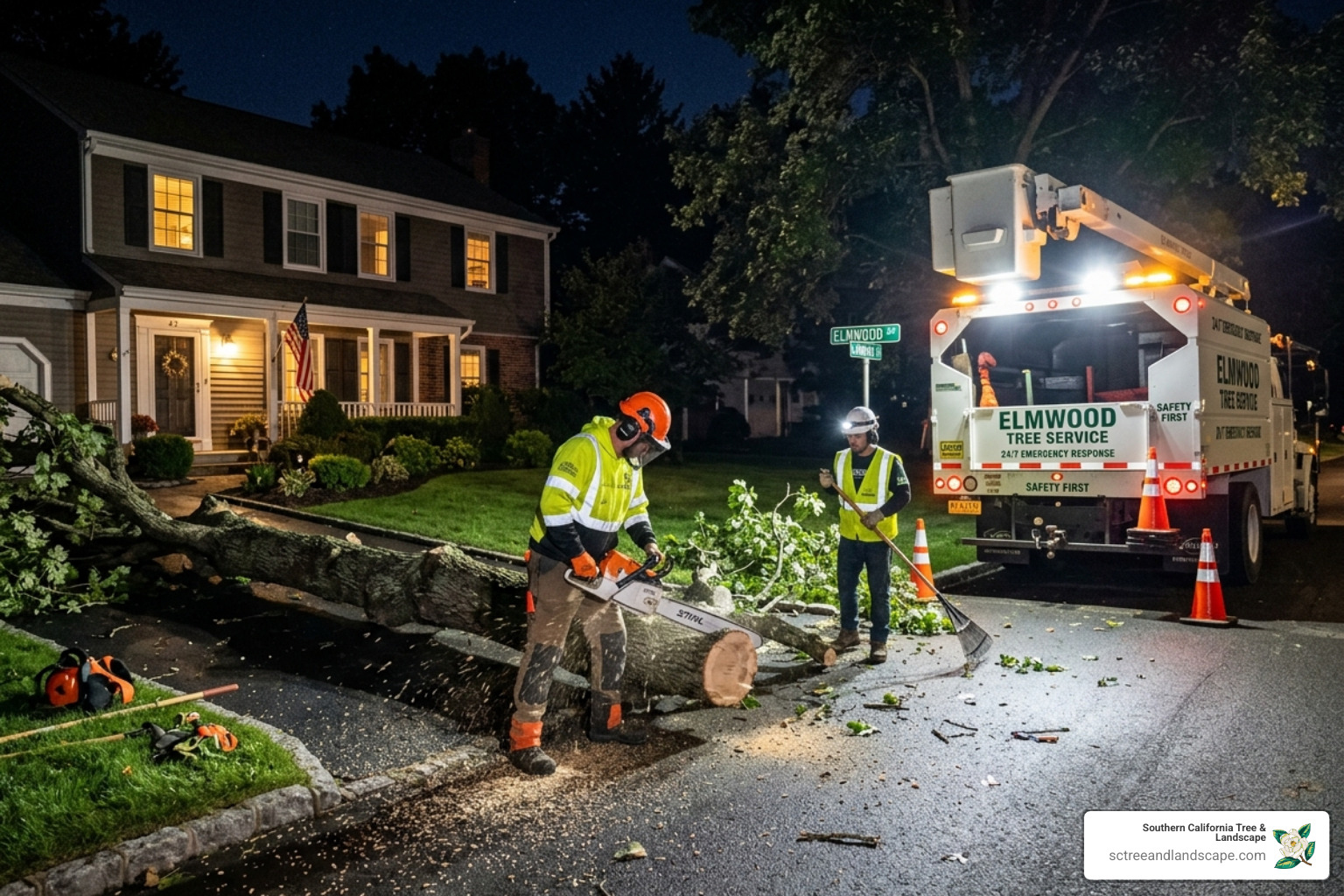
Upon receiving an emergency call, a crew is mobilized. The first goal is stabilization. We set up a safety perimeter using cones or tape to keep residents and onlookers away from the “fall zone.” If it’s night, we deploy high-intensity emergency lighting to ensure every cut is visible and safe.
Step 2: On-Site Risk Assessment
An ISA-certified arborist or a highly experienced crew leader performs a physics-based assessment. They look at wood tension (where the tree is under pressure), weight distribution, and potential “targets” (like your neighbor’s fence or a utility line). This is critical because cutting a tree under tension can cause it to “snap back” or shift unexpectedly.
Step 3: Utility and Structural Coordination
If the tree is resting on a house, we don’t just start cutting. We evaluate how the weight is distributed. Our Emergency Tree Services | Rapid Response team ensures that the removal doesn’t cause more damage than the initial fall. We also coordinate with utility providers if lines are threatened.
Step 4: Sectional Dismantling and Removal
Using techniques like “negative rigging,” we remove the tree in small, controlled sections. This prevents heavy logs from dropping onto your property. If the tree is in a tight space or on a roof, we may use a crane to lift the pieces straight up and away.
Step 5: Cleanup and Final Inspection
Once the hazard is gone, we don’t leave you with a mess. We chip the brush, haul away the heavy logs, and rake the area. A final walkthrough ensures no “widow makers” (loose branches) are left hanging in nearby trees. For more on how we care for your property long-term, see our guide on Tree service: Essential care for your property’s green giants.
Advanced Equipment for 24 Hour Emergency Tree Removal
To handle these high-stakes jobs, we utilize specialized gear that the average landscaper simply doesn’t carry:
- Crane-Assisted Removal: Essential for lifting trees off houses without dragging them across the shingles.
- Precision Rigging: High-strength ropes and pulleys to lower limbs gently.
- Aerial Lifts: To reach high branches that are too unstable to climb.
- Commercial-Grade Wood Chippers: To process debris quickly and clear the site.
- Night-Operation Lighting: Powerful LED arrays to turn night into day for maximum safety.
Why Professional Expertise Outperforms DIY Efforts
It might be tempting to grab a chainsaw from the garage to clear a fallen limb, but emergency tree work is the most dangerous type of arboriculture. Thousands of ER visits every year are caused by untrained operators using chainsaws.
| Risk Factor | DIY Attempt | Professional Service |
|---|---|---|
| Tension Wood | Tree can “kick back” or snap, causing fatal injuries. | Trained to identify and release tension safely. |
| Equipment | Often underpowered or dull, leading to accidents. | Commercial-grade, sharp, and safety-inspected. |
| Liability | If you drop a limb on your neighbor’s car, you pay. | Fully insured; company takes the liability. |
| Hidden Hazards | Risk of electrocution or falling from heights. | Certified in safety protocols (ANSI Z133). |
| Structural Damage | Removing a limb can cause the rest of the tree to shift onto the house. | Controlled rigging ensures zero additional damage. |
Navigating Costs and Insurance Claims
One of the biggest stressors during a tree emergency is the financial aspect. “How much is this going to cost?” and “Will my insurance cover it?” are the first questions we hear.
How Insurance Typically Works
Most homeowners insurance policies cover 24 hour emergency tree removal if the tree fell due to a “named peril” (like a windstorm or lightning) and landed on a covered structure. This includes your home, garage, or even a fence.
- Coverage Limits: Many policies have a cap on tree removal, often ranging from $500 to $1,000 per tree, but if the tree is on your house, the cost of getting it off is usually covered under the “dwelling” portion of your policy, which has much higher limits.
- Blocking Access: If a tree falls and blocks a driveway or a ramp for the disabled, many policies will cover the removal even if it didn’t hit a building.
- The “No Damage” Scenario: If a tree falls in the middle of your yard and doesn’t hit anything or block anything, insurance rarely covers the cleanup.
Our Role in Your Claim
We don’t just cut the tree; we help you get paid. We provide:
- High-quality photo documentation of the tree on the structure.
- Detailed, itemized invoices that separate the cost of “hazard tree removal” from “debris hauling.”
- Arborist reports explaining why the removal was an immediate necessity for safety. You can learn more about our comprehensive approach on Our Services page.
Factors Influencing 24 Hour Emergency Tree Removal Costs
Several variables dictate the final price of an emergency call:
- Time of Day: Calls at 2:00 AM on a Sunday require overtime pay for specialized crews.
- Tree Size and Species: A massive Eucalyptus requires more manpower and heavier equipment than a small palm.
- Complexity: Is the tree tangled in power lines? Is it hanging over a swimming pool? These require slower, more technical work.
- Equipment: If a crane is required, the cost will increase significantly (often by $2,000 or more), but it is often the only way to prevent further home damage.
Preventing Future Tree Emergencies
The best emergency is the one that never happens. Regular maintenance is the key to property safety in Southern California.
- Regular Pruning: Removing “sail area” from a tree allows wind to pass through the canopy rather than pushing the tree over.
- Risk Assessment Programs: Having an ISA-certified arborist from our team inspect your trees annually can identify “included bark” or root rot before the next storm hits.
- Soil Saturation Monitoring: After heavy rains, check your trees for any new leaning or soil movement.
- Structural Cabling: For trees with split trunks, we can sometimes install high-strength cables to hold them together during high winds.
Learn more About our family-owned commitment to tree health and safety.
Frequently Asked Questions about 24/7 Tree Services
How quickly can a professional crew respond to an emergency?
In the Southern California areas we serve—like Torrance, Harbor City, and Covina—our goal is to have a crew on-site within 60 to 90 minutes. During major regional storms, we use a triage system. We prioritize “tree on house” and “blocked access” calls first. Even in peak storm conditions, we aim for same-day response to secure your property.
Does homeowners insurance cover the full cost of removal?
It depends on your specific policy and the situation. If the tree hit your house, insurance usually covers the cost of removing the tree from the structure and the debris. However, they may not cover stump grinding unless it’s necessary for the repair of the structure. Always document the damage before the crew starts work!
What should I do while waiting for the emergency crew to arrive?
- Evacuate: If a large tree is on your roof, move everyone to a safe part of the house or outside.
- Stay Away: Do not go near the tree, especially if power lines are involved.
- Document: From a safe distance, take photos and video of the damage for your insurance adjuster.
- Utilities: If you smell gas or see water leaks, turn off the main valves if it is safe to do so.
- Call the Pros: If you haven’t already, Contact Us immediately to get on the dispatch list.
Conclusion
Facing a tree emergency is a stressful experience, but you don’t have to handle it alone. Since 1991, Southern California Tree & Landscape has been the family-owned choice for homeowners and HOAs across the South Bay and the greater Los Angeles area. With our ISA-certified arborists and experienced crews, we bring the right equipment and the right expertise to every crisis.
Whether it’s a fallen oak in Covina or a leaning palm in Torrance, we are ready to restore safety to your property 24 hours a day, 365 days a year. Don’t wait for a leaning tree to become a fallen one—reach out for a professional assessment today.
For immediate assistance or to schedule a preventative risk assessment, visit our 24 Hour Emergency Tree Removal page and let us help you protect your property’s green giants.