
Why Your Tree Landscape Is One of the Best Investments You Can Make
A well-planned tree landscape can transform any property — improving curb appeal, cutting energy costs, and adding real dollar value. Whether you manage an HOA, a commercial campus, or a residential estate in Southern California, trees are one of the highest-return investments you can make in your outdoor space.
Here are the most impactful tree landscaping ideas to get started:
- Create shade and privacy — Use evergreens like arborvitae or Italian cypress as screens; plant canopy trees on the west and south sides to block summer heat.
- Add a focal point — A specimen tree like a redbud or Japanese maple draws the eye and anchors a design.
- Reduce energy costs — Strategically placed trees can cut summer cooling costs by 15–50%.
- Manage stormwater — A single mature tree can intercept over 1,500 gallons of rainwater per year.
- Boost property value — Trees properly integrated into a landscape can increase property values by 7–19%.
- Support wildlife and air quality — A mature tree absorbs roughly 48 pounds of CO₂ annually and provides habitat for local species.
- Design around existing trees — Map root zones first, choose shade-tolerant plants, and use permeable hardscaping to preserve mature trees.
Trees do all of this while getting more valuable over time — unlike most landscape features that age and depreciate.
The best landscapes don’t happen by accident. They start with a clear purpose: shade, privacy, beauty, food, or habitat — then work backward to species selection, placement, and long-term care. In Southern California, that also means accounting for drought conditions, clay soils, utility setbacks, and local ordinances before a single tree goes in the ground.
I’m Troy Basmajian, President of Southern California Tree & Landscape, and over the past decade I’ve led a team of more than 100 professionals helping HOAs, commercial properties, and residential estates across the region design, install, and maintain exceptional tree landscapes. In this guide, I’ll walk you through everything we’ve learned — from species selection and safe planting distances to protecting mature trees during construction and integrating water features into wooded settings.
The Benefits of a Well-Designed Tree Landscape
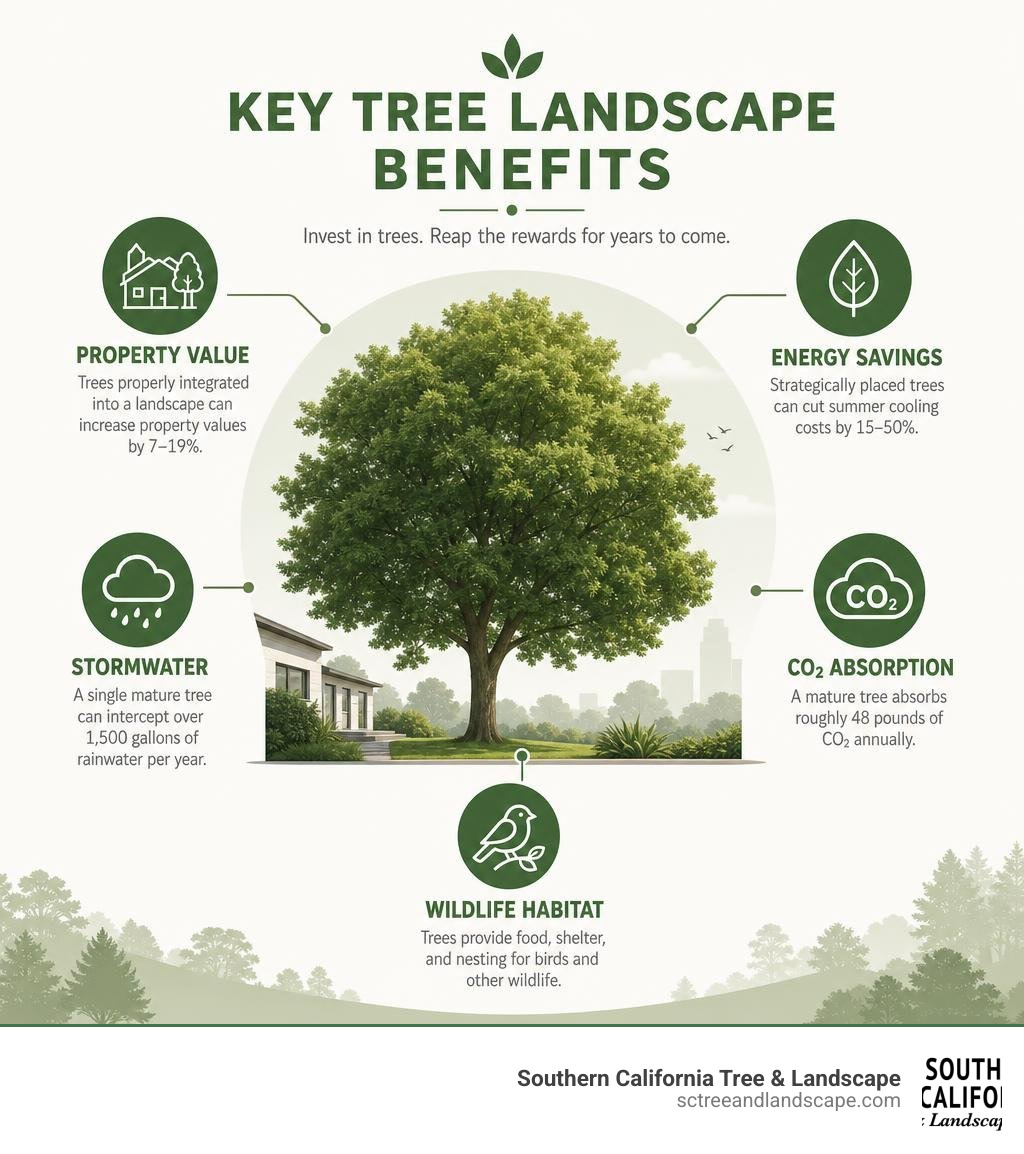
When we design a tree landscape in Southern California, we aren’t just placing pretty plants in the ground. We are installing long-term environmental and financial assets. Properly integrated trees act as biological machinery that directly lowers your operating costs and increases your equity.
Financially, the numbers are hard to ignore. Studies show that a mature tree can provide an estimated $273 in direct annual environmental benefits, which quickly compounds across a larger HOA or commercial campus. By shading concrete driveways, walls, and roofs, trees dramatically lower the “heat island” effect around your buildings. This strategic placement translates to a 15–50% reduction in summer cooling costs—a massive relief during our intense Southern California summers. In the winter, they can act as windbreaks, shaving 10–20% off heating bills. Furthermore, trees can boost overall property values by 7% to 19% when designed thoughtfully.
Beyond the balance sheet, trees perform critical ecological work. A single mature tree absorbs roughly 48 pounds of carbon dioxide per year while releasing enough oxygen to support two people. They also play a major role in regional stormwater management. Their leaves intercept rainfall, and their extensive root systems act like sponges, allowing a single mature tree to intercept over 1,500 gallons of water annually. This reduces the burden on municipal storm drains and mitigates erosion on sloped properties.
In Southern California, local landscaping standards and municipal ordinances often dictate how we manage our urban forests. Municipalities from Torrance to Covina have strict guidelines regarding canopy coverage, tree preservation, and water-wise planting. Designing with these standards in mind ensures your property remains compliant, sustainable, and beautiful for decades to come.
Designing a Tree Landscape for Privacy, Shade, and Focal Points
A great tree landscape uses different tree types like pieces on a chessboard, with each variety serving a distinct functional role.
- Privacy Screens: Evergreens are our go-to tools for blocking unwanted views, deadening street noise, and cutting down harsh winds. Species like Thuja ‘Green Giant’ Arborvitae or compact Podocarpus can be planted closely to create dense, living green walls. They are far more affordable and long-lasting than traditional fencing.
- Shade Providers: Large canopy trees planted on the west and south sides of buildings act as natural air conditioners. Deciduous trees are perfect here; they block the brutal summer sun but drop their leaves in winter to let warm sunlight filter through.
- Focal Points: Specimen trees are the “showstoppers” of your yard. A beautifully placed Japanese Maple, a vibrant Redbud, or a sculptural Olive tree draws the eye, anchors your garden beds, and gives the landscape a sense of permanence and high-end design.
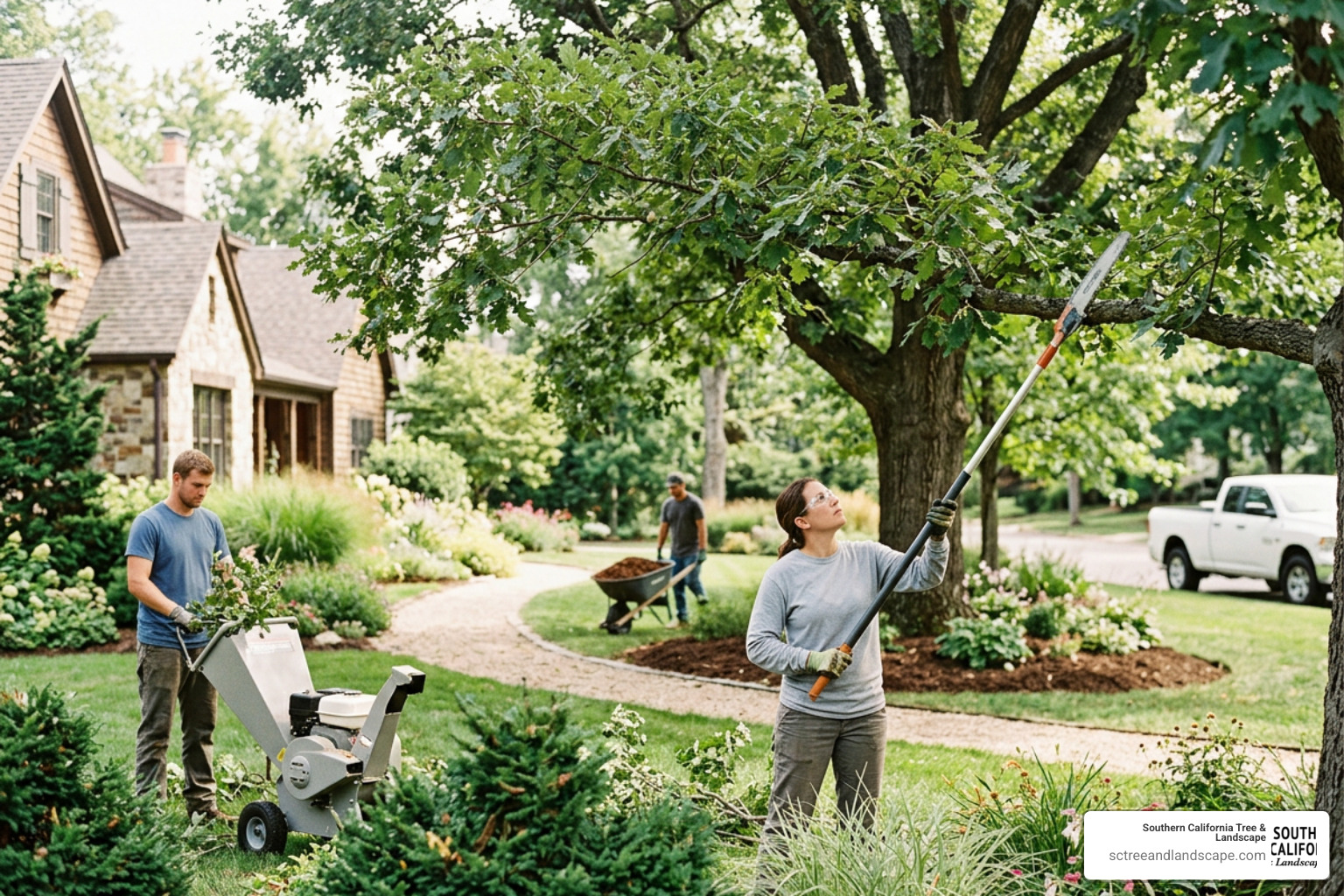
To keep these functional giants healthy, they require targeted, professional care from the day they are planted. For a deeper dive into managing these massive assets, check out our guide on Tree Service: Essential Care for Your Property’s Green Giants.
Best Practices for Maintaining a Healthy Tree Landscape
Maintaining a stunning tree landscape requires more than just occasional watering. Regular, proactive maintenance keeps your trees structurally sound and safe from disease.
Pruning is the cornerstone of tree health. Proper structural pruning removes dead, diseased, or crossing branches, allowing more sunlight and airflow through the canopy. If a tree has grown too large for its space, we use crown reduction techniques rather than “topping” (which ruins the tree’s structure and makes it hazardous).
Pest control is another major concern in Southern California. Bark beetles and leaf beetles can quickly devastate stressed trees, particularly conifers and eucalyptus. Recognizing early warning signs—such as discolored leaves, boring holes, or oozing sap—is crucial. We highly recommend reading up on The Secret to Curing Common Tree Diseases Fast and exploring Wood You Believe It: Effective Treatments for Bark and Leaf Beetles to protect your canopy from these destructive pests.
For high-climbing or complex pruning tasks, it’s always safest to hire professional tree trimming services to ensure your trees are trimmed safely and in compliance with local safety standards.
Selecting and Placing the Right Tree Species
The golden rule of tree landscaping is: the right tree in the right place. Choosing a tree simply because it looks good at the nursery is a recipe for cracked concrete, blocked views, and high maintenance bills down the road.
When choosing species, we look closely at USDA hardiness zones and prioritize native or climate-adapted varieties. Native trees are naturally equipped to handle Southern California’s wet winters and dry summers, requiring far less supplemental water once established.
You must also plan for the tree’s mature height and root spread. A cute, five-gallon sapling can easily grow into a 60-foot giant with a root system that extends 1.5 times the width of its canopy. If you need inspiration or localized advice on selecting species that thrive in our unique microclimates, consulting with professional landscape and tree services is a smart first step to find species that match your property’s specific conditions.
Climate, Soil, and Drainage Considerations
Southern California is famous for its diverse microclimates—ranging from the cool, salty breezes of the South Bay to the intense, dry heat of Covina. Alongside these temperature shifts, we often contend with heavy clay soils. Clay drains slowly, which can trap water around a tree’s root ball and lead to root rot.
Before planting, we always perform a simple soil drainage test: dig a hole, fill it with water, and see how long it takes to empty. If it takes longer than 24 hours, you have drainage issues that must be addressed by amending the soil, installing French drains, or selecting species that tolerate “wet feet.”
Understanding how your local climate and soil conditions interact with your trees is the first step to proper care. For beginners looking to understand how these factors influence growth and pruning needs, our Beginner’s Guide to Tree Trimming is an invaluable resource.
Safe Planting Distances from Structures and Utilities
Planting a tree too close to a house, commercial building, or power line is an expensive mistake. Roots can infiltrate sewer lines and lift concrete, while expanding branches can damage roofs and interfere with overhead utility lines.
To avoid these hazards, always follow the mature spread rule: take the expected mature width (spread) of the tree, divide it in half, and plant the tree at least that distance away from any structure. For example, if a tree’s mature spread is 40 feet, it should be planted at least 20 feet away from your home. Always call 811 to map out underground utility lines before digging.
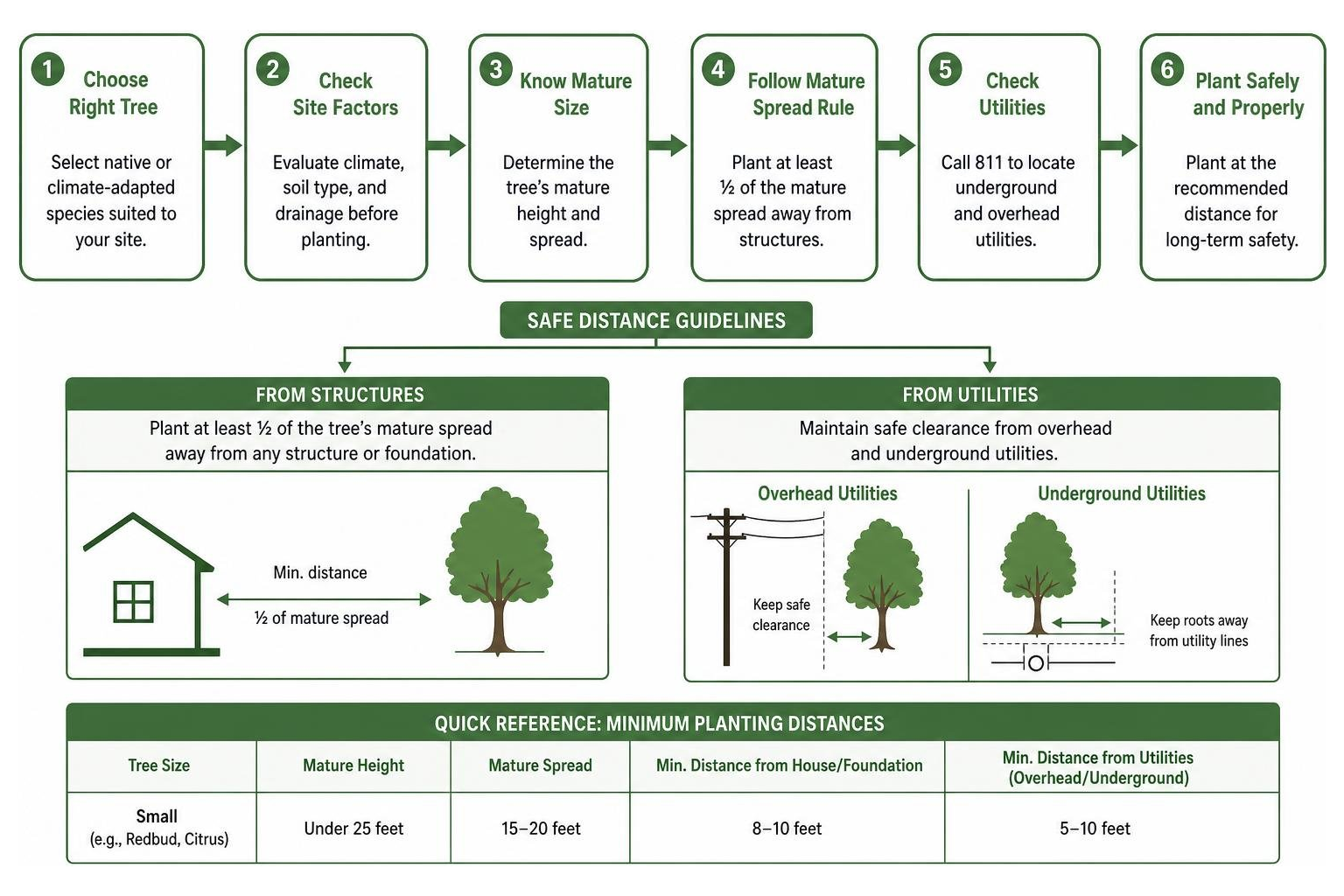
Here is a quick reference guide for safe planting distances based on mature tree size:
| Tree Size | Mature Height | Mature Spread | Min. Distance from House/Foundation | Min. Distance from Utilities (Overhead/Underground) |
|---|---|---|---|---|
| Small (e.g., Redbud, Citrus) | Under 25 feet | 15–20 feet | 8–10 feet | 5–10 feet |
| Medium (e.g., Jacaranda, Olive) | 25–40 feet | 25–35 feet | 15–20 feet | 15–20 feet |
| Large (e.g., Coast Live Oak, Sycamore) | Over 40 feet | 40+ feet | 20–30+ feet | 30+ feet |
Designing Around Existing and Mature Trees
A mature, decades-old oak or pine tree is an irreplaceable asset. Designing a landscape around these existing giants preserves the ecological balance of your property and gives your yard an immediate sense of maturity that young saplings cannot replicate.
The secret to designing around mature trees is to treat them as partners rather than obstacles. Instead of trying to grow a thirsty, sun-loving lawn directly under a shady canopy, embrace the shade. Underplant mature trees with shade-tolerant, low-water plants like native ferns, coral bells, or wild ginger.
Working with existing trees requires a delicate touch and a deep understanding of tree biology. To ensure these delicate integrations are handled correctly, it is highly recommended to work with certified arborists who understand how to balance construction and tree health.
Protecting Root Zones During Construction and Landscaping
The most common cause of death for mature trees on active construction or landscaping sites is root damage. People often assume that because a tree’s trunk is untouched, the tree is safe. However, heavy equipment driving over the root zone compacts the soil, crushing the tiny feeder roots that absorb water and oxygen.
To protect your trees, you must map out and protect the critical root zone (CRZ). The CRZ generally extends 1 to 1.5 times the width of the tree’s canopy.
Within this zone, follow these strict protection rules:
- No Heavy Machinery: Never park trucks or drive heavy equipment over the CRZ.
- Install Protective Barriers: Erect sturdy fencing around the CRZ to keep workers and materials out.
- Use Trenchless Digging: If you must run irrigation or utility lines through the root zone, use trenchless boring rather than standard trenching to go under the roots rather than cutting through them.
- Manage Soil Levels: Adding as little as two inches of soil over a root zone can suffocate a mature tree. Keep the original soil grade intact.
When pruning mature trees to clear space for new structures, make sure you don’t over-thin the canopy, which can shock the tree. Learn the right way to manage this balance in The Ultimate Guide to Thinning Your Tree Without Losing Your Mind.
Integrating Hardscaping, Pathways, and Water Features
Integrating hardscaping—like patios, walkways, and water features—around trees requires specialized design techniques to ensure roots can still “breathe.”
Instead of pouring solid, impermeable concrete over root zones, use permeable pavers, gravel, or stepping stones set on a sand base. These materials allow water and air to penetrate down to the roots while minimizing soil compaction.
Water features can also be stunning additions to a wooded lot. An ecosystem pond or a pondless waterfall adds movement, soothing sound, and beautiful light reflections to a shady, tree-filled yard. Pondless waterfalls are particularly useful in tight, root-heavy spots because they require less deep excavation than a full pond.

When planning major landscape remodels that blend hardscaping with mature trees, it’s highly beneficial to work with experienced local designers. You can find highly rated regional experts by browsing THE BEST 10 Landscaping in SOUTH BAY, CA to find professionals who specialize in complex hardscape integrations.
Long-Term Care and Maintenance for Your Property
Once your tree landscape is installed, long-term care is what keeps it thriving. In Southern California, efficient water management is our top priority.
Drip irrigation systems are highly recommended for trees because they deliver water slowly and deeply, straight to the root zone, minimizing evaporation. As trees grow, remember to move your drip emitters outward to match the expanding drip line of the canopy—roots at the edge of the canopy are the ones actively absorbing water, not the ones right next to the trunk.
Mulching is another essential practice. Apply a 2-to-4-inch layer of organic mulch (like wood chips) around the base of your trees to retain soil moisture, suppress weeds, and regulate soil temperature. Just remember the “donut, not the volcano” rule: keep the mulch 2 to 3 inches away from the trunk itself to prevent moisture buildup, which can rot the bark and invite pests.
Different species also require highly specialized pruning schedules. For instance, if your property features eucalyptus trees, they require precise timing and techniques to prevent hazardous branch drops. We’ve put together a comprehensive guide on this topic: Don’t Branch Out Too Far: The Ultimate Eucalyptus Pruning Guide. For other large species, you may need to control their overall size safely without sacrificing their natural beauty; you can read about those advanced techniques in Honey, I Shrunk the Tree and Other Crown Reduction Secrets.
Frequently Asked Questions About Tree Landscaping
How far should a tree be planted from a house?
As a general rule of thumb, you should divide the tree’s mature spread (width) in half and plant it at least that far from your house. This ensures branches won’t scrape your roof and roots won’t exert pressure on your foundation. For very large trees like oaks or sycamores, we recommend a minimum distance of 20 to 30 feet. If you are dealing with tight urban lots in Southern California, consulting with professional tree services can help you identify compact or columnar species that can safely be planted closer to structures.
Can you build a pond or water feature near mature trees?
Yes, but it requires careful planning. You must use a high-quality pond skimmer to handle falling leaves and debris before they sink and decay, which can cause algae blooms. When excavating for the pond, work around major structural roots rather than cutting them. If a tree is failing or needs to be cleared to make room for a safe water feature, always consult a professional stump grinding service to prep the area properly. Learn more about your options in Wood You Believe It: Finding the Best Stump Removal & Grinding Service.
How do you protect tree roots during construction?
The best way to protect tree roots is to map out the critical root zone (CRZ) and block it off with sturdy fencing. If construction equipment must pass over the root zone, lay down protective plywood barriers over a thick layer of wood chip mulch to distribute the weight and prevent soil compaction. If a tree does suffer sudden, severe damage during construction, contact an emergency tree care provider immediately. For tips on handling these situations, read Branching Out: What to Do When You Need an Emergency Tree Removal Company.
Conclusion
A beautiful, functional tree landscape is one of the most rewarding improvements you can make to your Southern California property. By selecting the right species, planning for mature growth, protecting your existing trees, and keeping up with regular maintenance, you can enjoy a vibrant, climate-resilient canopy that adds value to your estate or commercial property for decades.
At Southern California Tree & Landscape, we have been helping our neighbors design, build, and maintain their dream outdoor spaces since 1991. Whether you are in Torrance, the South Bay, or Covina, our experienced crews and ISA-certified arborists are ready to bring your vision to life.
Ready to elevate your property’s canopy? Explore our professional landscaping and tree services or check out our dedicated Our Services: Tree Service page to schedule a consultation with our expert team today!