
What a Tree Health Assessment Tells You
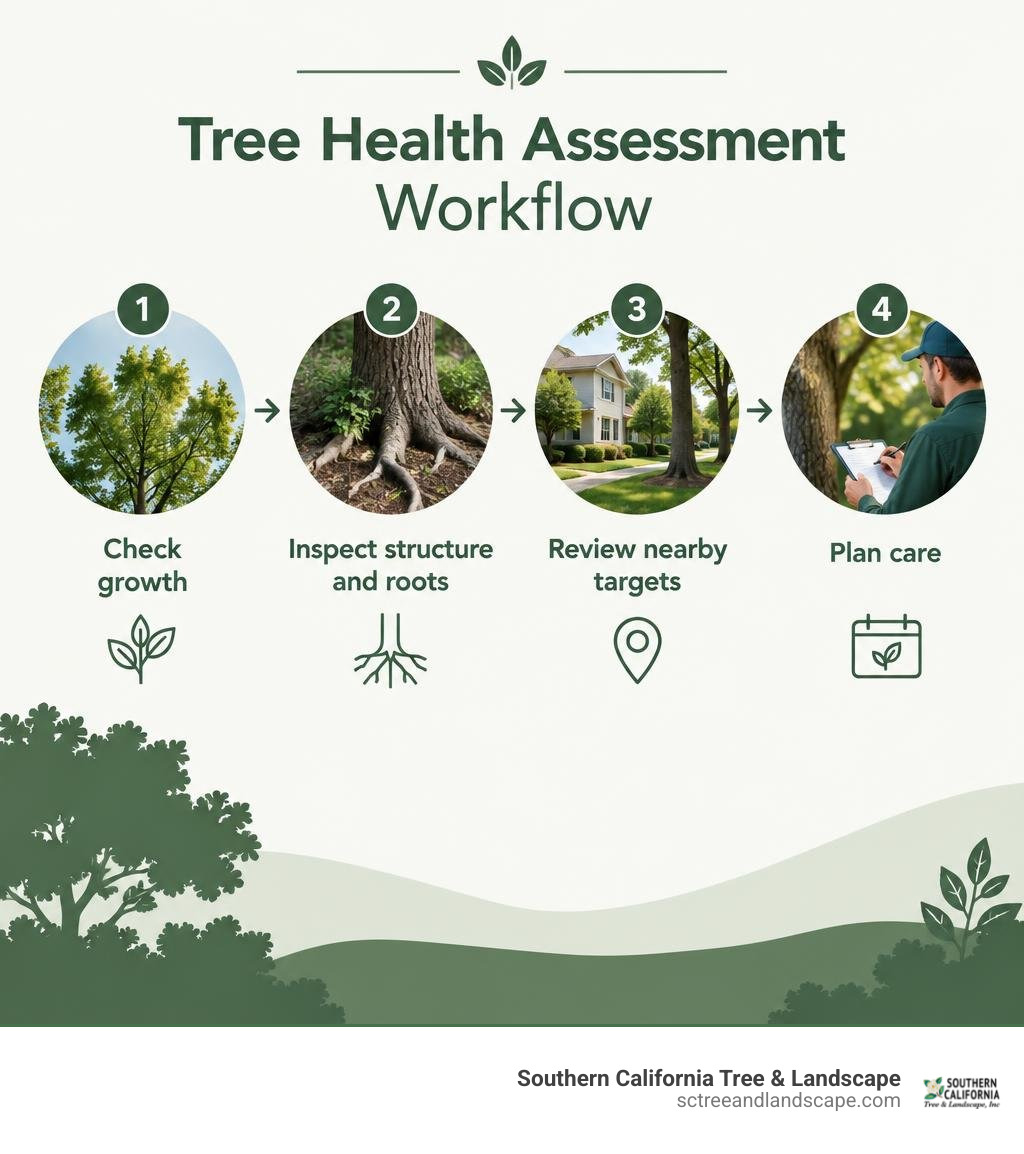
A tree health assessment checks two things: how well a tree is growing and whether its branches, trunk, and roots are structurally sound. Look for thinning leaves, dead branches, cracks, fungal growth, or soil lifting around the base. If you notice a major defect near a walkway, home, or parking area, keep people clear and ask a qualified arborist to inspect it.
The goal is not to make a tree risk-free. It is to decide what needs attention, what can be monitored, and what is best left alone while preserving the shade and other benefits the tree provides.
I’m Troy Basmajian, president of Southern California Tree & Landscape. Over the past decade, I’ve helped oversee tree care for properties across Southern California, where a tree health assessment can guide practical decisions about safety and long-term care.
Learn more about tree health assessment:
Understanding Tree Health Assessments: Purpose, Scope, and Value
A mature canopy adds tremendous aesthetic beauty, cools surrounding hardscapes, and provides critical shade across our neighborhoods in Torrance, South Bay, Covina, and Harbor City. However, large canopy specimens are dynamic living systems. Without regular diagnostic checks, subtle physiological decline or internal decay can remain completely unnoticed until severe winds strike.
Professional tree health evaluations provide property managers and homeowners with an evidence-based roadmap. Rather than relying on guesswork, comprehensive diagnostic protocols balance ecosystem value against potential property liability. Investing in dedicated tree services ensures your living assets remain thriving, resilient, and safe for years to come.
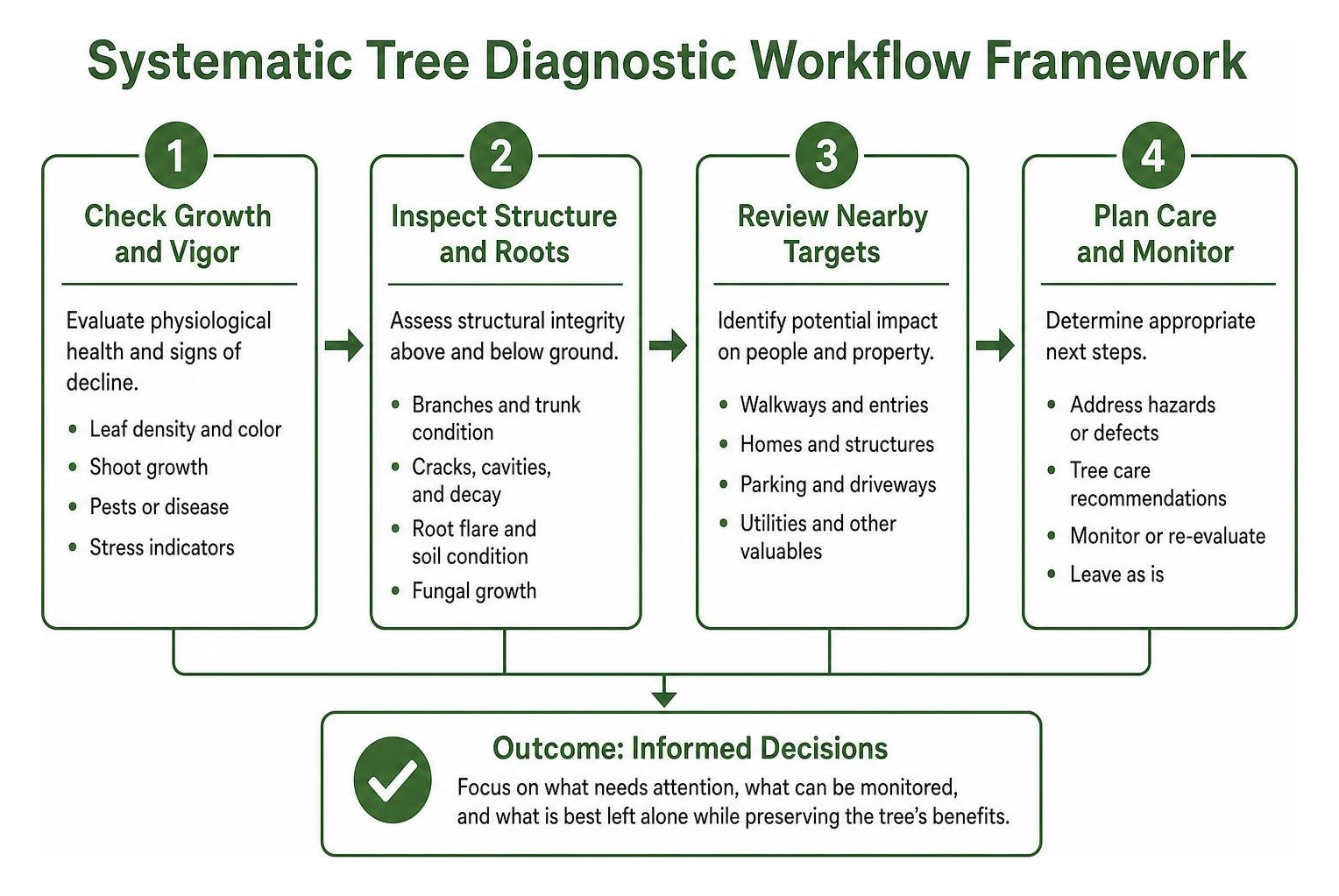
Core Objectives of a Systematic Tree Health Assessment
The central purpose of evaluating an amenity tree is to evaluate its internal biomechanical integrity alongside its physiological vitality. A proper assessment does not aim to eliminate all risk—zero risk in urban forestry is physically impossible, as living biological structures naturally flex and change over time. Instead, the process identifies actionable hazards while maximizing the ecological and financial value that mature canopies offer.
Following established European arboricultural assessment standards, modern arborists evaluate whether the specimen is safely fulfilling its functional role. This requires checking whether wood decay has compromised structural stability, diagnosing contagious pathogens early, and tailoring recommendations to the tree’s specific life-cycle stage.
How Assessments Differ from Tree Inventories and Worksite Inspections
Property owners often confuse a health assessment with an inventory or a routine worksite safety check. Each serves a very distinct function:
- Tree Inventory: A broad cataloging effort that records baseline metrics across a property, such as genus, species, trunk diameter at breast height (DBH), GPS location, and general life stage.
- Worksite Inspection: A localized safety screening conducted before construction or maintenance to ensure machinery clearance, utility line safety, and worker protection.
- Tree Health Assessment: A deep physiological and structural diagnosis that evaluates tissue vitality, internal wood soundness, root plate stability, and site-specific risk factors.
For long-term asset management, scheduling a detailed certified arborist tree inspection provides actionable diagnostic insights that go far beyond basic trunk measurements and species identification tags.
Evaluating Tree Vitality: Physiological Condition and Site Dynamics
Evaluating the living engine of a tree requires understanding how water, nutrients, and sunlight interact within its vascular system. When assessing vitality, an arborist looks closely at active metabolic symptoms across the foliage, fine twigs, and bark tissue.
Foliage and Crown Vitality Indicators
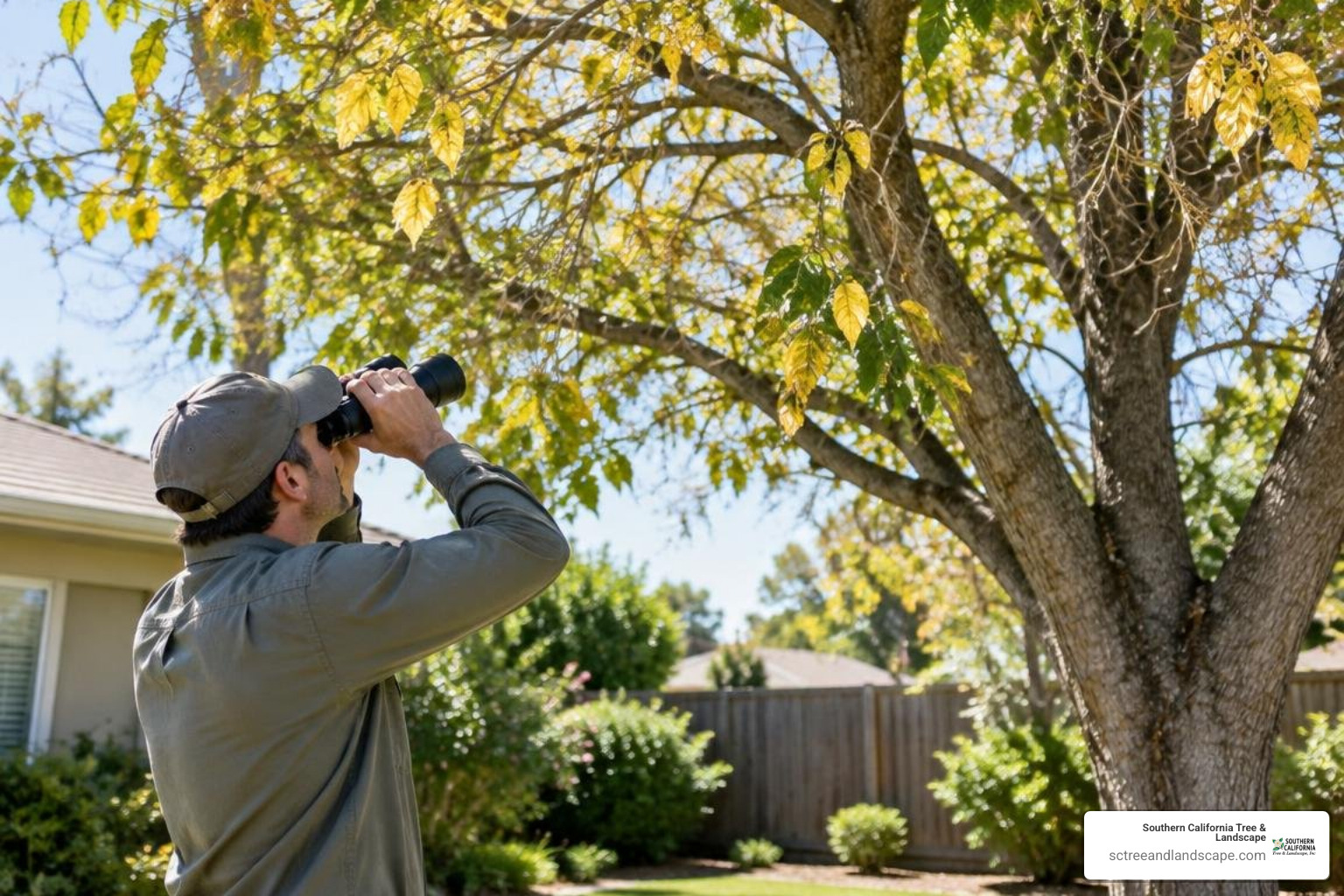
Canopy symptoms often provide the earliest visual warning signs of root dysfunction or vascular infection. Key indicators include:
- Chlorosis Patterns: Uniform pale yellowing across the leaf surface may point to severe nitrogen shortages or root loss. Distinct interveinal chlorosis (yellow tissue with dark green veins) commonly signals iron or manganese deficiencies caused by high-pH soils.
- Crown Dieback & Thinning: Premature leaf drop, sparse foliage clusters, or dying branch tips at the top of the canopy indicate that the tree is struggling to pump water to its highest extremities.
- Epicormic Sprouting: A sudden explosion of small, weak shoots emerging directly along the main trunk or primary scaffolds is a stress response—the tree is desperately attempting to generate energy following severe canopy loss or root decline.
Promptly identifying and treating tree pests and diagnosing common tree diseases prevents secondary invaders like borers from overwhelming weakened specimens. For complex cases, referencing established extension diagnostic guidelines helps differentiate between normal seasonal changes and true systemic decline.
Soil, Root Zone, and Environmental Stress Factors
Over 50% of abiotic tree mortality originates directly within the root zone. Even the healthiest specimen cannot thrive if its subterranean foundation is starved of oxygen or mechanically damaged.
Key subterranean stress factors include:
- Soil Compaction: Heavy foot traffic, vehicles, or construction equipment compress soil pores, suffocating root tips and blocking moisture infiltration.
- Stem-Girdling Roots: Roots that wrap tightly around the base of the trunk act like a tightening belt, slowly strangling vascular transport tissue and creating weak shear planes.
- Mulch Volcanoes: Piling organic mulch directly against the root flare traps moisture, rots the bark, and invites fungal pathogens into the lower trunk. Mulch should always be pulled back several inches from the root collar.
- Grade Changes & Drainage Impairment: Adding fill dirt over an existing root plate cuts off essential oxygen exchange, while poor landscape runoff leads to chronic waterlogging and root rot.
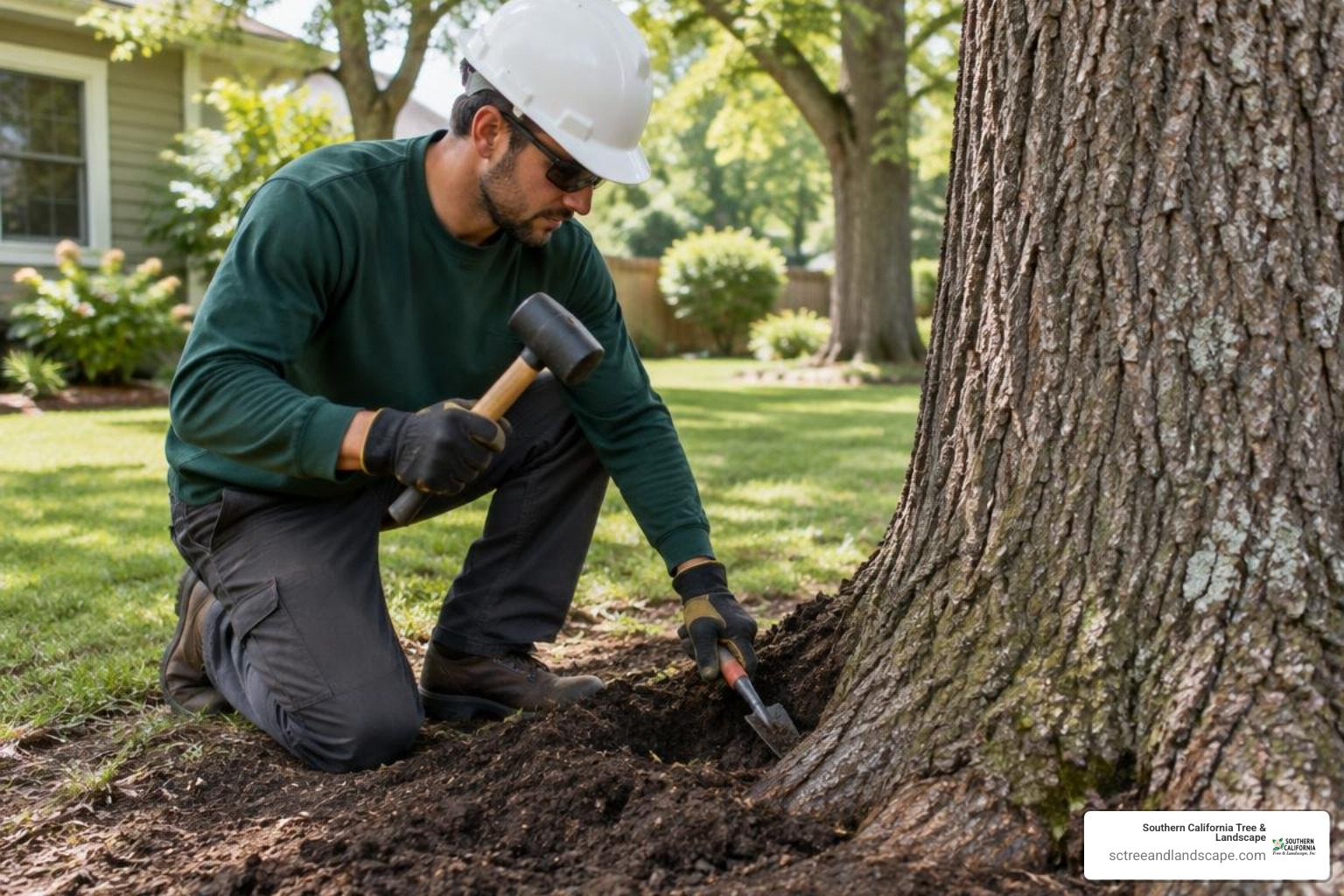
Field diagnostic methods, such as those detailed in university guidance on tree evaluation, utilize soil probes and hand trowels to check subsurface moisture and root health before recommending corrective action.
Assessing Structural Stability and Mechanical Integrity
While physiological vigor determines how well a tree grows, mechanical integrity determines whether it can safely support its own weight during heavy storms and coastal wind gusts.
Trunk, Bark, and Root Plate Stability
Evaluating the mechanical frame involves a systematic inspection from the root flare up into the primary branch attachments:
- Root Plate Architecture: The structural root plate serves as the anchor point. Using species-specific multipliers, an arborist estimates whether the critical root radius is intact or compromised by past trenching.
- Acoustic Mallet Sounding: Striking the trunk base with a rubber mallet produces distinct acoustic feedback. A crisp, sharp rebound indicates dense, healthy wood, whereas a dull, hollow thud warns of internal decay pockets.
- Cracks and Seams: Deep, longitudinal cracks that penetrate through the bark into the inner wood—especially those with companion seams or oozing fluid—signal serious structural stress.
- Fungal Fruiting Bodies: Bracket fungi (conks) and mushrooms emerging along the root flare or lower trunk are visual indicators that wood-decay fungi are actively digesting cellulose and lignin.
Following the methodologies in peer-reviewed storm damage tree examination guides, arborists document these structural defects to calculate the overall likelihood of failure.
Target Analysis and Risk-to-Benefit Evaluation
A severe structural defect only constitutes a safety hazard if there is a target—people, vehicles, buildings, or active recreational areas—within the fall zone.
Assessors evaluate target occupancy rates:
- Constant Occupancy: A primary residence, bedroom window, or busy street.
- Intermittent Occupancy: Driveways, backyard patios, or secondary walkways.
- Rare Occupancy: Open garden beds or remote perimeter property lines.
If a defective limb hangs over a rarely visited flower bed, the overall risk rating remains low, allowing property owners to preserve the tree without costly emergency removals. Furthermore, consulting local tree preservation regulations helps ensure all risk-mitigation measures comply with municipal codes in cities like Torrance.
The Two-Tiered Tree Health Assessment Process: Basic vs. Advanced Diagnostics
Professional assessments follow a structured diagnostic progression. If a standard visual evaluation reveals severe symptoms or uncertainty, advanced instrument diagnostics provide internal data.
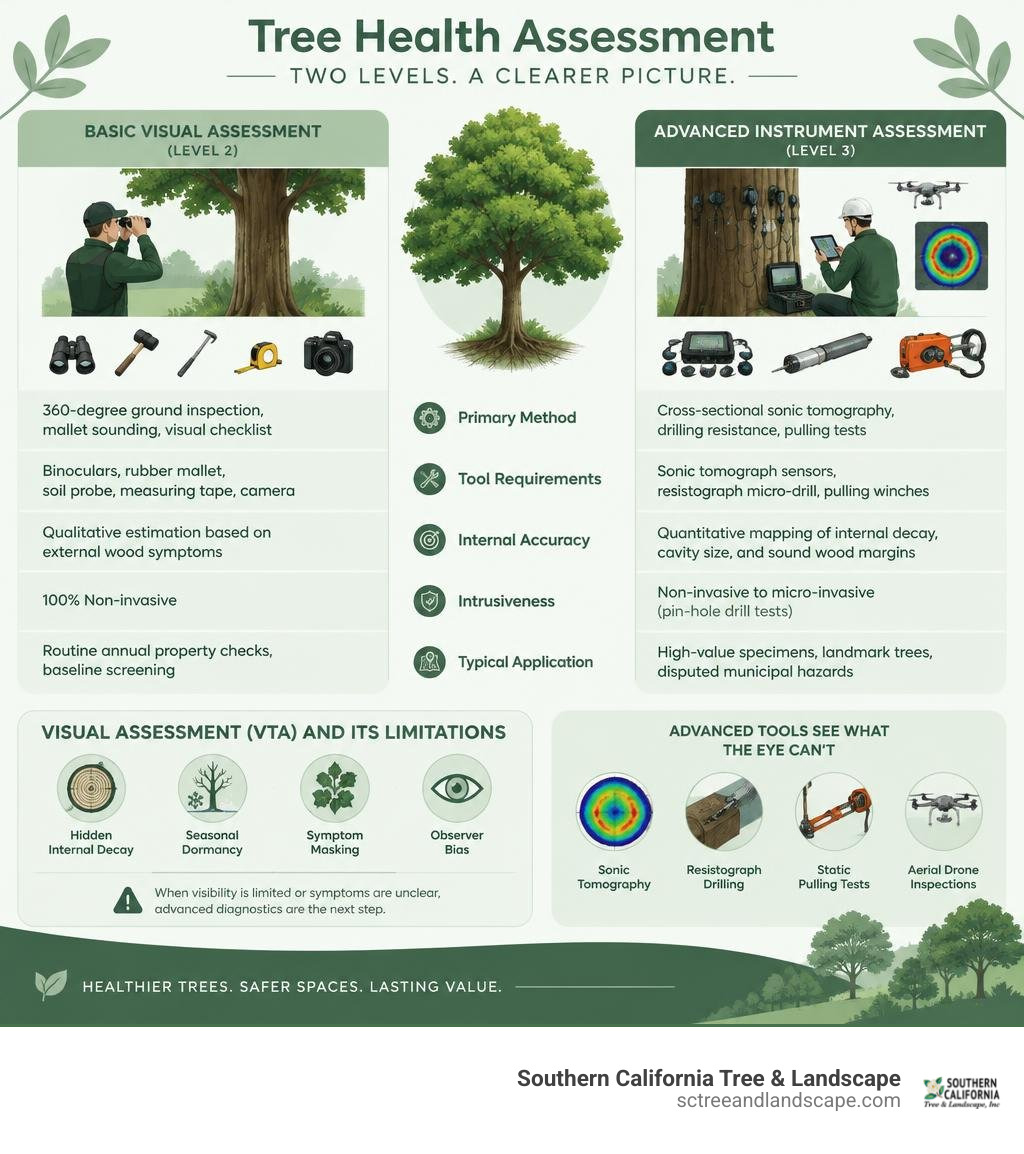
| Diagnostic Feature | Basic Visual Assessment (Level 2) | Advanced Instrument Assessment (Level 3) |
|---|---|---|
| Primary Method | 360-degree ground inspection, mallet sounding, visual checklist | Cross-sectional sonic tomography, drilling resistance, pulling tests |
| Tool Requirements | Binoculars, rubber mallet, soil probe, measuring tape, camera | Sonic tomograph sensors, resistograph micro-drill, pulling winches |
| Internal Accuracy | Qualitative estimation based on external wood symptoms | Quantitative mapping of internal decay, cavity size, and sound wood margins |
| Intrusiveness | 100% Non-invasive | Non-invasive to micro-invasive (pin-hole drill tests) |
| Typical Application | Routine annual property checks, baseline screening | High-value specimens, landmark trees, disputed municipal hazards |
Visual Tree Assessment (VTA) and Its Inherent Limitations
A basic Level 2 visual inspection is the global industry standard for everyday property management. The assessor walks 360 degrees around the tree, evaluating the crown, trunk, root flare, and surrounding site conditions.
However, visual assessments have clear limitations:
- Hidden Internal Decay: Thick outer sapwood can mask massive internal heartwood rot.
- Seasonal Dormancy: Assessing deciduous trees in mid-winter makes foliar symptom evaluation difficult.
- Symptom Masking: Dense climbing ivy or severe snow coverage can obstruct critical trunk cracks and fungal conks.
- Observer Bias: Qualitative evaluations rely on the inspector’s personal experience and judgment.
When environmental conditions obstruct clear visibility, or when a high-value tree exhibits ambiguous decay symptoms, advancing to Level 3 diagnostics is necessary.
Diagnostic Tools and Technology Used in Advanced Tree Health Assessment
Advanced diagnostic tools allow arborists to view inside a living trunk without causing structural damage:
- Sonic Tomography: Sensors placed around the trunk send sound waves through the wood. Sound travels rapidly through dense, healthy wood and slows down through decayed or hollow sections, generating a 2D color map of internal trunk condition.
- Resistograph Drilling: A micro-fine needle drills into the trunk at a constant speed, measuring mechanical resistance to detect internal cavities and soft rot pockets.
- Static Pulling Tests: Winches and strain sensors simulate wind loads to measure root plate tipping and trunk elasticity under dynamic force.
- Aerial Drone Inspections: High-resolution drone cameras assess upper canopy forks, weak branch attachments, and crown decay inaccessible from ground level.
Developing Actionable Management Plans and Mitigation Strategies
A professional diagnostic report should provide clear, prioritized guidance rather than vague warnings. Once field data is collected, the arborist develops a clear management plan tailored to your property’s goals.
Prioritizing Interventions: From Non-Intervention to Structural Pruning
Non-intervention must always be considered as the primary management baseline. If a tree exhibits minor defects with no nearby targets, the best and most cost-effective approach is regular monitoring.
When action is required, solutions are prioritized based on risk severity:
- Target Relocation: Moving patio furniture, swing sets, or parking areas outside the fall zone.
- Crown Maintenance: Executing targeted routine tree maintenance and canopy pruning to remove deadwood, reduce end-weight on overextended limbs, and improve canopy airflow.
- Supplemental Support Systems: Installing dynamic or static cabling and bracing systems to stabilize co-dominant trunks.
- Emergency Mitigation: Handling hazardous limb removal following high-wind events with dedicated storm damage tree service.
- Controlled Removal: When structural failure is imminent and cannot be mitigated safely, removal and stump grinding protect property boundaries.
Professional Qualifications, Biosecurity, and Ethical Standards
Tree assessment is a technical discipline requiring certified credentials and strict ethical standards:
- ISA Certified Arborist Credential: Ensures the assessor has documented field experience, passed rigorous testing, and adheres to continuing education requirements.
- Tree Risk Assessment Qualification (TRAQ): Standardized training in target analysis and probability-of-failure modeling.
- Biosecurity Protocols: Assessors must sanitize pruning saws, trowels, and soil probes between job sites to prevent spreading pathogens like Fusarium wilt across Southern California properties.
- Objective Reporting: Independent assessors evaluate trees objectively, avoiding bias toward unnecessary removals or expensive treatments.
Frequently Asked Questions About Tree Health Checks
How often should mature trees undergo a professional health inspection?
Large, mature canopy trees should undergo a comprehensive visual inspection at least once a year and immediately following major storm events. Regular annual inspections catch subtle changes in canopy density, soil heaving, or fungal growth before they turn into costly hazards.
What are the earliest visual symptoms of internal trunk decay?
The most reliable early indicators include fungal fruiting conks on the bark or root flare, sudden deadwood accumulation in the upper canopy, weeping bark wounds with dark fluid, vertical bark seams, and a hollow acoustic sound when sounded with a rubber mallet.
Can a tree survive severe root damage or soil compaction?
Yes, depending on the severity of the damage and the species’ vitality. If caught early, arborists can revitalize stressed root zones through radial trenching, vertical soil mulching, liquid aeration, and targeted organic amendments to encourage new fibrous root growth.
Conclusion
Protecting the mature trees across your landscape requires balancing physiological care with regular structural evaluations. By identifying hidden decay early, remedying compacted soil, and keeping canopies properly maintained, you protect both your property and the environmental benefits mature trees provide.
Our team at Southern California Tree & Landscape has served Torrance, South Bay, Covina, and Harbor City since 1991. As a family-owned company featuring ISA-certified arborists, experienced field crews, and rapid emergency response, we deliver thorough diagnostic evaluations and expert care. Whether you are addressing structural concerns or planning a comprehensive landscape update, explore our complete guide to backyard oasis design to see how healthy trees form the cornerstone of every beautiful property. Contact us today to schedule your comprehensive on-site tree evaluation.