
Why Douglas-Fir Bark Beetle Treatment Can’t Wait
Douglas-fir bark beetle treatment is one of the most urgent tree care challenges facing property owners and land managers across western North America — and Southern California is no exception.
Here’s a quick summary of the most effective treatment options:
| Treatment Method | Best For | Timing |
|---|---|---|
| MCH anti-aggregation pheromone capsules | Protecting high-value individual trees and stands | Before spring beetle flight (by mid-April) |
| Preventive pyrethroid bark sprays | High-value trees near homes, businesses, or recreation sites | Before beetles emerge when temps reach 60°F |
| Stand thinning | Reducing long-term outbreak risk across a property | Year-round, ideally before an outbreak begins |
| Sanitation logging / infested tree removal | Stopping spread from already-attacked trees | Before spring emergence (before April) |
| Solar treatment (clear plastic over cut logs) | Small stands where removal is impractical | After felling, during warm sunny weather |
| Trap trees | Drawing beetles away from standing trees | Felled before April, removed before winter |
The Douglas-fir beetle (Dendroctonus pseudotsugae) is the most destructive bark beetle affecting mature Douglas-fir forests in western North America. During outbreaks in western Oregon and Washington from 1950 through 1969 alone, these tiny insects — roughly the size of a grain of rice — killed an estimated 7.4 billion board feet of timber. More recently, around 14,000 acres of Douglas-fir forests were impacted in Colorado in a single year (2018), with 11,000 of those acres previously unaffected.
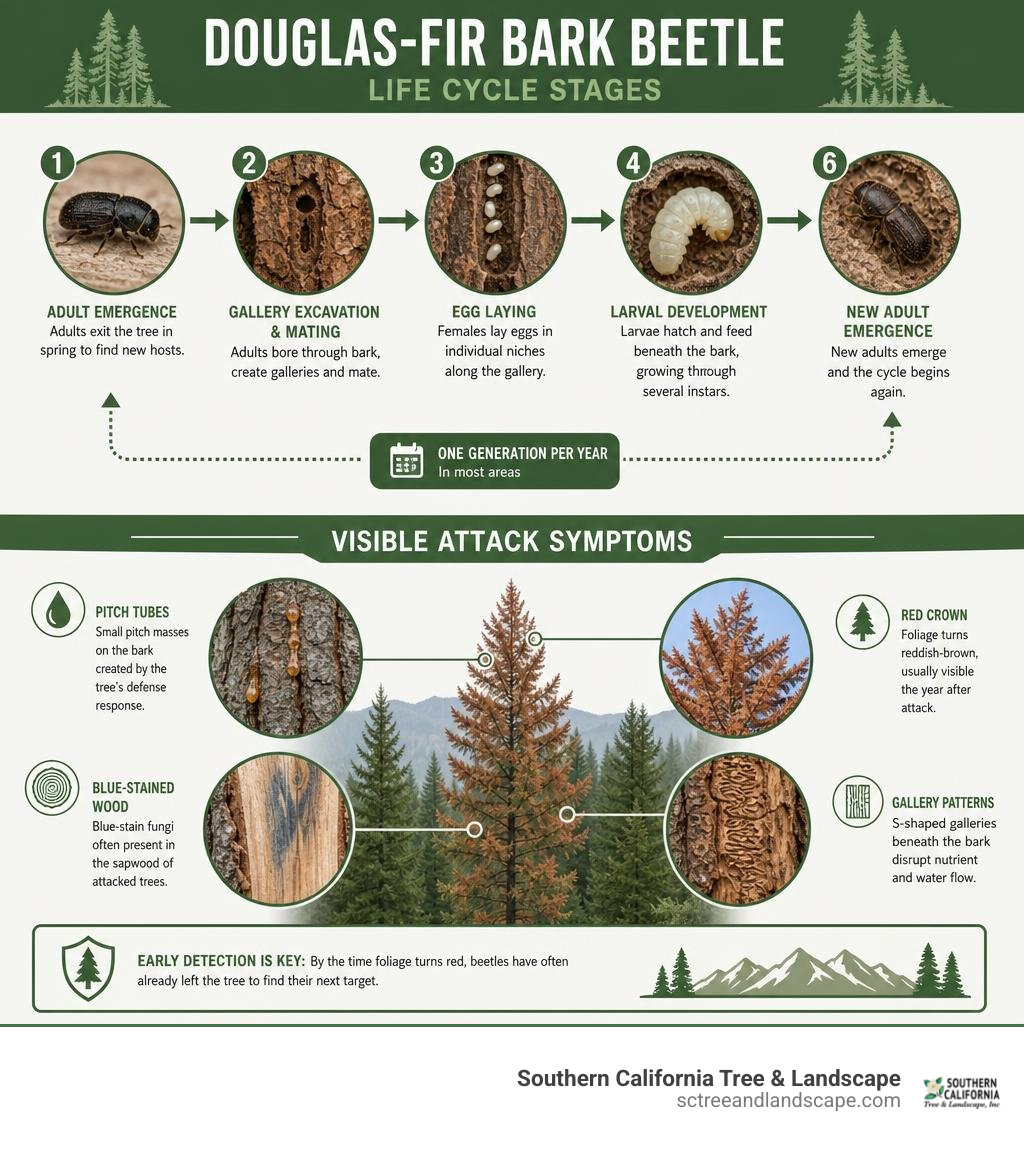
What makes this pest especially dangerous is its speed and stealth. By the time you see foliage turning reddish-brown, the beetles have often already left the tree — moving on to their next target. That one-year lag between attack and visible symptoms means outbreaks can quietly escalate before most property owners realize there’s a problem.
I’m Troy Basmajian, President of Southern California Tree & Landscape, and over the past decade leading our tree care team, I’ve seen how quickly an untreated beetle problem can escalate from a few dead trees to a widespread stand-level crisis. This guide pulls together the most current and effective douglas-fir bark beetle treatment strategies so you can act before your property pays the price.
Identifying Infestation Symptoms and High-Risk Stand Conditions
Early detection is the single most critical component of effective beetle management. Because adults complete their gallery construction and egg placement entirely beneath the bark, finding an active attack requires looking for physical cues left on the trunk long before the canopy shows signs of stress.
Property owners who regularly inspect their trees can reference helpful guides like A Guide to Managing Douglas-fir Beetles on Private Property to help distinguish native bark beetle activity from minor aesthetic insect damage.
Visual Symptoms: Frass, Pitch Streams, and Canopy Fade
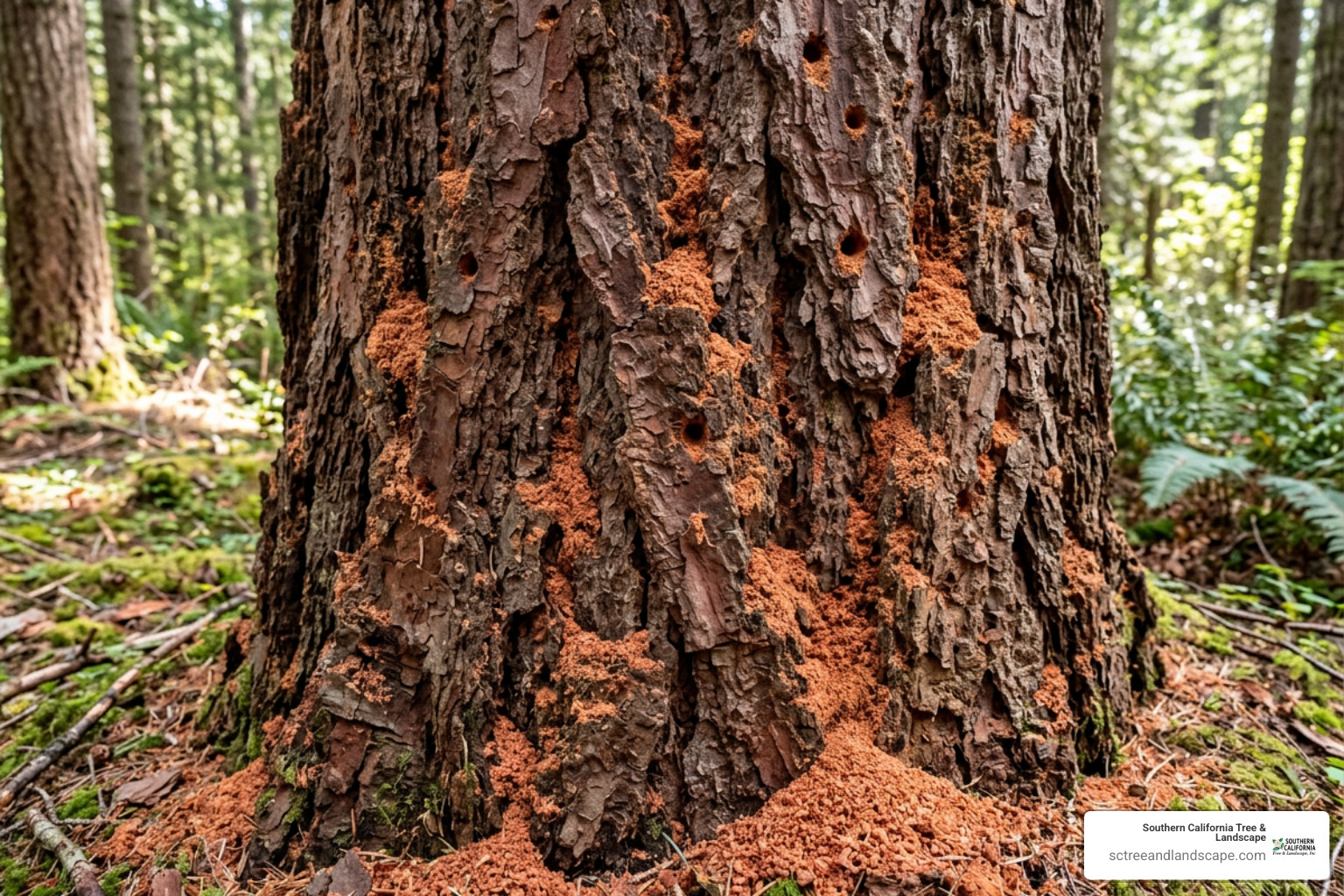
When an adult beetle bore through the thick outer bark of a Douglas-fir, it carves out an entry hole about the diameter of a pencil lead. As it burrows into the sugar-rich phloem layer, it pushes out fine particles of chewed bark and digested wood called frass.
- Reddish-Orange Frass: This fine, reddish-brown or orange dust collects in deep bark crevices, spider webs, and around the root collar at the base of the trunk. It is often the very first visible symptom of an active infestation in spring.
- Clear Resin or Pitch Streams: Host trees fight back against attacking insects through resin pressure. Stressed trees under attack often display long, clear resin streams higher up on the trunk—frequently between 30 and 35 feet off the ground—where beetles initiate colonization.
- Canopy Color Fade: Needle discoloration occurs roughly 8 to 12 months after the initial attack. The canopy fades progressively from healthy dark green to pale yellow, bright straw-orange, and eventually a uniform reddish-brown. By this point, the brood has usually completed development and departed.
- Woodpecker Damage and Exit Holes: Woodpeckers frequently flake off chunks of bark to feed on larvae inside, leaving bare patches on the upper trunk. Tiny, round exit holes scattered across the bark indicate where the new generation of adults has emerged.
For a deeper dive into pest dynamics across various urban and forest trees, check out our insights on Wood You Believe It Effective Treatments for Bark and Leaf Beetles.
Hazard Factors: Age, Diameter, and Storm Blowdown
Not all stands or individual trees face equal risk. Douglas-fir beetles demonstrate clear preferences for mature, overcrowded, or structurally compromised trees.
- Tree Size and Age: Trees with a trunk diameter at breast height (DBH) greater than 14 inches—and stands with an average age exceeding 120 years—are at the highest risk during widespread outbreaks.
- Stand Density: Overstocked stands with a basal area exceeding 250 square feet per acre experience intense root competition for water and nutrients, severely lowering natural resin production.
- Storm Blowdown and Damage: Severe winter storms, high winds, and snow breakage create prime breeding conditions. Wind-thrown or freshly downed Douglas-firs over 12 inches in diameter provide ideal, low-defense host tissue.
A standard rule of thumb in forest health management is that having more than 3 downed trees per acre (greater than 12 inches in diameter) creates a population reservoir where beetles can multiply rapidly. The following spring, emerging broods can easily overwhelm and kill 1 to 2 adjacent standing green trees per acre. Landowners concerned about recent weather impacts can review historical forestry guidelines in Microsoft Word – ODF Blowdon and Bark Beetles in Western Oregon.docx .
Comprehensive Douglas-Fir Bark Beetle Treatment Protocols
Managing beetle populations requires an integrated pest management (IPM) framework. Depending on whether your goal is protecting a single high-value landscape tree in Torrance or managing a larger wooded parcel in Southern California, combining cultural strategies with targeted biological or chemical treatments delivers the best success rate.

Detailed technical protocols documented in the RESEARCH LABORATORY TECHNICAL REPORT emphasize that timing and host vigor are the two factors that dictate whether an intervention succeeds or fails.
Timing Your Preventive Douglas-Fir Bark Beetle Treatment Before Spring Flight
Timing is everything when applying a douglas-fir bark beetle treatment. Adult beetles overwinter under the bark as mature adults or full-grown larvae. In spring, as soon as ambient air temperatures consistently cross the 60°F (16°C) threshold—typically between early April and mid-May depending on local microclimates—adults emerge and begin their flight search for new hosts.
- Pre-Flight Application Window: All preventive barrier sprays and anti-aggregation pheromones must be deployed before the spring flight begins. Applying treatments after beetles have penetrated the inner bark phloem will not reverse the damage or save the tree.
- Flight Duration: The primary flight window spans late spring through early summer (April to June), with peak attack activity occurring from June through August. Late summer flights usually account for less than 10% of total annual attacks.
To better understand how timing impacts overall tree health during disease and pest outbreaks, read The Secret to Curing Common Tree Diseases Fast.
Long-Term Preventative Douglas-Fir Bark Beetle Treatment Through Stand Thinning
While chemical barriers protect individual trees short-term, silvicultural thinning is the most effective long-term preventative douglas-fir bark beetle treatment for stands and wooded properties.
Thinning reduces competition for groundwater, soil nutrients, and sunlight, directly boosting tree health and boosting oleoresin synthesis. Resin pressure acts as the tree’s primary defense system; when beetles bore into the bark of a healthy, well-hydrated tree, a strong surge of sap “pitches out” the invading insects and seals the wound.
- Target Basal Area: Reduce stand stocking below 250 square feet of basal area per acre to lower susceptibility.
- Species Diversity: Promote mixed-species stands by favoring non-host conifers like pines or incense cedars where appropriate.
- Age Class Structure: Maintain age diversity across the property to avoid large, contiguous blocks of uniform, mature host trees.
For comprehensive guidelines on managing stand hazard ratings, consult the official guide on Douglas-fir Beetle Management.
Anti-Aggregation Pheromones and Chemical Spray Applications
When faced with an active regional outbreak, property owners have two main high-potency options for protecting high-value trees: semiochemical pheromone repellents and direct chemical trunk barrier sprays.
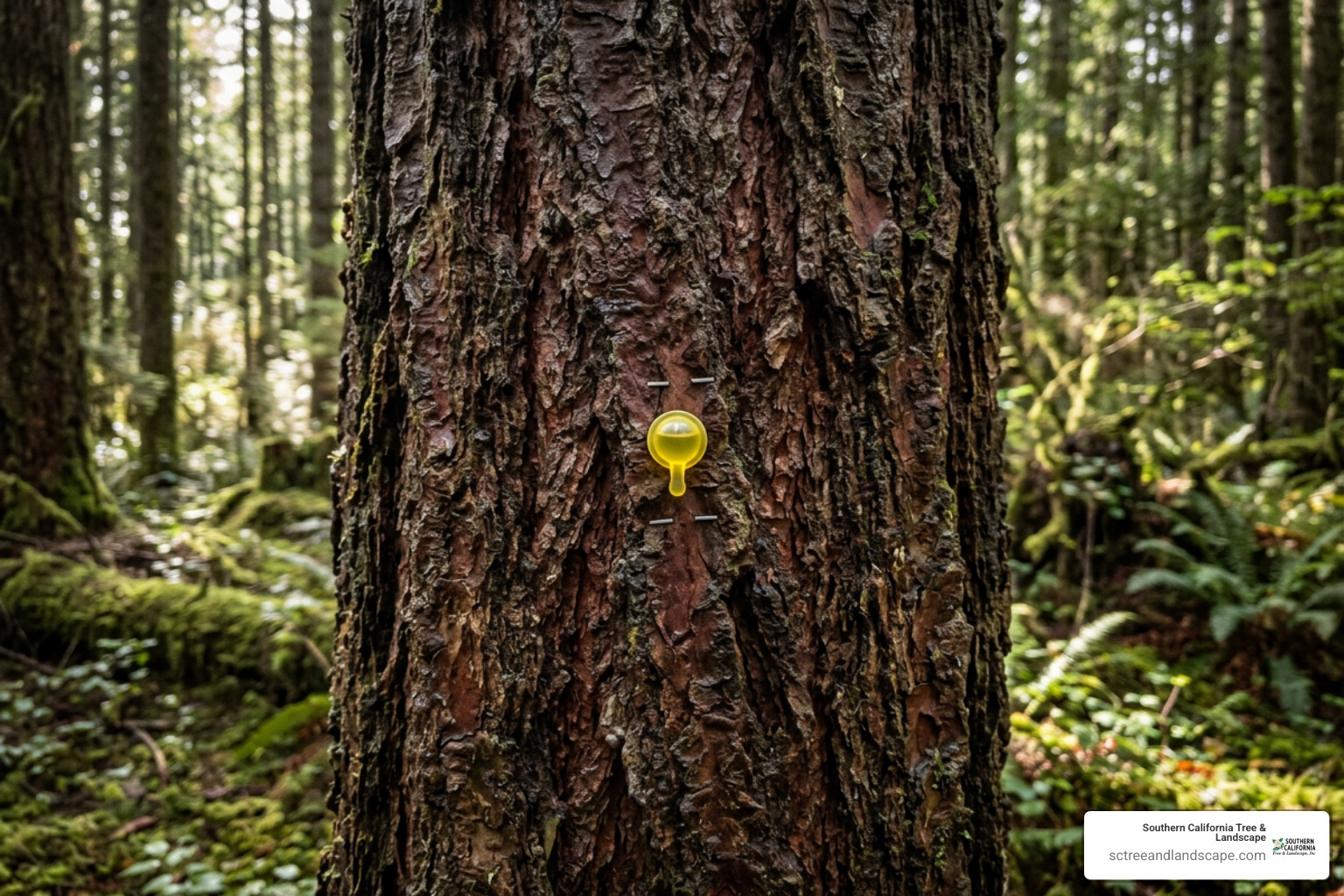
Federal research compiled by the Technology Enterprise Team confirms that anti-aggregation repellents provide an environmentally friendly, chemical-free line of defense for sensitive properties, campgrounds, and residential landscapes.
MCH Anti-Aggregation Repellents
When pioneer adult beetles colonize a tree, they emit aggregation pheromones (such as frontalin and seudenol) that call in thousands of additional beetles to overwhelm the tree’s defenses. Once the tree is fully occupied, male beetles produce an anti-aggregation pheromone called MCH (3-methylcyclohex-2-en-1-one). This chemical signal tells arriving beetles that the host is full (“no vacancy”), causing them to bypass the tree and fly elsewhere.
Synthetically produced MCH bubble capsules mimic this natural signal with outstanding results:
- Efficacy: Studies show MCH treatments can reduce successful attacks by over 90% on target trees during outbreaks.
- Application Rate (Acreage): For stand-level protection, deploy capsules at a standard rate of 30 capsules per acre attached in a uniform grid pattern (spaced roughly 40 feet apart) or along a perimeter boundary.
- Application Rate (Individual Trees): For individual high-value landscape trees, staple 2 bubble capsules on opposite sides of the trunk at a height of 6 to 12 feet. For large trees exceeding 24 inches DBH, apply 4 capsules spaced evenly around the circumference.
- Cost Efficiency: MCH bubble capsules cost approximately $2 to $3 per capsule, making complete area treatments around $80 to $100 per acre.
Property owners interested in integrating MCH repellents into their landscape care plan can review our guide on Tree Service Essential Care for Your Property’s Green Giants.
Chemical Trunk Sprays and Insecticide Formulations
For immediate, direct protection of specimen landscape trees, preventive high-pressure chemical trunk sprays create a toxic surface barrier that kills adult beetles before they can bore through the outer bark.
- Active Ingredients: Professional pyrethroid formulations containing Bifenthrin, Permethrin, or carbamate formulations like Carbaryl are EPA-registered for bark beetle control.
- Coverage Area: Sprays must coat the entire main stem from the root collar up to the lower branches (or as high as equipment can safely reach), thoroughly saturating bark crevices where beetles land.
- Important Limitations: Chemical barrier sprays are strictly preventive. They cannot kill larvae already feeding under the bark, and they must be reapplied annually prior to spring flight.
Sanitation, Trap Trees, Solarization, and Natural Controls
When beetle populations climb, physical controls, sanitation routines, and natural biological predators help keep numbers in check without relying solely on synthetic chemicals.
| Control Strategy | Actionable Mechanism | Key Implementation Rule |
|---|---|---|
| Sanitation Logging | Removes infested wood containing active broods | Fell and haul wood away before April flight |
| MCH Pheromones | Emits anti-aggregation “no vacancy” scent signal | Deploy 30 caps/acre or 2-4 per tree by mid-April |
| Chemical Sprays | Direct pyrethroid contact barrier on outer bark | Saturate trunk up to lower canopy before temps reach 60°F |
| Solarization | Thermal heat kills larvae and eggs inside logs | Cover stacked logs tightly with clear plastic in full sun |
| Trap Trees | Sacrificial fresh logs attract arriving spring adults | Fell before April in shade; process before winter |
Sanitation Logging and Removal Timing
Sanitation logging is the physical removal of infested trees and fresh storm debris before the new generation of adults can mature and spread.
- Removal Schedule: Trees under current attack must be cut, processed, or removed from the property prior to early April.
- Stump and Slash Management: Keep cut stumps as low as possible (under 30 cm / 12 inches) and peel the remaining bark above that line. All woody debris and slash greater than 8 inches (20 cm) in diameter should be chipped, burned under proper permits, or solarized.
Property owners looking for qualified professional assistance with delicate tree removals can explore The Homeowner Guide to Local Tree Service Companies and Arborists.
Solar Treatments, Trap Logs, and Natural Predators
For small residential or rural properties where heavy equipment cannot easily haul away logs, alternative physical and biological controls can manage beetle populations effectively:
- Solar Heat Treatment: Cut infested logs into manageable lengths, stack them in a clear location exposed to direct, full sunlight, and cover them completely with heavy, clear 4-to-6-mil plastic. Seal the edges with dirt to trap heat. Internal temperatures beneath the bark will quickly exceed lethal thresholds for larvae and pupae.
- Trap Trees: Trap trees are intentionally felled green trees (dropped in shaded locations in groups of 3 to 5 prior to April 1) used to draw emerging spring adults away from healthy standing trees. Because beetles prefer fresh blowdown, they concentrate their attacks on these logs. The trap logs must then be removed and processed before winter.
- Natural Predators: In balanced ecosystems, nature provides its own controls. Predatory clerid beetles (Thanasimus undatulus) and long-legged Medetera flies actively feed on adult bark beetles and larvae. Furthermore, parasitic wasps like Karpinskiella paratomicobia insert eggs into adult female beetles, reducing their reproductive egg output by up to two-thirds.
Frequently Asked Questions About Bark Beetle Management
What is the most effective time to apply MCH pheromone capsules?
MCH bubble capsules should be installed in early spring, ideally by the third week of April (or before ambient spring temperatures regularly top 60°F). Installing them before the spring beetle flight begins ensures arriving adults encounter the repellent signal immediately when searching for host trees. Capsules remain active throughout the summer flight window.
Can an infested Douglas-fir tree be saved once larvae are inside?
Unfortunately, no. Once adult beetles successfully enter the inner bark phloem layer and deposit eggs, systemic insecticides and trunk barrier sprays cannot reach or save the tree. The combined action of larval gallery feeding and introduced blue-stain fungi interrupts the tree’s vascular system. Management efforts must pivot to removing the tree to protect surrounding timber.
How do natural controls help suppress bark beetle populations?
Natural predators—including predatory clerid beetles, Medetera flies, parasitic wasps, and woodpeckers—play a major role in collapsing beetle outbreaks over a 2-to-4-year cycle. Additionally, strong resin flow from healthy, well-hydrated trees acts as a natural mechanical barrier that can physically trap and push invading beetles out of entry holes.
Conclusion
Managing a bark beetle outbreak requires a quick, organized approach. By monitoring your property for early symptoms like reddish-orange frass and resin streams, maintaining proper stand density, and applying targeted MCH pheromone capsules or chemical barriers before the spring flight, you can safeguard your trees against this destructive pest.
Whether you need a hazard evaluation for mature conifers, professional stand thinning, or precise preventive bark treatments across Torrance, South Bay, Covina, or Harbor City, our ISA-certified arborists at Southern California Tree & Landscape are ready to assist. Learn more about our team by visiting South Bay’s Best Tree Doctors Certified Arborists in Torrance and Beyond or request an evaluation through our Our Services: Tree Service page today.