
Why Covina Landscape Drainage Repair Can’t Wait
Covina landscape drainage repair is one of the most urgent — and most overlooked — maintenance issues facing local homeowners and property managers. If water is pooling in your yard, washing out mulch, or creeping toward your foundation after a rainstorm, you likely have a drainage problem that needs professional attention soon.
Here’s what you need to know at a glance:
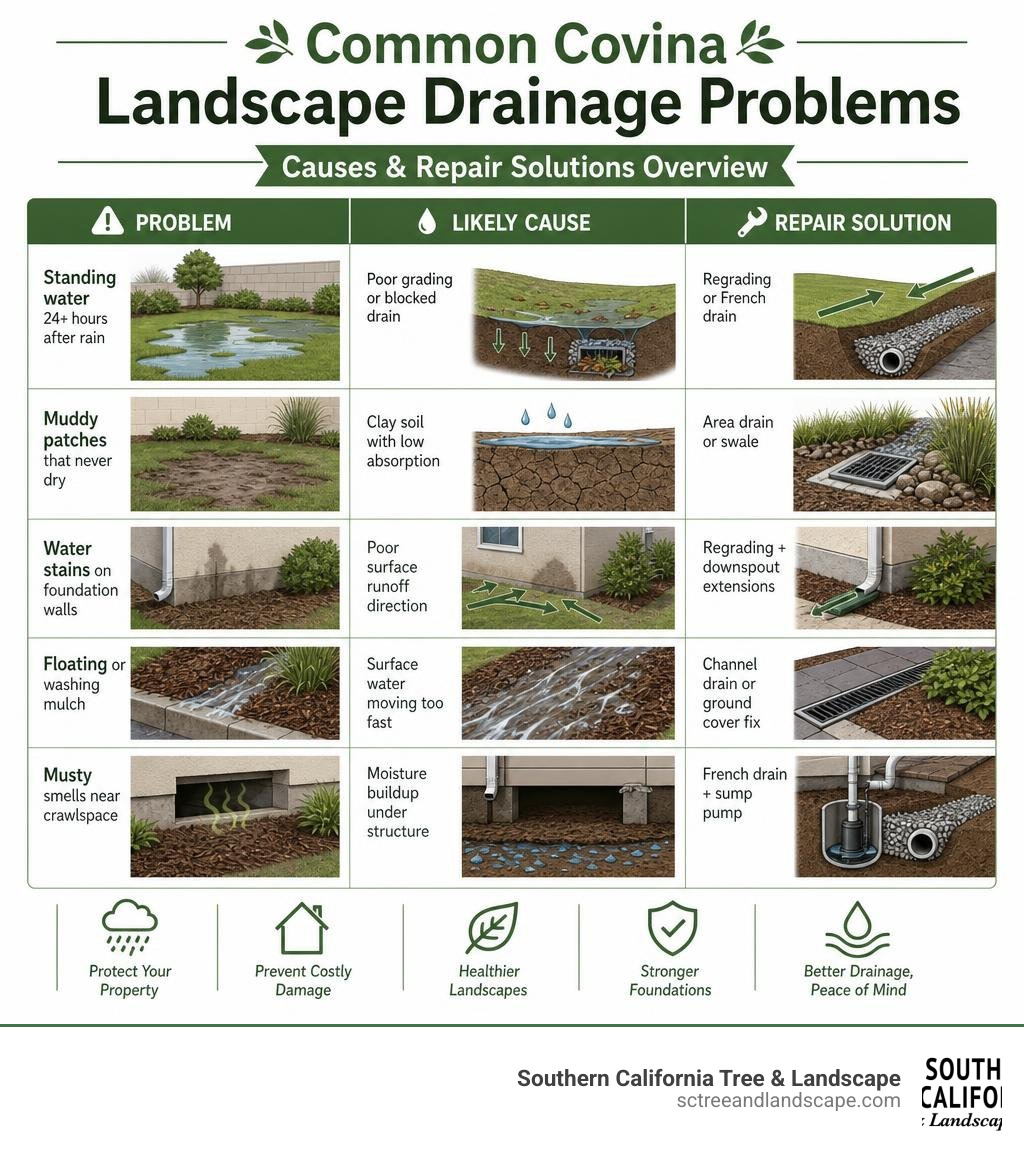
| Problem Sign | Likely Cause | Typical Solution |
|---|---|---|
| Standing water 24+ hours after rain | Poor grading or blocked drain | Regrading or French drain |
| Muddy patches that never dry | Clay soil with low absorption | Area drain or swale |
| Water stains on foundation walls | Poor surface runoff direction | Regrading + downspout extensions |
| Floating or washing mulch | Surface water moving too fast | Channel drain or ground cover fix |
| Musty smells near crawlspace | Moisture buildup under structure | French drain + sump pump |
Covina sits in the San Gabriel Valley, where a tough combination of expansive clay soils, hard groundwater, and intense seasonal rain events creates drainage challenges that are different from other parts of Southern California. When the rains hit — and in recent years they’ve hit hard — properties without properly engineered drainage systems can suffer serious damage to foundations, hardscaping, and landscaping fast.
The good news: with the right drainage solution, these problems are fully fixable.
I’m Troy Basmajian, President of Southern California Tree & Landscape, and over the past decade I’ve led our team in delivering landscape drainage repair and irrigation solutions to residential and commercial properties across Southern California, including many clients dealing with the specific soil and climate challenges Covina presents. In this guide, I’ll walk you through everything you need to know to protect your property.
Common Drainage Problems in Covina Landscapes
Covina landscapes face a unique set of environmental factors that conspire against proper water flow. From the geology beneath our feet to the way our neighborhoods were built in the post-war boom of the 1950s and 1960s, keeping water moving in the right direction requires constant vigilance.
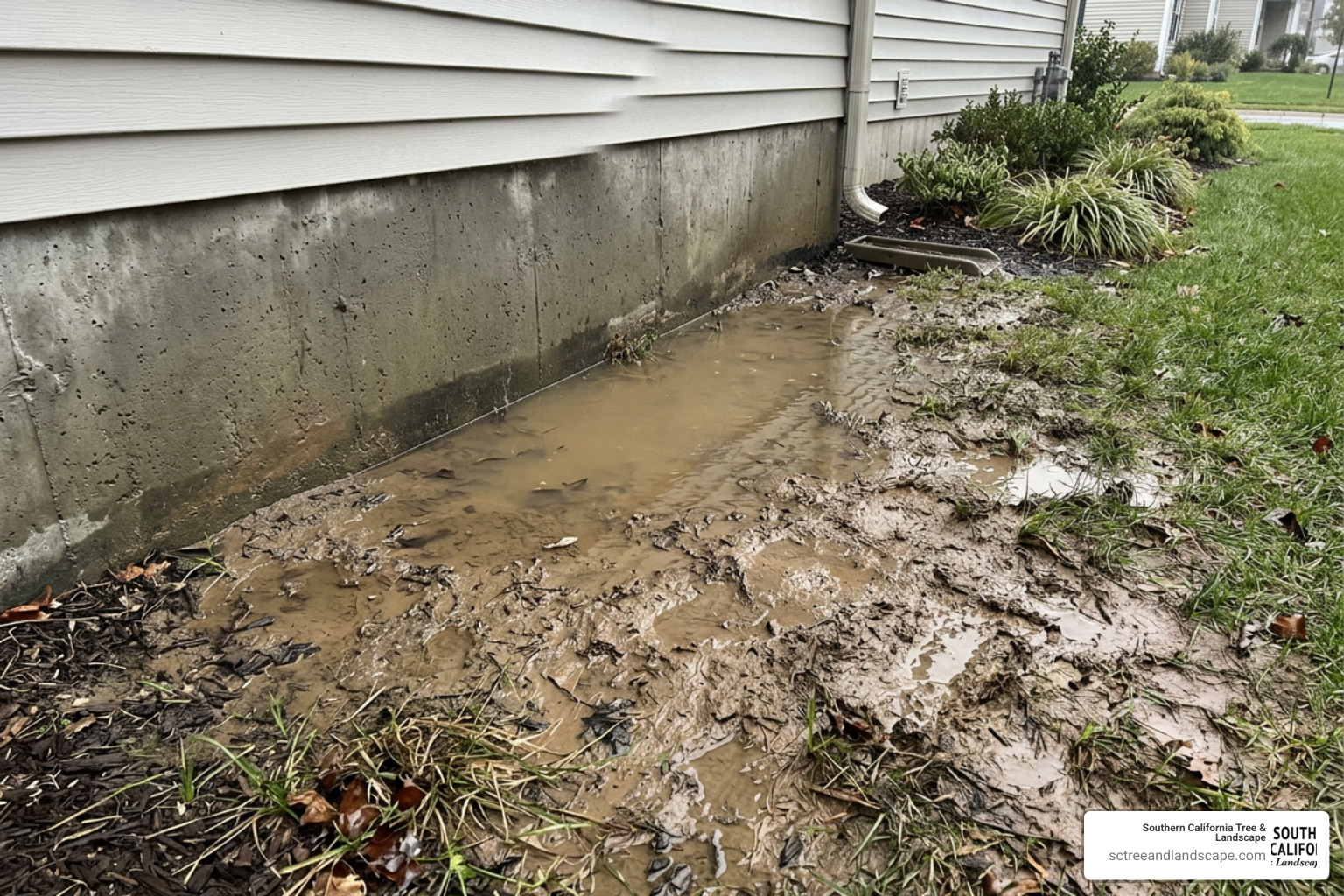
The primary culprit behind poor drainage in Covina is the local soil profile. Much of the San Gabriel Valley features heavy clay pockets and sandy loam. Clay soil acts like a sponge that swells when wet and shrinks when dry. When a heavy storm rolls in, this clay quickly becomes saturated, refusing to absorb any more water. Instead of sinking into the ground, stormwater sheets across your yard, looking for the lowest point. If your yard’s grading isn’t perfect, that lowest point is often right next to your home’s concrete slab or crawlspace.
Compounding this soil issue is the region’s hard water. Drawn from the Main San Gabriel Basin, our local water carries a high mineral content—typically between 16 and 18 grains of hardness per gallon. Over years of heavy irrigation, these minerals can deposit scale inside underground drainage pipes, narrowing the passage and making them highly susceptible to clogs from dirt, leaves, and root intrusion.
Finally, we cannot ignore the physical movement of the earth. The San Gabriel Valley is seismically active. Minor ground shifts and tremors can easily misalign underground PVC pipe joints, crack older clay or cast-iron lines, and create small gaps where tree roots can easily enter to seek out moisture. Once a pipe joint is compromised, soil washes into the line, creating an underground dam that causes water to back up into your yard.
Signs You Need Covina Landscape Drainage Repair
How do you know if your property is suffering from a minor puddle or a major drainage failure? Some signs are obvious, while others require a bit of detective work.
- Standing Water: If puddles linger in your lawn or flower beds for more than 24 hours after a heavy rain or a routine irrigation cycle, your soil is either severely compacted or your drainage system is failing.
- Foundation Cracks and Stem Wall Staining: Look closely at the concrete foundation of your home. If you notice dark water stains, white powdery mineral deposits (efflorescence), or widening cracks, water is pooling against the concrete and exerting hydrostatic pressure.
- Musty Smells and Mold: Damp crawlspaces and basements are breeding grounds for mold, which can begin colonizing within 24 to 48 hours of sustained moisture exposure. If you notice a musty odor inside your home, check the exterior perimeter immediately.
- Soil Erosion and Floating Mulch: If every rainstorm washes your expensive mulch onto the driveway or carves mini-canyons through your flower beds, you have uncontrolled surface runoff.
- Soggy Turf Near Sprinklers: Sometimes, drainage issues are actually hidden irrigation leaks. If you notice isolated muddy patches even during dry summer months, you may need to Stop the Leak and Save Your Garden with Easy Drip Repair to prevent soil saturation and subsequent foundation stress.
Effective Solutions for Covina Landscape Drainage Repair
Fixing a drainage issue is never a one-size-fits-all project. A successful repair requires diagnosing the root cause of the water accumulation and installing a system designed to handle the volume and flow path of your specific property.
To achieve this, a blend of surface collection and subsurface redirection is almost always required to keep Southern California soils stable. When designing these systems, protecting your home’s foundation must always be priority number one.
Here is a comparison of the most common professional drainage solutions we implement:
| Drainage Type | Best Used For | Key Components |
|---|---|---|
| French Drain | Subsurface water, soggy soil, foundation protection | Perforated pipe, washed gravel, geotextile fabric wrap |
| Area Drain | Surface water pooling in low spots of lawns or gardens | Catch basins, solid PVC pipe, decorative grates |
| Channel Drain | Sheet flow on hardscapes, driveways, patios | Long metal or plastic grates, shallow trench channels |
| Swale / Regrading | Redirecting large volumes of surface runoff naturally | Sloped land, river rock, deep-rooted ground cover |
French Drains and Area Drains
For subsurface water management, French drains are the gold standard. A French drain is essentially a trench filled with gravel and a perforated pipe that redirects water away from areas where you don’t want it (like your foundation) to a safe discharge point.
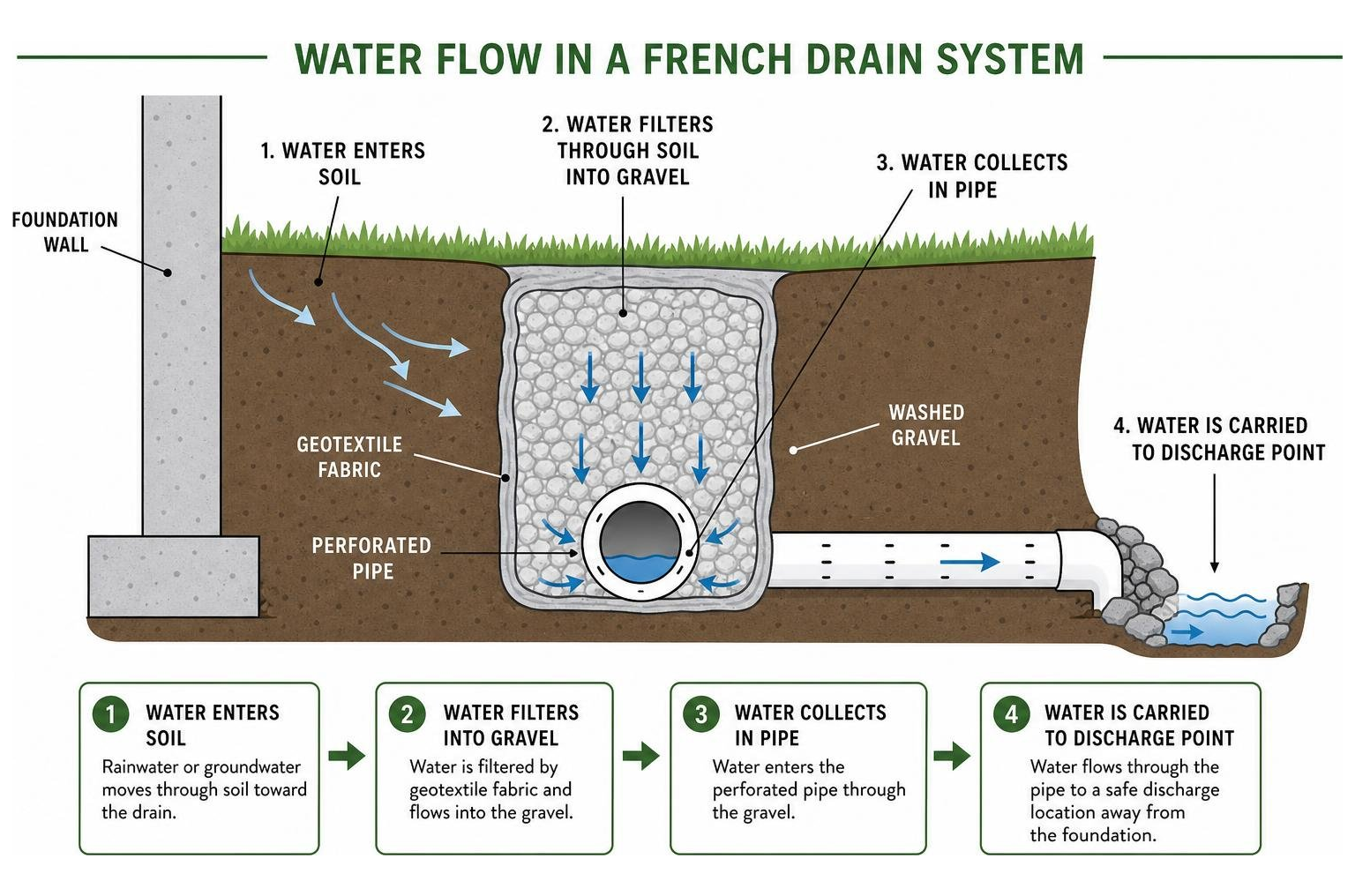
To build a French drain that lasts in Covina’s clay-heavy soils, we must follow strict engineering guidelines. First, the trench is lined with a high-quality, non-woven geotextile fabric. This fabric acts as a filter, allowing water to pass through while keeping fine clay particles from clogging the system. We then lay a perforated pipe (usually smooth-wall PVC, which handles root pressure much better than cheap corrugated pipe) on a bed of washed river stone. The pipe is covered with more stone, and the fabric is wrapped over the top before backfilling with soil or decorative rock.
Area drains, on the other hand, focus on surface water. These systems use square or round catch basins topped with grates, placed at the lowest points of your landscape. Solid PVC pipes connect these basins to direct water to the street, a dry well, or a municipal storm drain. In older Covina properties, these systems may feature outdated clay tiles that have collapsed under the weight of shifting soils. In these cases, we perform targeted tile drain replacement services to restore high-volume flow and prevent yard flooding.
Channel Drains and Driveway Culverts
Hardscapes require a different approach. Concrete patios, pool decks, and driveways cannot absorb water, leading to rapid runoff during sudden downpouts. If your driveway slopes toward your garage, a single heavy storm can result in thousands of dollars in water damage.
To solve this, we install channel drains (also known as trench drains). These are long, narrow grates embedded directly into the concrete or asphalt. They capture sheet flow across the entire width of the hardscape and carry it away through underground pipes.
For properties with open drainage ditches along the roadside, a driveway culvert is essential. The culvert is the pipe running beneath your driveway entrance that allows roadside water to flow uninterrupted. If your culvert is cracked, collapsed, or clogged with debris, water will back up and wash out your driveway. We provide professional culvert cleaning, installation, and repair to ensure your property remains accessible and storm-ready year-round.
How Covina’s Soil and Climate Impact Drainage Design
Designing a drainage system in Covina requires a deep understanding of our local microclimate and geology. We don’t get rain every day, but when we do, it often comes in heavy, concentrated bursts.

During our hot, dry summers, Covina’s clay soils dry out completely, cracking and shrinking. When winter storms arrive, these cracks initially swallow water, but the clay quickly swells shut, turning the ground into an impermeable barrier. This rapid transition from bone-dry to fully saturated puts immense stress on underground pipes. If a drainage system is built using cheap, thin-walled corrugated plastic, the shifting clay can easily crush or pinch the line, rendering it useless. That is why we only use heavy-duty, schedule 40 PVC pipes for our landscape drainage installations.
Furthermore, some older or more rural properties on the outskirts of Covina and West Covina still rely on septic systems. If your yard has poor drainage, standing surface water can saturate your septic absorption area, leading to system backups. When we design drainage systems near these zones, we coordinate carefully with septic specialists to ensure landscape runoff is routed safely away from your septic infrastructure.
Integrating Irrigation and Drainage Systems
You cannot talk about drainage without talking about irrigation. In Southern California, over-watering is one of the leading causes of artificial drainage problems. If your sprinklers are throwing out more water than your clay soil can absorb, you are creating a perpetual swamp in your own backyard.
We believe in a holistic approach to landscape management. By pairing smart irrigation technology with robust drainage systems, we can dramatically reduce water waste while keeping your soil stable. Modern smart controllers adjust your watering schedules based on real-time local weather data, ensuring you only water when necessary.
If you suspect your current irrigation setup is contributing to your yard’s drainage issues, we highly recommend exploring professional Irrigation Services: A Smart Solution for Your Landscape. Whether you need to retrofit your lawn with low-flow rotary nozzles or require a Rain Bird Rescue: Finding Certified Repair Experts Nearby to fix faulty valves, addressing these water sources is a crucial step in your overall drainage strategy. You can learn more about our comprehensive watering solutions on Our Services: Irrigation page.
Cost Factors and Choosing a Contractor in Covina
When planning a Covina landscape drainage repair project, understanding the financial investment is key. Because every property has different slopes, soil compaction levels, and accessibility challenges, pricing varies based on the scope of the work.
Here is a breakdown of typical costs and labor rates in the local landscaping industry:
- Labor Rates: Professional landscaping crews typically charge between $25 to $50 per person per hour. For a standard two-person crew performing excavation and pipe laying, expect labor costs of $50 to $100 per hour.
- Project Ranges: Small, localized drainage fixes (such as extending a few downspouts or clearing a minor clog) can cost between $200 and $600. Partial system installations or tile drain replacements generally range from $1,000 to $3,000.
- Full System Installations: Designing and installing a comprehensive, property-wide drainage network with multiple catch basins, French drains, and curb connections typically ranges from $4,000 to $8,000, with highly complex or large estate projects exceeding $10,000.
- Associated Landscaping Costs: Often, installing drains requires removing and replacing turf, plants, or hardscapes. A typical flower bed restoration averages between $800 and $3,000, while high-end additions like landscape lighting run from $2,000 to $6,000.
When hiring a contractor, it is vital to work with a licensed, insured professional who understands local municipal codes. In our area, some neighborhoods fall under a special Landscape Maintenance District , which governs public landscape areas, easements, and specific runoff regulations. Working with an experienced local contractor ensures your system remains fully compliant with city guidelines.
What to Expect in a Covina Landscape Drainage Repair Project
A professional drainage installation is a structured, engineering-focused process. Here is what you can expect when you partner with us:
- Site Assessment and Mapping: We begin by walking your property, using laser levels to map the slope, identifying low spots, and locating existing utility lines.
- Design and Permitting: We draft a custom drainage plan showing exactly where water will be collected, how it will travel, and where it will discharge. If your project requires connecting to a municipal storm drain or cutting into a curb, we handle all city permits.
- Excavation and Protection: Our crews carefully excavate the trenches. We take great care to protect your existing lawn, cutting turf in clean strips so it can be re-laid easily once the work is complete.
- Installation: We lay the geotextile fabric, place the pipes and basins, and secure all fittings with heavy-duty solvent cement.
- Backfilling and Testing: We fill the trenches with washed stone and soil, compacting it slightly to prevent future settling. Before we close up the system, we run water tests to ensure perfect gravity flow.
- Restoration: We restore your landscaping, replant any disturbed flower beds, and leave your yard clean, tidy, and ready for the next storm.
Frequently Asked Questions about Covina Drainage
How often should I maintain my landscape drainage system?
We recommend inspecting and maintaining your drainage system at least twice a year—once in the late fall before the winter rains arrive, and once in the spring to clear out any debris accumulated during storm season. Maintenance should include clearing leaves from catch basin grates, checking discharge outlets for blockages, and occasionally running a garden hose down the lines to ensure water flows freely.
Can poor drainage damage my home’s foundation?
Absolutely. When water pools next to your foundation, the surrounding clay soil swells, exerting immense hydrostatic pressure against the concrete walls. Over time, this pressure can cause foundation walls to crack, bow, or shift. Additionally, water can seep into crawlspaces, causing wood rot in floor joists and creating mold issues that compromise your home’s indoor air quality.
Do I need a permit for drainage repair in Covina?
For simple repairs, downspout extensions, or minor yard grading, a permit is generally not required. However, if your drainage project involves significant grading, installing a driveway culvert, or connecting a discharge line directly to a public street or municipal storm drain, you will need to obtain a permit from the Covina or West Covina Public Works Department.
Conclusion
A beautiful landscape is only as good as the infrastructure supporting it. Without a properly designed and maintained drainage system, Covina’s heavy clay soils and intense seasonal storms can quickly turn your dream yard into a costly, waterlogged nightmare.
At Southern California Tree & Landscape, we have been helping local homeowners protect their properties since 1991. As a family-owned business with an ISA-certified arborist on staff, highly experienced crews, and a rapid emergency response team, we understand exactly what it takes to design drainage systems that stand the test of time.
Don’t wait for the next winter storm to find out if your yard can handle the rain. Explore Our Services today and schedule your professional site assessment to keep your property dry, safe, and beautiful for years to come.