
Your Drip System Is Leaking — Here’s How to Fix It Fast
Drip irrigation repair is something every Southern California property owner will face sooner or later. The good news? Most fixes take less than 30 minutes with a few basic tools.
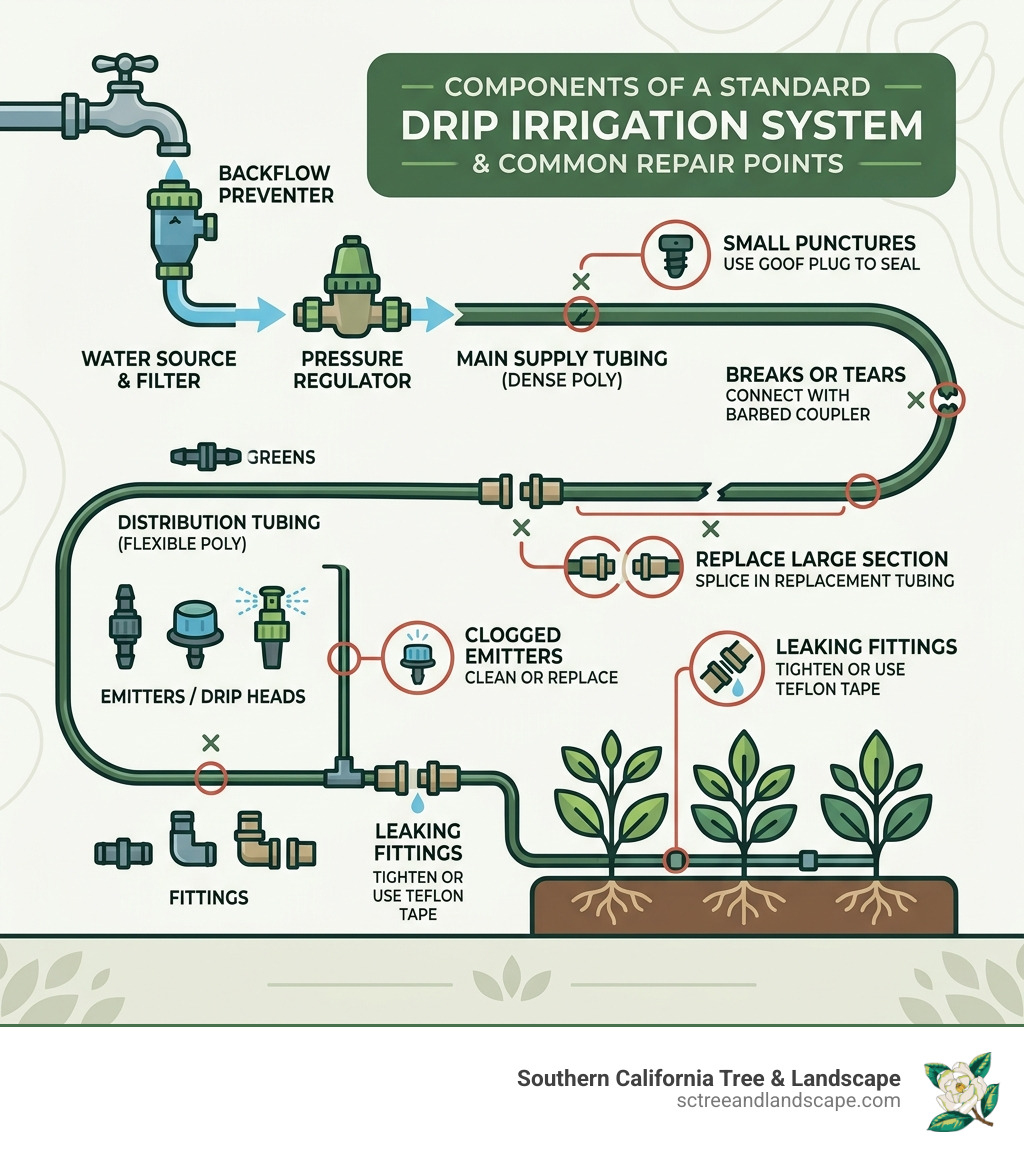
Quick answer — the most common drip irrigation repairs:
- Small holes or punctures — Push in a goof plug to seal the hole instantly
- Breaks or tears in tubing — Cut out the damaged section and connect with a barbed coupler
- Large damaged sections — Splice in a replacement piece of tubing using two couplers
- Clogged emitters — Remove, soak in water, clean with a brush, or replace
- Leaking fittings — Tighten connections, replace washers, or apply Teflon tape to threads
A small drip system leak might not look like much. But left unattended, even a slow drip wastes thousands of gallons of water — and in Southern California, that adds up fast on your water bill.
Drip systems run at just 15–25 psi, far gentler than standard sprinkler systems. That low pressure means the tubing is easy to work with — but it also means any break, clog, or loose fitting will quickly show up as soggy soil, struggling plants, or an unexpected geyser in your garden bed.
The most common culprits? A shovel that grazed the line, a dog that decided the tubing looked chewable, a lawn mower that got too close, or tubing that simply dried out and cracked after years of Southern California sun. Sound familiar?
The sections below walk you through every repair scenario — step by step.
Common Causes of Drip System Damage
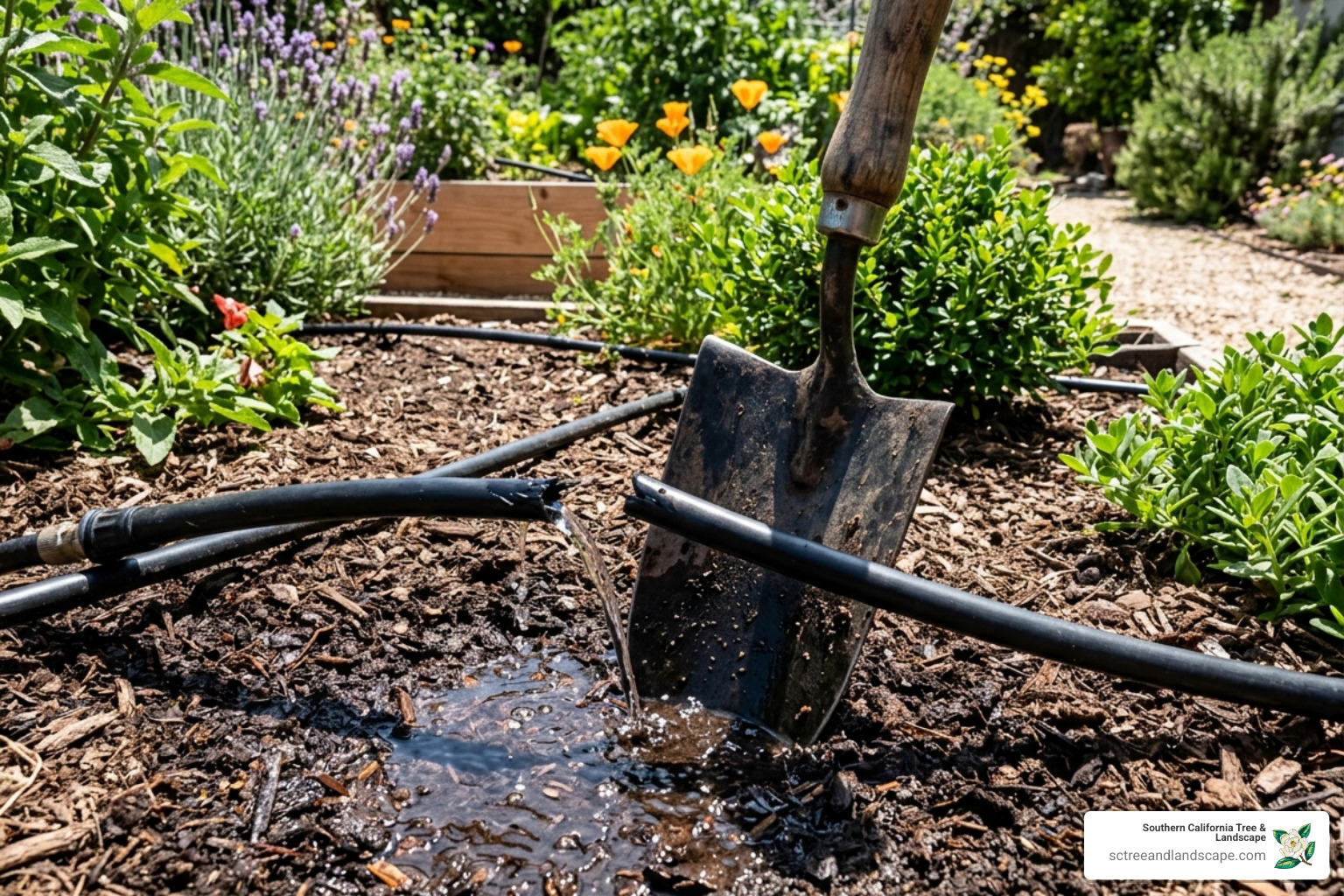
Drip irrigation tubing is surprisingly resilient. It can handle being stepped on and can withstand the fluctuating temperatures of a South Bay April. However, it isn’t bulletproof. Understanding what causes damage is the first step in drip irrigation repair.
- The “Errant Shovel” Incident: This is perhaps the most frequent cause of damage we see. You’re out in the garden in April 2026, adding some new spring color, and snap—your shovel slices right through a buried or mulched line.
- Wildlife and Pets: In Southern California, thirsty rodents, squirrels, and gophers often view your drip lines as a convenient straw. Even “man’s best friend” might occasionally use a surface line as a chew toy.
- Lawn Mower Accidents: If your tubing isn’t properly staked down or buried, the neighbor’s kid or a hired mower can easily snag a line, leading to a tangled mess and multiple breaks.
- UV Degradation: While modern poly tubing is treated for UV resistance, the intense Southern California sun eventually makes plastic brittle. Over several years, this leads to cracking and “pinhole” leaks.
- Mineral Buildup and Clogging: Our local water can be hard. Over time, calcium and magnesium deposits—along with occasional algae or fine silt—can block emitters.
- Pressure Spikes: Household water pressure typically sits between 50 and 80 psi. Drip systems are designed for 15–25 psi. If your pressure regulator fails, the high pressure can literally blow fittings apart or cause the tubing to split.
- Freezing Temperatures: While rare in coastal areas like Torrance or Harbor City, inland spots can experience frost. Water left in the lines can freeze, expand, and crack the plastic.
For a deeper dive into the mechanics of these failures, How to Repair a Drip Irrigation Line: Complete Step-by-Step Guide offers excellent insights into why these materials fail over time.
Essential Tools for Drip Irrigation Repair
Before you start digging, you need the right gear. We recommend keeping a dedicated “Drip Kit” in a portable bag so you aren’t running back and forth to the garage.
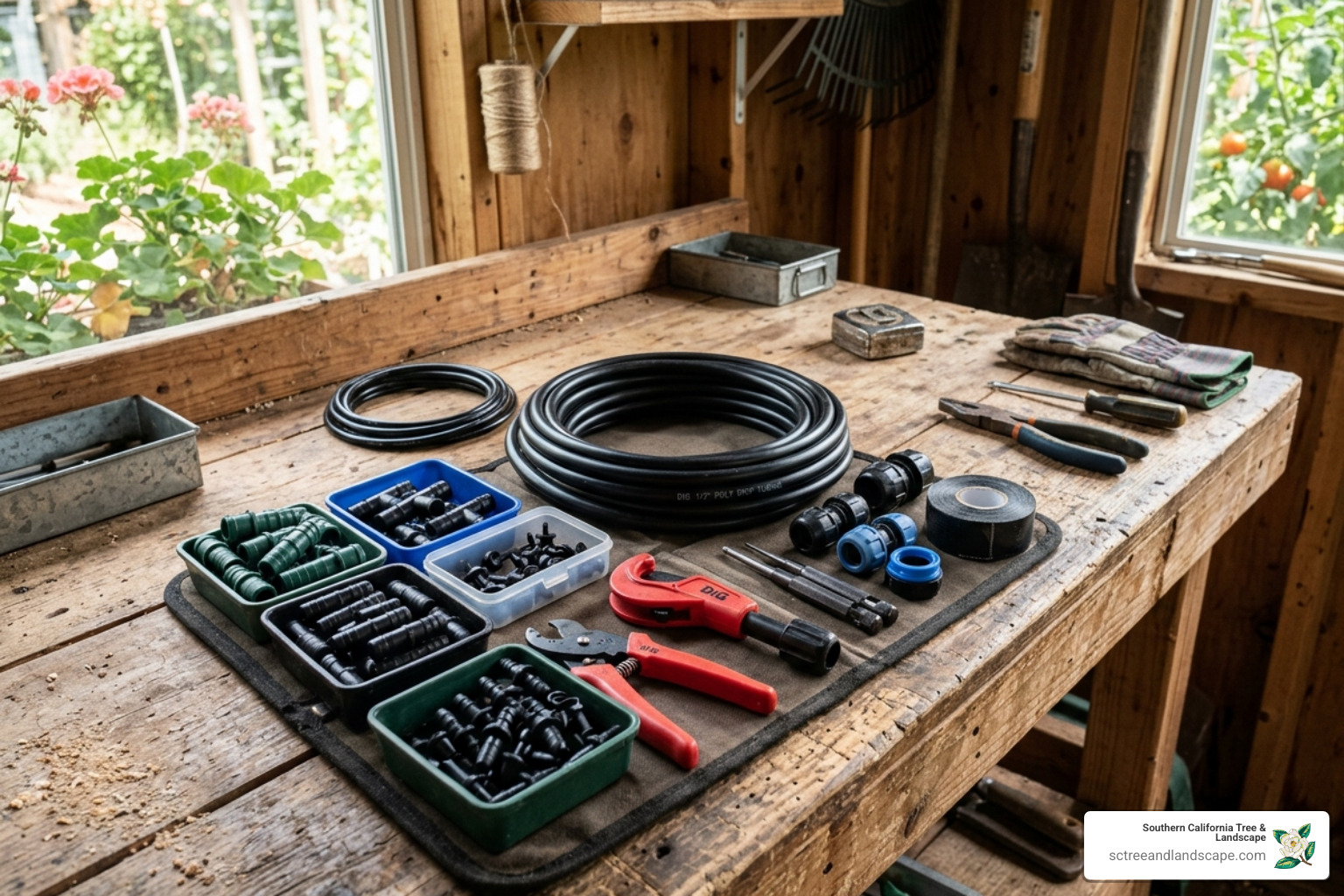
- Tubing Cutters: While scissors or a utility knife work in a pinch, a dedicated tubing cutter ensures a perfectly square, clean cut. This is vital for a leak-free seal with couplers.
- Goof Plugs: These are tiny, double-ended plastic plugs. They “fix your goofs”—like when you punch a hole for an emitter in the wrong spot or a rodent bites a tiny hole.
- Barbed Couplers (1/2″ and 1/4″): These are the bread and butter of drip irrigation repair. You push them into the tubing to join two pieces together.
- Compression Fittings: These are slightly more expensive than barbed fittings but are easier to install on older, stiffer tubing.
- Silicone Repair Tape: Not your average duct tape! This is self-fusing tape that creates a watertight seal under pressure.
- Spare Tubing: Keep a few feet of both 1/2″ main line and 1/4″ distribution tubing on hand.
- Emitter Punch Tool: Essential for inserting new emitters into the main line without causing unnecessary damage.
- Pressure Gauge: To ensure your system is operating within that “sweet spot” of 15–25 psi.
Having these tools ready is part of a smart landscape strategy. For more on managing your system’s health, check out Irrigation Services: A Smart Solution for Your Landscape.
Step-by-Step Guide to Fixing Leaks and Breaks
The first step in any repair is locating the damage. Turn the system on manually and walk the line. Look for:
- Soggy patches of mulch or soil.
- Water “geysering” or bubbling up.
- Plants that look wilted despite the system running (this often indicates a clog upstream).
- A “hissing” sound coming from under the ground.
Once found, shut off the water supply immediately to prevent further waste.
Drip Irrigation Repair for Small Holes
If you find a tiny puncture from a staple, a rodent, or a misplaced emitter, you don’t need to cut the line.
- Clean the area: Wipe away dirt so you can see the hole clearly.
- Select a Goof Plug: These have a smaller end and a larger end. Use the side that fits most snugly.
- The Snap: Push the barbed end of the plug into the hole until you feel or hear it “snap” into place.
- Relocating: If you were moving an emitter, simply plug the old hole and use your punch tool to create a new one at least 2 inches away.
Drip Irrigation Repair for Large Breaks
If a shovel has severed the line or a section is crushed, follow the “2-inch rule.”
- Assess the Gap: If the damaged area is less than 2 inches, you can usually use a single coupler. If it’s larger, you’ll need two couplers and a fresh “bridge” of tubing.
- Square Cuts: Use your tubing cutters to remove the damaged section. Ensure the ends are straight and clean.
- The Heat Trick: If the tubing is stiff (common with older lines), dip the ends in a thermos of hot water or use a hair dryer for a few seconds. This softens the plastic, making it much easier to slide onto the barbed coupler.
- Insert the Coupler: Push the tubing onto the barb until it hits the center stop. Repeat for the other side.
- Secure: For high-pressure zones, you might use a “locking” or “perma-loc” fitting which screws down over the tubing for extra security.
If you find yourself dealing with complex breaks or multiple zones that won’t hold pressure, our team can help. Explore Our Services: Irrigation for professional assistance.
Preventive Maintenance and System Optimization
Repairing a leak is great, but preventing the next one is better. Maintenance is the difference between a garden that thrives and one that merely survives the Covina heat.
Filtration and Pressure
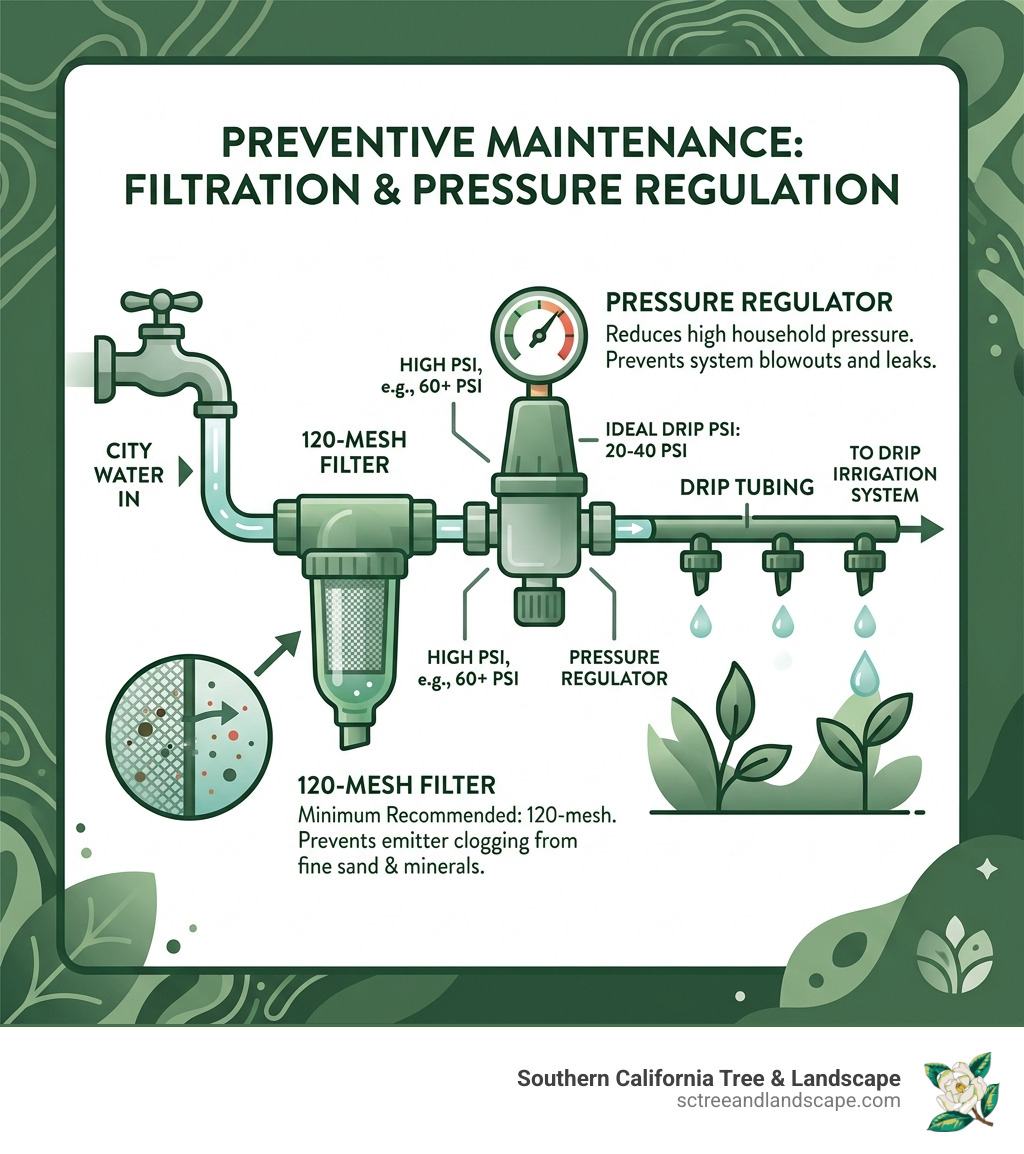
Clogging is the #1 enemy of drip systems. We recommend a minimum of 120-mesh filtration for standard emitters. If you are using drip tape, you may need up to 155-mesh. This keeps fine sand and minerals from reaching your emitters.
Equally important is the pressure regulator. Without it, the 60+ psi from your Torrance home’s spigot will eventually cause a “blowout.”
Flushing the System
At least twice a year—and always after a drip irrigation repair—you must flush the lines.
- Remove the end caps from your main lines.
- Turn the water on for 1–2 minutes.
- This pushes out any plastic shavings from your repair or accumulated silt.
- Replace the caps and check for even flow.
Winterization and Protection
In Southern California, “winterizing” isn’t about deep freezes, but about system health. Use a flush valve at the lowest point of your system to drain water when the system is off. This prevents algae growth and mineral settling.
To protect against UV and physical damage, always keep your tubing covered with 2–3 inches of mulch. This hides the “unsightly” black pipes and protects them from the sun and wandering shovels.
| Feature | Barbed Coupler | Compression Fitting | Repair Tape |
|---|---|---|---|
| Best Use | Permanent repair for 1/2″ poly | Stiff/old tubing repairs | Emergency/temporary bandage |
| Ease of Install | Moderate (requires strength) | Easy (push and lock) | Very Easy (wrap) |
| Pressure Rating | Up to 30 psi | Up to 50 psi | Variable (low) |
| Cost | Lowest | Moderate | High (per use) |
For a full list of how we can help keep your landscape in peak condition, visit Our Services.
Frequently Asked Questions about Drip Irrigation Repair
How do I clean or replace clogged emitters?
If a plant looks thirsty but the line is pressurized, you likely have a clogged emitter.
- The Vinegar Soak: Remove the emitter and soak it in a 50/50 mix of white vinegar and water for a few hours to dissolve mineral deposits.
- The Toothpick Method: For surface clogs, a quick poke with a toothpick or a soft brush can sometimes clear the debris.
- Replacement: Emitters are cheap. If cleaning doesn’t work, pull it out, plug the hole with a goof plug, and punch a new emitter nearby. We recommend using pressure-compensating (PC) emitters to ensure every plant gets the same amount of water, regardless of elevation.
When should I use repair tape versus a coupler?
Think of silicone repair tape as a “liquid bandage.” It is fantastic for emergency repairs when you don’t have the right fittings on hand or if you have a hairline crack in a hard-to-reach spot. However, for a severed line or a large hole, a barbed coupler is a more permanent, structural fix. Tape can eventually fail under the constant expansion and contraction of the tubing in the South Bay sun.
How do I test my system after a repair?
Never bury your repair immediately!
- Manual Run: Turn the system on and let it run for 5 minutes.
- The “Paper Towel” Test: If you aren’t sure if a connection is weeping, wrap a dry paper towel around it. Any moisture will show up instantly.
- Pressure Check: Use a gauge at the end of the line to ensure you haven’t lost significant pressure due to the repair.
- Flush: As mentioned before, flush the line to ensure no debris from the repair is heading toward your emitters.
Conclusion
Drip irrigation repair doesn’t have to be a daunting task. With a few goof plugs, a couple of couplers, and a little bit of patience, you can keep your Southern California garden lush while saving thousands of gallons of water.
At Southern California Tree & Landscape, we’ve been family-owned since 1991, serving Torrance, Covina, and the entire South Bay. Whether you need a simple repair or a full system audit from an ISA-certified arborist, our experienced crews provide rapid emergency responses to keep your landscape thriving.
Don’t let a hidden leak drive up your water bill or kill your prized roses. Contact our experts for professional irrigation repair services today, and let’s ensure your garden stays green all through 2026 and beyond!