
Why Choosing the Right Wood Boring Beetle Insecticide Can Save Your Property
The right wood boring beetle insecticide can mean the difference between a minor treatment and a major structural repair bill. Here’s a quick summary of the most effective options:
| Insecticide Type | Best For | Key Active Ingredient |
|---|---|---|
| Borate treatments (e.g., Tim-BOR, Bora-Care) | Unfinished structural wood, prevention and cure | Sodium borate |
| Permethrin sprays | Indoor timber, furniture, attic rafters | Permethrin (pyrethroid) |
| Systemic soil/granule treatments | Living trees and shrubs | Imidacloprid |
| Contact sprays (bifenthrin, lambda-cyhalothrin) | Active infestations on tree bark and stems | Bifenthrin / lambda-cyhalothrin |
| Biological controls | Soil-dwelling larvae, eco-sensitive areas | Beneficial nematodes, spinosad |
Wood-boring beetles are one of the most underestimated threats to homes, commercial properties, and landscape trees in Southern California. By the time you notice the small exit holes or fine powdery frass they leave behind, larvae may have already been tunneling through your wood for months or even years.
Some species — like the black polycaon beetle — can take up to 20 years to complete their life cycle inside hardwood flooring. That’s a long time for hidden damage to build up before anyone notices.
The good news: early identification and the right treatment make a significant difference. The challenge is knowing which product to use, how to apply it, and when a problem is beyond DIY.
I’m Troy Basmajian, President of Southern California Tree & Landscape, Inc., and over the past decade I’ve seen how the wrong approach to wood boring beetle insecticide can waste time and money while the infestation continues to grow. In this guide, I’ll walk you through everything you need to make a confident, informed decision — from identifying beetle species to choosing the right treatment for your specific situation.
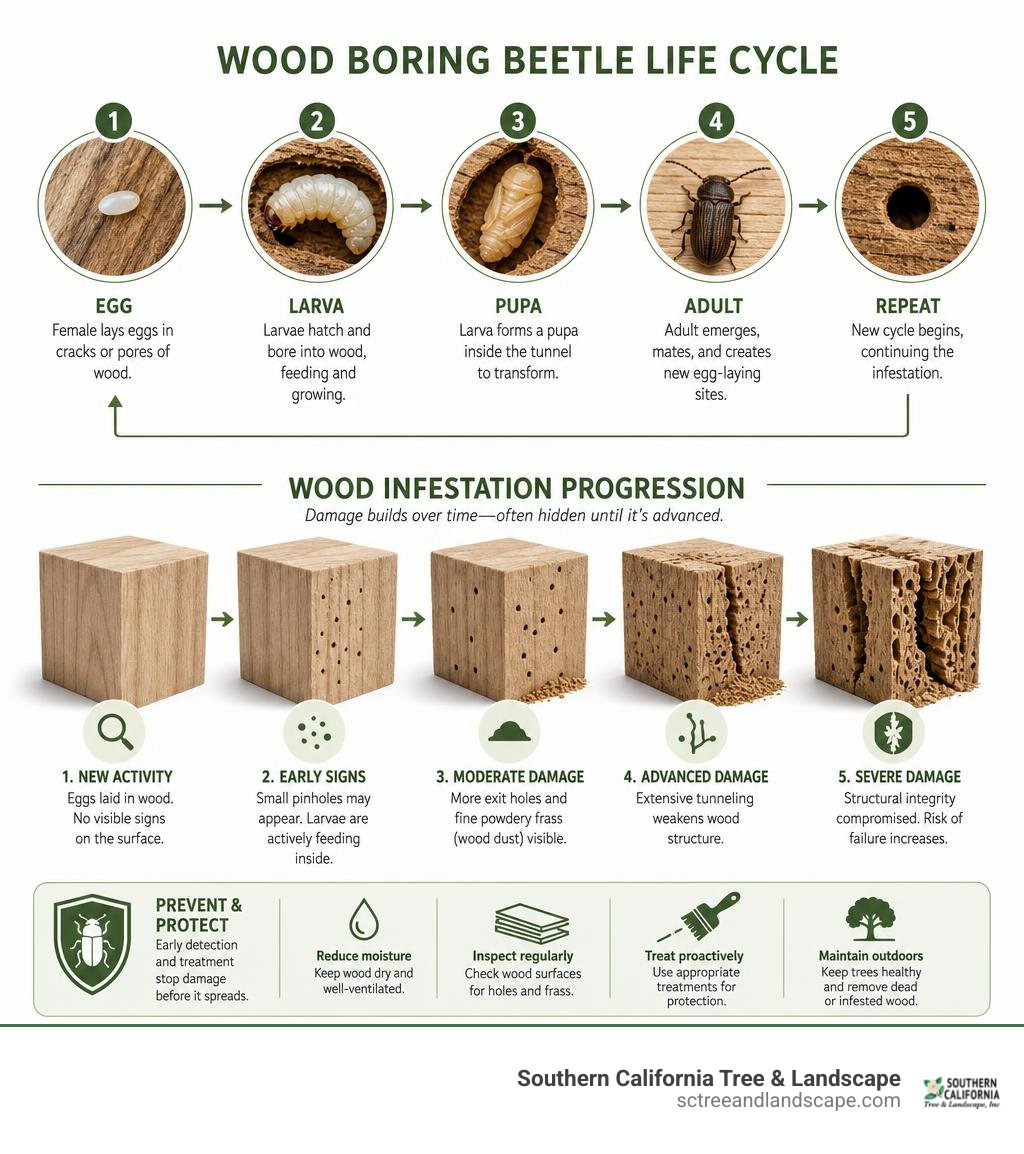
Identifying Common Wood-Boring Beetles and Infestation Signs
To choose the proper wood boring beetle insecticide, we must first know which pest is attacking the wood. Wood-boring beetles fall into distinct families, each targeting specific types of timber and wood moisture levels:
- Powderpost Beetles (Lyctinae): These beetles attack hardwoods (such as oak, walnut, and ash) with wood moisture content as low as 8%. Softwoods are unaffected because they lack the large open pores needed for egg laying. Their feeding produces a texture similar to fine talcum powder or baking flour.
- Deathwatch Beetles (Anobiidae): Common in damp subfloor framing, joists, and crawl spaces, these beetles prefer wood moisture content above 14%. They chew round exit holes and leave behind coarse, gritty frass. They earned their name in medieval times because adult beetles tap their heads against wood galleries during mating, creating a ticking sound at night.
- False Powderpost Beetles (Bostrichidae): These beetles target both hardwoods and softwoods. A famous member of this group, the leadcable borer, can chew through soft metals like lead sheathings and silver, as well as wine barrels!
- Ambrosia Beetles & Bark Beetles: These pests primarily target living or stressed trees rather than dry structural lumber. Adult females bore into the sapwood and stem tissue, transporting mutualist fungi in specialized body structures called mycetangia to farm food deep inside the wood.
When inspecting suspected damage, you can perform the simple ballpoint pen test. Try inserting the tip of a standard ballpoint pen into the exit hole. Powderpost beetle exit holes are tiny (1/16 to 1/8 inch, perfectly round), while larger exit holes indicate false powderpost or longhorned beetles.
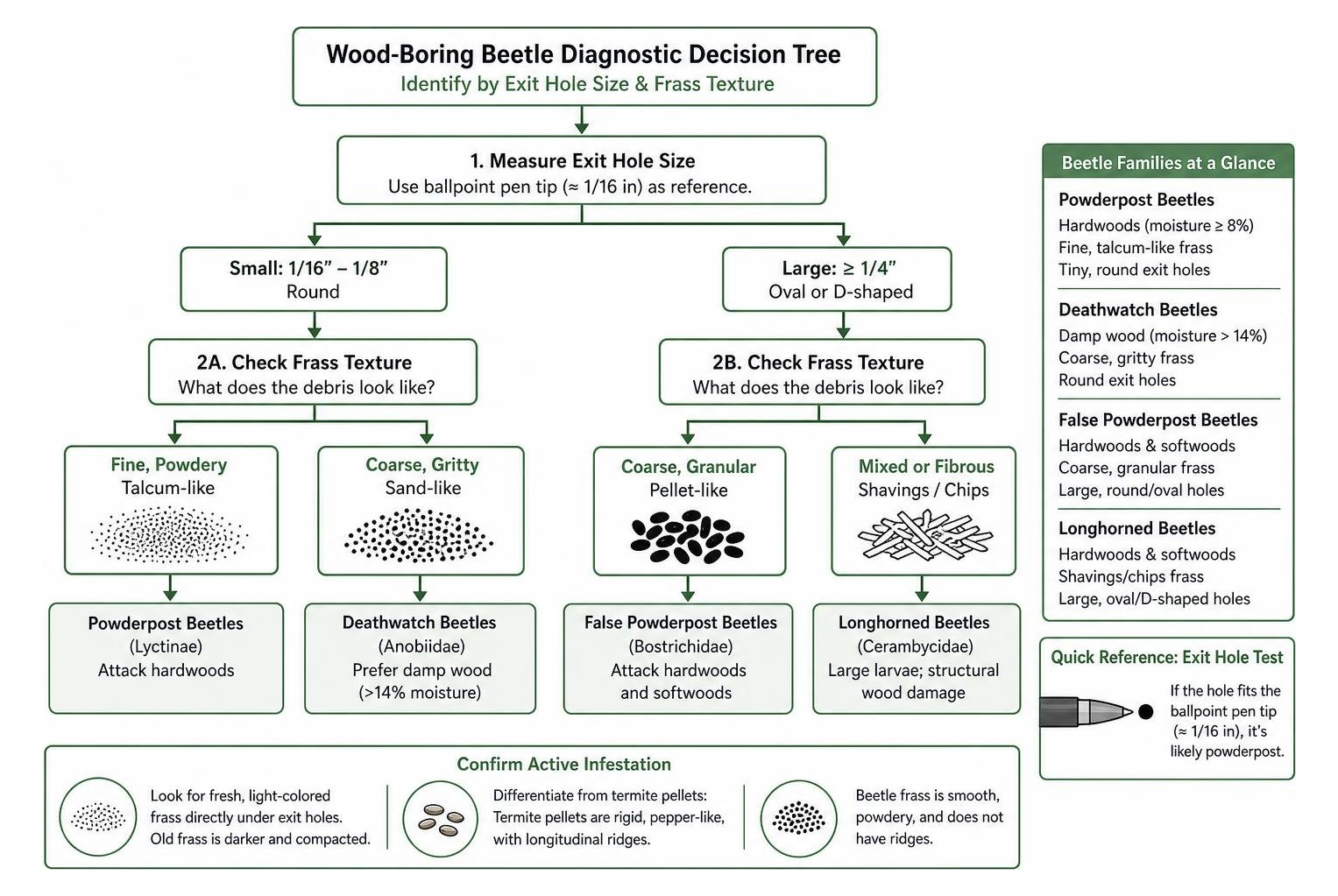
To confirm active infestations, check for fresh, light-colored sawdust collecting directly underneath exit holes. Differentiating termite pellets from beetle frass is equally important: drywood termite pellets are rigid, pepper-like, and feature distinct longitudinal ridges, whereas beetle frass is smooth and powdery. For more diagnostic guidance, consult the UC IPM Guide to Wood-Boring Beetles and the California Forest Pest Council’s resource on Tree Bark and Wood Borers. You can also read our expert insights on Effective Treatments for Bark and Leaf Beetles.
Indoor Structural Pests vs. Outdoor Landscape Tree Borers
It is vital to distinguish between insects attacking dry interior timber and those infesting living landscape trees across the South Bay and Covina regions.
Indoor wood-boring pests infest hardwood flooring, subflooring, antique furniture, and attic rafters. These insects do not require live plant tissue to survive and can reinfest dry structural wood continuously if untreated.
Outdoor landscape borers — such as pine bark beetles and Invasive Shothole Borers — target live shade and ornamental trees. Invasive Shothole Borers carry a symbiotic fungus (Fusarium) that blocks the tree’s vascular tissue, causing branch dieback and eventual tree failure. Treating living landscape giants requires systemic treatments or trunk sprays rather than indoor wood penetrants. Learn more about regional tree threats through the official Invasive Shothole Borers Information portal and our comprehensive Pine Tree Pest Management Guide.
Active Ingredients in Wood Boring Beetle Insecticide Options
Selecting the right active ingredient depends on whether you are treating bare structural timber, finished furniture, or living trees on your property.
| Active Ingredient | Chemical Class | Mechanism of Action | Target Application | Residual Longevity |
|---|---|---|---|---|
| Disodium Octaborate Tetrahydrate (DOT) | Inorganic Borate | Stomach poison; disrupts metabolic digestion when larvae consume treated wood fibers | Unfinished indoor timber, joists, subflooring | Life of the wood (indefinitely if kept dry) |
| Permethrin | Synthetic Pyrethroid | Contact & stomach poison; disrupts nerve impulse transmission in insect nervous systems | Indoor timber, attics, spot furniture injection | Up to 10 years indoors |
| Bifenthrin / Lambda-Cyhalothrin | Synthetic Pyrethroid | High-knockdown contact poison; creates protective protective stem barriers | Outdoor tree bark, trunks, logs, green timber | 30 to 90 days outdoors |
| Imidacloprid / Thiamethoxam | Neonicotinoid | Systemic vascular uptake; blocks nicotinic acetylcholine receptors | Living landscape trees, soil drenches | 12 to 18 months in living plants |
| Spinosad / Natural Pyrethrins | Bioinsecticide | Rapid contact paralysis and sublethal reproductive suppression | Eco-sensitive areas, landscape shrubs | Short residual (1 to 7 days) |
Research into timber and tree protection shows that synthetic pyrethroids like lambda-cyhalothrin achieve exceptional toxicity against wood-boring ambrosia beetles, exhibiting an LC50 of just 0.002 mg/L in scientific trials (see this peer-reviewed Insecticide Study on Ambrosia Beetles). Meanwhile, neonicotinoids like thiamethoxam and acetamiprid provide 98% to 100% mortality on treated stems up to 7 days post-application while halting gallery construction and fungal cultivation.
When dealing with combined wood rot and insect threats, specialized multi-action formulas offer broad protection. Read our guide on Curing Common Tree Diseases Fast to see how tree health and pest control intersect.
Systemic Insecticides vs. Contact Sprays and Penetrating Borates
Understanding how different chemical classes operate helps prevent costly misapplications:
- Penetrating Borates (Sodium Borates): Products like Bora-Care and Tim-BOR are applied directly to bare wood. Using glycol-based carriers, borates diffuse deeply into the wood matrix. When larvae feed on the wood cellulose, the borate acts as a stomach poison, killing the larvae while leaving the wood toxic to future generations.
- Contact Sprays (Pyrethroids): Permethrin and bifenthrin kill adult beetles on contact as they emerge from or attempt to land on wood surfaces. They do not penetrate deeply into dry heartwood, but they provide a fast contact barrier.
- Systemic Insecticides (Neonicotinoids): Formulations containing imidacloprid or thiamethoxam are applied as soil drenches or trunk injections for living landscape trees. The roots or vascular system transport the active chemical upward into the xylem, poisoning sap-feeding and wood-boring larvae from the inside out.
Choosing a Preventative vs. Curative Wood Boring Beetle Insecticide
Application dosages and concentrations differ significantly depending on whether you are preventing an infestation or curing an active one:
- Preventative Rates: Designed for raw building materials or healthy trees. For example, standard liquid wood preservatives require 100 ml/m² to 200 ml/m² (1 liter per 5 m²) to establish a surface barrier against egg deposition.
- Curative Rates: Required when active larvae are chewing inside timber. Curative applications demand a heavier concentration — typically 300 ml/m² (1 liter per 3.3 m²) — often paired with injection into existing exit holes or micro-drilled galleries.
For technical details on professional microemulsion technology and application rates, consult the official Lignum Pro Technical Data Sheet.
Application Methods and Safety Precautions
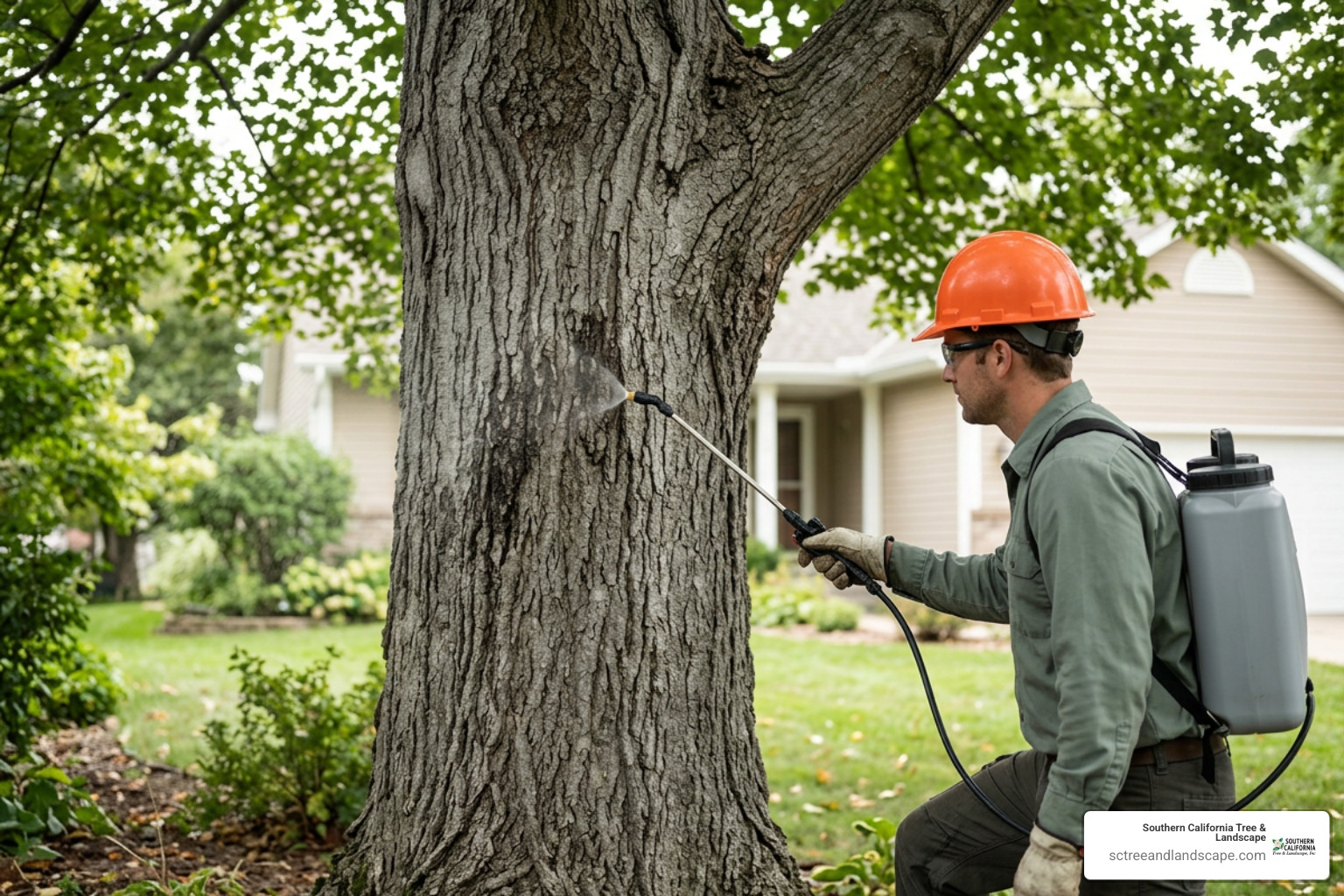
Working with any wood boring beetle insecticide requires strictly following product labels and safety protocols to protect human health, pets, and the surrounding ecosystem:
- Personal Protective Equipment (PPE): Always wear coveralls, nitrile or rubber chemical-resistant gloves, and safety goggles. When spraying liquid formulations in confined spaces like attics or crawlspaces, wear a half-face respirator equipped with organic vapor cartridges.
- Drying and Safety Windows: Exclude children and pets (especially cats, which are sensitive to synthetic pyrethroids like permethrin) from treated zones during application and throughout the full drying window — typically 48 hours for liquid timber sprays.
- Environmental & Wildlife Hazards: Pyrethroids and borates are toxic to aquatic organisms and bees. Avoid spraying near open ponds, streams, or blooming plants. In structural lofts, verify that protected wildlife (such as bats) are not roosting prior to chemical application.
Always consult product labels and technical references, such as the Barrettine Technical Data Sheet, before handling chemical concentrates.
Application Methods for Wood Boring Beetle Insecticide Solutions
Depending on the wood format and target site, applicators utilize four primary delivery methods:
- Topical Brushing & Coarse Spraying: Ideal for unfinished structural timbers, floor joists, and attic rafters. Spraying should be conducted at low pressure (under 20 PSI) to minimize airborne drift while thoroughly saturating bare wood surfaces.
- Micro-Drilling & Injection: For dense hardwoods or finished furniture where surface sprays cannot penetrate, drill tiny pilot holes (0.5 mm to 1 mm in diameter) directly into active galleries to a depth of 10 mm. Inject liquid insecticide directly into the gallery network using a brass or syringe needle.
- Soil Drenching & Granular Basal Application: Used for living landscape trees. Liquid imidacloprid mixes are poured directly around the base of the tree trunk within the drip line, allowing root uptake into xylem tissues.
- Trunk Injections: Performed by certified arborists using specialized high-pressure injection capsules to deliver systemic insecticide directly into the cambium layer of mature trees.
Natural and Biological Control Alternatives
For property owners seeking eco-friendly or non-chemical options, several effective bio-based controls exist:
- Beneficial Nematodes: Microscopic entomopathogenic nematodes (such as Heterorhabditis bacteriophora and Steinernema carpocapsae) search out insect larvae in soil and damp wood galleries, releasing symbiotic bacteria that eliminate pests naturally. Commercial nematode mixes are rated against over 200 soil-dwelling and wood-boring insect species.
- Diatomaceous Earth (DE): Insecticidal-grade silica dust absorbs the protective waxy cuticle of adult beetles walking across treated surfaces, causing dehydration and death.
- Spinosad Bioinsecticides: Derived from soil bacterium fermentation, spinosad provides high acute contact control with reduced environmental impact compared to broad-spectrum synthetic chemicals.
- Thermal & Freeze Treatments: For non-structural wooden items, heat treatment (core temperature of 133°F for 30 minutes or kiln drying at 120°F to 140°F for 6 hours) or deep freezing at 0°F for 72 hours kills all beetle life stages, including eggs.
Frequently Asked Questions about Wood-Boring Beetle Control
How long does it take for beetle insecticide treatments to work?
Contact sprays like permethrin and bifenthrin kill adult beetles within 24 to 48 hours of contact. However, eradicating an entire internal larval infestation takes longer. Penetrating borates rely on larvae consuming treated wood fibers as they feed, which can take 2 to 4 weeks depending on wood moisture levels and gallery depth. Systemic tree drenches require 2 to 6 weeks to move from root systems up into upper trunk canopies.
Can insecticides be applied over painted or finished wood?
No. Sealants, paint, varnish, and polyurethane create an impermeable barrier that prevents liquid insecticides from absorbing into the wood matrix. To treat finished wood, you must strip or sand away the surface coating prior to application, or use micro-drilling techniques to inject insecticide directly into internal galleries. Sealing bare wood with paint or finish after treatment helps prevent future egg-laying in open wood pores.
When should I hire a professional arborist instead of DIY insecticide?
You should contact a certified arborist or licensed pest management professional if:
- The wood-boring beetle damage affects main structural support beams, foundation sills, or roof trusses.
- Infestation occurs on mature landscape trees where crown dieback, trunk weeping, or branch drop poses a safety hazard.
- Treating the tree requires specialized trunk injection equipment, high-pressure canopy spraying, or tall ladder work.
- Invasive pests like the Invasive Shothole Borer threaten valuable landscape trees across your Torrance, Harbor City, or South Bay property.
Conclusion
Protecting your home and property from wood-boring beetles requires accurate species identification, choosing the appropriate wood boring beetle insecticide, and applying it safely and thoroughly. Whether you are safeguarding subfloor joists with penetrating borate solutions or protecting mature trees from invasive borers, taking early action prevents structural damage.
At Southern California Tree & Landscape, our ISA-certified arborists have protected residential and commercial properties across Torrance, Covina, the South Bay, and greater Southern California since 1991. If you suspect wood-boring insects are threatening your landscape trees, explore our comprehensive Tree Service Essential Care guide or contact our team directly through our Professional Tree Services page to schedule a professional evaluation today!