
What You Need to Know About Dutch Elm Disease Treatment
Dutch elm disease treatment is most effective when started early — ideally before symptoms spread beyond 15% of the tree’s canopy. Here’s a quick overview of your main options:
- Preventative fungicide injection – Propiconazole (Alamo) or thiabendazole (Arbotect 20S) injected into the root flares every 1–3 years
- Therapeutic pruning – Remove infected branches at least 5–10 feet below the last visible streaking in the sapwood
- Root graft severance – Trench between nearby elms (within 30–50 feet) to stop underground spread
- Sanitation – Remove and chip infected trees within 2–3 weeks of detection to eliminate beetle breeding sites
- Biological control – Annual injection of Dutch Trig® (a biocontrol agent) to reduce beetle-transmitted infection rates
- Replanting – Replace lost trees with resistant varieties like ‘Princeton’ or ‘Valley Forge’ elm, or alternative species
No treatment is a guaranteed cure. But acting fast — and combining multiple strategies — gives your trees the best chance of survival.
Dutch elm disease has devastated elm populations worldwide. In North America alone, more than 75% of the estimated 77 million elms present in 1930 had died by 1989. The disease moves fast: once a tree is infected, decline can become visible in as little as 4–6 weeks, and death can follow within one to three years.
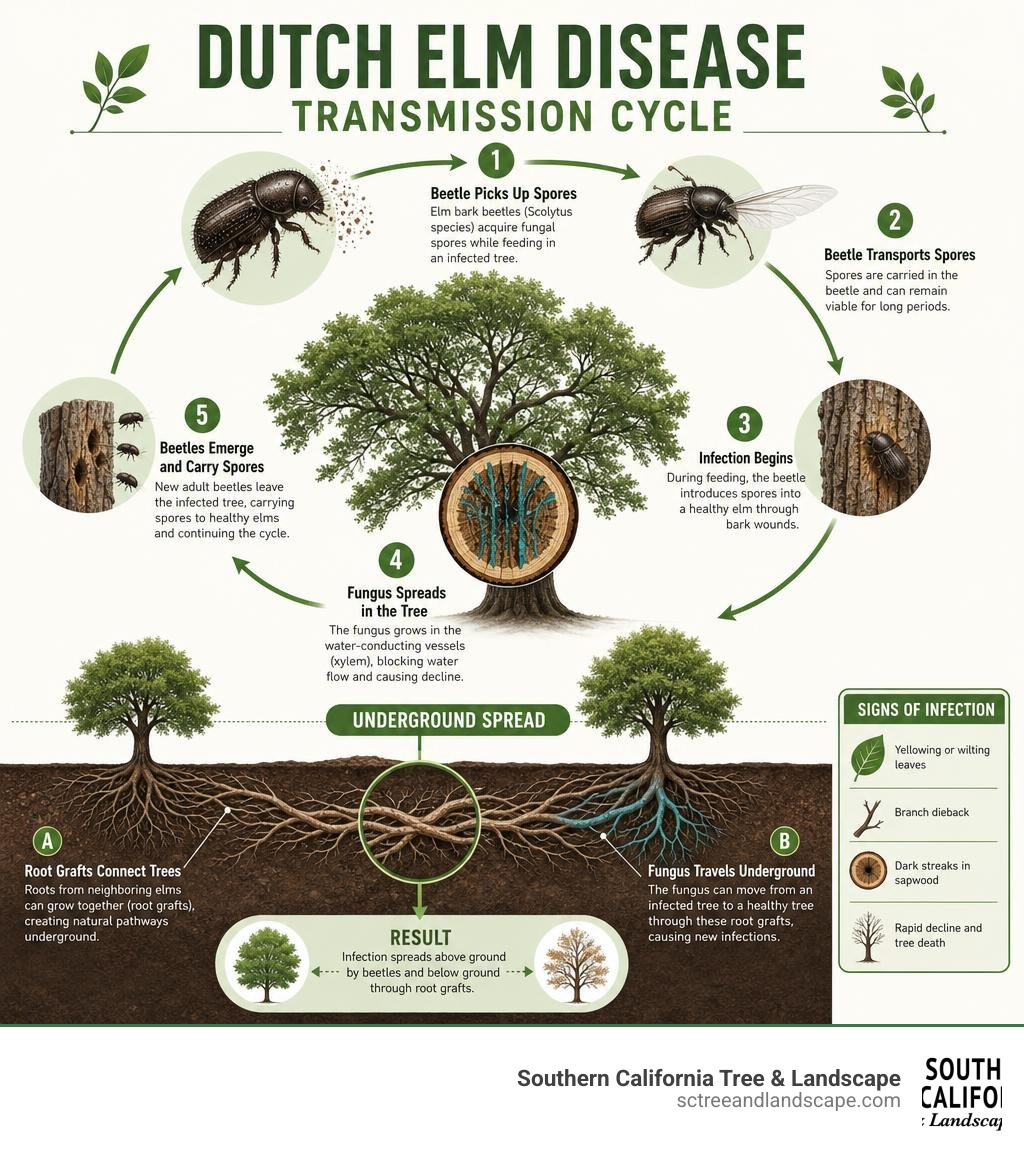
The culprit is a fungus — Ophiostoma novo-ulmi — that clogs the tree’s water-conducting system. It spreads in two ways: through elm bark beetles that carry fungal spores from tree to tree, and silently underground through root grafts between neighboring elms. That combination makes it especially hard to contain once it takes hold in a landscape.
For HOA managers and property owners in Southern California, even a single infected elm can trigger a chain reaction across an entire row of trees — often before symptoms are even visible.
I’m Troy Basmajian, President of Southern California Tree & Landscape, and over the past decade I’ve worked with commercial properties, HOAs, and municipalities throughout the region on exactly these kinds of dutch elm disease treatment challenges. In the sections below, I’ll walk you through everything you need to know — from accurate diagnosis to the most effective treatment and prevention strategies available in 2026.
Understanding Dutch Elm Disease: Causes and Transmission
To choose the right dutch elm disease treatment, we first have to understand how this aggressive vascular wilt disease operates. Dutch elm disease (DED) is caused by two non-native fungal pathogens: Ophiostoma ulmi and the far more aggressive Ophiostoma novo-ulmi.
When the fungus enters an elm tree, it moves rapidly through the xylem (the tree’s water-transporting vessels). The tree recognizes the foreign invader and attempts to wall it off by producing tyloses—tiny, balloon-like plugs—and gums. Unfortunately, this self-defense mechanism backfires. The tree ends up completely blocking its own water transport, leading to rapid wilting, canopy dieback, and eventually death.
How does the fungus get inside the tree in the first place? It relies on two primary transmission pathways:
1. Overland Spread via Elm Bark Beetles
The primary vectors for overland spread are elm bark beetles. In North America, the smaller European elm bark beetle (Scolytus multistriatus), the banded elm bark beetle, and the native elm bark beetle carry sticky fungal spores on their bodies.
These beetles breed in dead, dying, or stressed elm wood. When the young adult beetles emerge in the spring and summer (typically from May through September), they fly to healthy elms to feed on the tender bark of twig crotches. As they feed, they inadvertently deposit the fungal spores directly into the tree’s active water stream. While these beetles can fly up to 1/4 mile on their own, strong winds can carry them much further, starting new infection pockets miles away.

2. Underground Spread via Root Grafts
When elms are planted close together—such as along streets, property lines, or in dense commercial landscapes—their roots naturally touch, overlap, and graft together. This creates a shared vascular network.
If one tree becomes infected, the Ophiostoma fungus can travel directly through these root grafts into the root systems of adjacent, healthy trees. Root graft transmission is incredibly efficient and can spread the disease to any susceptible elm within 30 to 50 feet of the infected host. To learn more about the biology of this pathogen, you can read the comprehensive guide on How to Identify and Manage Dutch Elm Disease or review scientific discussions in Dutch elm disease: an overview of the biology and management regimens .
How to Diagnose Dutch Elm Disease Symptoms
Early detection is absolutely critical. If we catch the infection when less than 5% to 15% of the canopy is affected, the success rate of our treatment options increases dramatically. In fact, research shows that up to 60% of infected elm trees have recovered when targeted pruning and chemical treatments are combined early enough.
Keep a close eye out for these classic signs of Dutch elm disease:
- Flagging: The most common early symptom. Leaves on a single branch or portion of the upper canopy suddenly wilt, turn yellow, curl, shrivel, and turn brown. This often starts in late June or early July but can occur anytime during the growing season.
- Shepherd’s Crook: The young, wilting shoots at the tips of affected branches bend over, resembling a shepherd’s staff.
- Vascular Staining (Sapwood Streaking): If you peel or slice back the bark of a symptomatic branch, you will see distinct dark brown, grey, or purplish linear streaks in the outer ring of the blonde sapwood. Healthy sapwood should be a uniform, light blonde color. Be sure to check this immediately after cutting, as exposed wood naturally browns (oxidizes) when left in the air too long.
Distinguishing DED from Similar Elm Problems
It is easy to mistake DED for other common tree issues. If you want to dive deeper into general plant pathology, check out our guide on The Secret to Curing Common Tree Diseases Fast. For a quick diagnostic reference, use the table below to compare DED with other look-alike conditions:
| Symptom / Feature | Dutch Elm Disease (DED) | Elm Yellows (Phytoplasma) | Bacterial Leaf Scorch |
|---|---|---|---|
| Vascular Wood Staining | Distinct brown/grey streaking in outer sapwood | None | None |
| Inner Bark Condition | Normal color; no distinctive odor | Tan discoloration; distinct wintergreen odor | Normal color; no odor |
| Foliage Pattern | Sudden “flagging” on individual branches first | Uniform yellowing across the entire canopy | Brown, scorched leaf margins with a yellow halo |
| Speed of Decline | Rapid (weeks to months) | Rapid (typically 1 season) | Slow, progressive decline over years |
| Primary Vectors | Elm bark beetles; root grafts | Leafhoppers | Spittlebugs; sharpshooters |
For a detailed look at regional variations in these symptoms, you can consult Dutch Elm Disease : Landscape : Center for Agriculture, Food, and the Environment (CAFE) at UMass Amherst or read about diagnostic practices on Dutch elm disease .
Integrated Pest Management (IPM) and Prevention Strategies
Managing DED successfully requires a proactive, multi-layered approach. Relying on a single treatment method is rarely enough; instead, we implement an Integrated Pest Management (IPM) strategy that targets both the fungal pathogen and its beetle vectors.
- Regular Scouting: We recommend inspecting all elm trees on your property at least twice during the growing season (typically in early summer and late summer) to catch flagging branches early.
- Sanitation: This is the cornerstone of any successful DED management program. If an elm tree is heavily infected (more than 20% canopy loss) and cannot be saved, it must be removed completely within 2 to 3 weeks of detection. This removes the dead wood that bark beetles require for breeding, effectively breaking their life cycle.
- Root Graft Severance: If an infected elm is within 30 to 50 feet of a healthy elm, we must mechanically disrupt the shared root systems before removing the diseased tree. We use a vibratory plow or a trenching machine to cut a line at least 3 to 4 feet deep between the trees. This physical barrier prevents the fungus from traveling underground.
- Vector Management: Keeping your elm trees healthy and stress-free is your best defense. Healthy trees are less attractive to bark beetles. Establish mulch rings to prevent lawnmower damage, provide supplemental water during dry spells, and protect trees from other pests to maintain high vigor.
- Dormant Pruning: Never prune healthy elm trees during the active growing season (spring and summer). Fresh pruning cuts release volatile chemical compounds that act as a beacon for hungry, spore-carrying bark beetles. Limit all routine structural pruning to the dormant winter months.
To keep your landscape’s mature trees in peak condition, explore our comprehensive guide on Tree Service: Essential Care for Your Property’s Green Giants.
Choosing the Right Dutch Elm Disease Treatment
When it comes to chemical and biological interventions, we categorize treatments into two main types: preventative (protecting a healthy tree) and therapeutic (attempting to save an already infected tree).
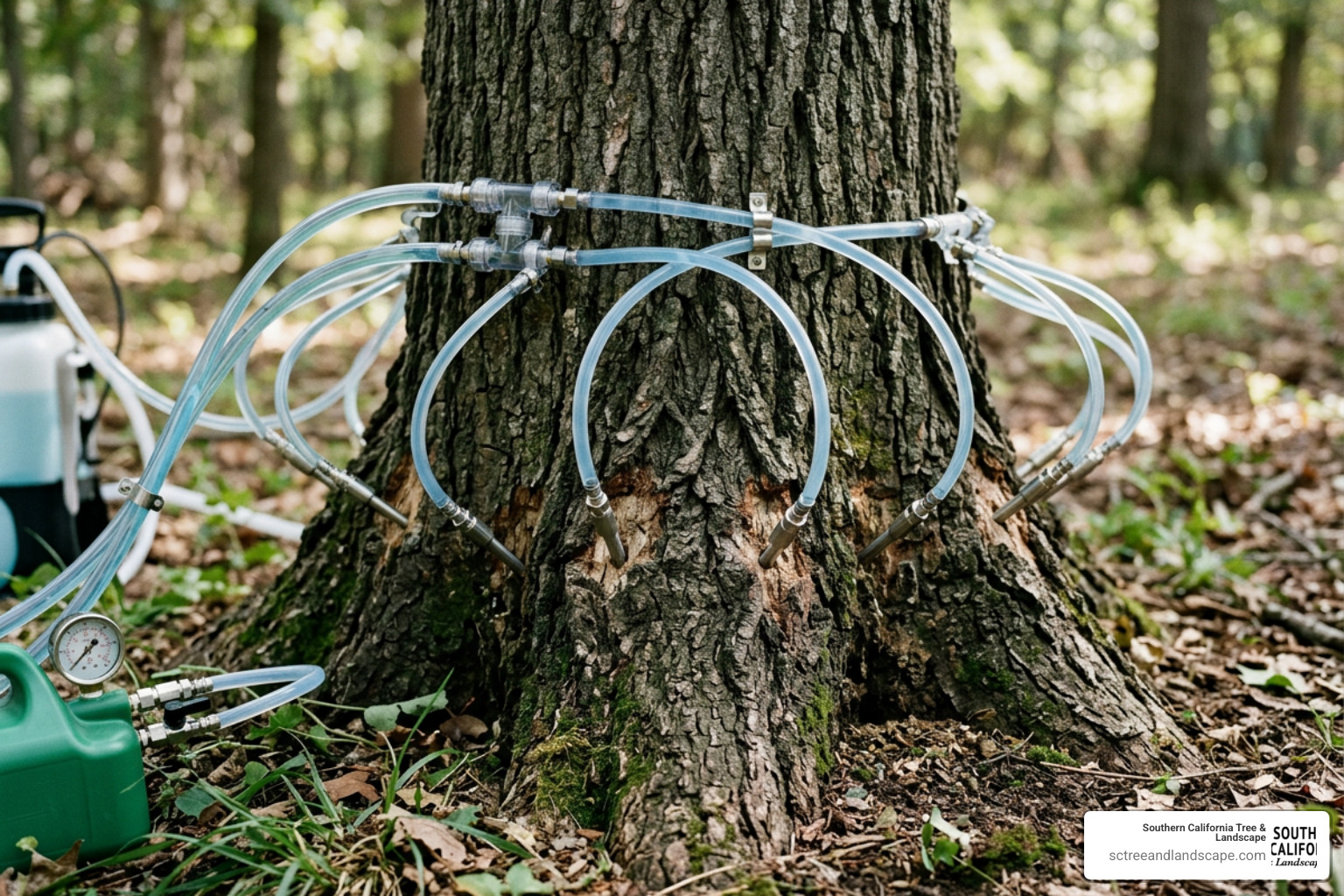
Preventative treatments are highly effective, while therapeutic treatments are generally reserved for high-value trees caught in the absolute earliest stages of localized branch infections. The primary delivery method is root flare macroinjection, where we drill small, precise holes into the root flares at the base of the trunk and infuse large volumes of diluted fungicide directly into the tree’s active water stream under low pressure.
For a closer look at professional application standards, refer to Managing Dutch Elm Disease: Treatment and Prevention.
Chemical Dutch Elm Disease Treatment Options
Two primary systemic fungicides are widely used in the tree care industry for DED control:
- Thiabendazole (marketed as Arbotect® 20S): This is the gold standard for long-term preventative control. According to labeled instructions, a high-rate root flare injection of thiabendazole provides 24 to 36 months of continuous protection. Its unique advantage is that its residues persist in the tree and can translocate into the new wood tissue formed in the seasons following the injection. It is typically applied in June after the spring foliage has hardened off.
- Propiconazole (marketed as Alamo® or Propizol®): This is a highly effective, faster-moving fungicide that is typically applied on a 1- to 2-year rotation. Propiconazole is highly water-soluble and gentle on the tree’s vascular system, making it an excellent choice for both preventative use and early-stage therapeutic trunk injections. It is applied early in the growing season (usually in May) when the tree is actively transpirating.
Biological Dutch Elm Disease Treatment: Dutch Trig®
An exciting alternative to traditional chemical fungicides is the biological control agent Dutch Trig® (which utilizes a specific, non-pathogenic strain of the fungus Verticillium albo-atrum, WCS850).
Unlike chemicals that kill the DED pathogen directly, Dutch Trig® works by inducing the tree’s natural immune system—a process called induced resistance. When injected into the tree in the spring at about 25% leaf expansion, it triggers the elm’s natural defenses, preparing it to fight off any future infections carried by bark beetles.
This biological treatment has been used commercially for over two decades with incredible success. Since 2010, long-term data shows that only 0.1% of treated elms became infected with DED through beetle transmission. However, it is important to note that Dutch Trig® must be applied annually, does not cure already infected trees, and does not prevent root-graft transmission. You can read the full scientific case study in Twenty-four years of Dutch Trig® application to control Dutch elm disease.
Best Practices for Pruning and Wood Disposal
If you spot a flagging branch early, therapeutic (eradicative) pruning can save the tree. However, this is not a standard pruning job. To successfully isolate the infection, you must locate the exact boundary where the dark sapwood staining ends and the clear, blonde wood begins.
We recommend pruning the branch at least 5 to 10 feet beyond (below) the last visible sign of vascular staining. If you don’t leave this clear wood buffer, you risk leaving fungal spores behind to continue traveling down the main trunk. Always disinfect your pruning tools with a bleach solution or specialized disinfectant between every single cut to prevent cross-contamination.
Once the wood is cut, proper disposal is critical to prevent spreading the disease to nearby trees.
Safe Elm Wood Disposal Methods
- Immediate Chipping: Chip all removed elm branches and debris down to pieces smaller than 1 inch in diameter. This destroys beetle larvae and dries out the wood, making it useless for beetle breeding.
- Debarking: If you plan to keep larger logs, you must completely strip off all the bark. Bark beetles can only breed in the moist cambium layer directly under the bark.
- Burying or Burning: Promptly bury infected wood under at least a foot of soil, or burn it in accordance with local fire regulations.
- Never Store as Firewood: Never stack unchipped, bark-on elm wood in your yard. Dying elm wood releases natural chemical scents that attract bark beetles from miles around, turning your woodpile into a major neighborhood infection source.
Planting Resistant Elm Varieties and Alternatives
If you are planning a new landscape design or need to replace a lost elm, the best long-term strategy is to plant disease-resistant cultivars. Over the past several decades, intensive breeding programs have developed American elm cultivars that can tolerate or actively resist DED infections.
Some of the most popular and successful resistant American elm (Ulmus americana) cultivars include:
- ‘Princeton’: A vigorous grower with a classic upright, vase-shaped canopy.
- ‘Valley Forge’: Highly resistant to DED, though it requires careful structural pruning in its early years to manage its wild, spreading growth habit.
- ‘Jefferson’ and ‘New Harmony’: Excellent street trees with beautiful form and strong disease tolerance.
(Note: While these cultivars are highly resistant to the fungus, some may exhibit canopy structures that are more prone to branch breakage under heavy winds. Regular structural pruning when young is highly recommended.)
You can also opt for highly resistant Asian elm species, such as the Chinese elm (Ulmus parviflora), or closely related alternatives like the Japanese zelkova (Zelkova serrata). To maintain a healthy, resilient landscape, always prioritize species diversity. Avoid planting single-species rows (monocultures) so that a single pest or disease cannot wipe out your entire property’s canopy. For more advice on selecting resistant varieties, you can review the Dutch elm disease: Symptoms, Causes & Control | RHS Advice guide.
Frequently Asked Questions about Dutch Elm Disease
Is there a permanent cure for Dutch elm disease?
No, there is no permanent, 100% guaranteed cure for Dutch elm disease once the fungus has spread extensively throughout a tree’s vascular system. However, if the infection is caught early (when less than 5% to 15% of the canopy is affected), a combination of strategic therapeutic pruning and systemic fungicide injections can successfully save the tree. If the disease has reached the main trunk or affected more than 20% of the canopy, treatment is rarely successful, and prompt tree removal is required to protect nearby elms.
How far apart must elm trees be to prevent root graft transmission?
Elm trees must generally be spaced at least 30 to 50 feet apart to minimize the risk of root graft transmission. If susceptible elms are planted closer than this, their root systems are highly likely to graft together underground. If one tree becomes infected, the fungus can easily pass to neighboring trees. In these close-planting scenarios, mechanical root graft severance (trenching) is essential to halt the underground spread.
When is the safest time of year to prune elm trees?
The safest time to prune elm trees is during the dormant winter season. During this time, elm bark beetles are inactive, and the tree is not releasing the fresh sap scents that attract them. Pruning during the spring and summer active growing season should be strictly avoided unless you are performing emergency eradicative pruning to remove an active, localized DED infection.
Conclusion
Dutch elm disease is a formidable threat, but with early detection, proper sanitation, and modern preventative treatments, we can successfully protect and preserve these magnificent shade trees. Whether you are managing an HOA in Torrance, a commercial park in Covina, or residential properties across the South Bay, Harbor City, and greater Southern California, taking a proactive approach to tree health is always the best investment.
At Southern California Tree & Landscape, we have been family-owned since 1991. Our team includes ISA-certified arborists, highly experienced crews, and rapid emergency response teams ready to assist you with everything from diagnostic testing to professional macroinjections and safe tree removals.
If you suspect one of your elms is showing signs of decline, don’t wait for the symptoms to spread. Contact us today to schedule a professional inspection and safeguard your property’s valuable canopy. To learn more about our professional tree care options, visit Our Services: Tree Service or explore our main Our Services page.