
A Tree Planting Service Builds Healthier, Longer-Lived Trees
Hiring a professional tree planting service is the best way to give a new tree a strong start. A qualified team assesses soil, sun, drainage, available space, utility locations, and the tree’s mature size before selecting, placing, and planting it at the correct depth. They also provide a practical watering and care plan for the critical establishment period.
That expertise matters. Poor species selection, incorrect planting depth, damaged roots, and missed follow-up care contribute to high failure rates for newly planted trees. A professionally installed tree can deliver shade, curb appeal, habitat, and long-term value without creating future conflicts with pavement, buildings, irrigation, or overhead lines.
For Southern California properties, the right choice is rarely just the fastest-growing tree. It is the tree that fits the site’s heat exposure, water needs, soil conditions, and long-term landscape goals.
I am Troy Basmajian, President of Southern California Tree & Landscape, and I lead teams serving commercial properties, residential estates, HOAs, municipalities, and institutional clients throughout the region. Our tree planting service experience is grounded in landscape installation, irrigation management, tree care, and the long-term maintenance needed to keep properties healthy and attractive.
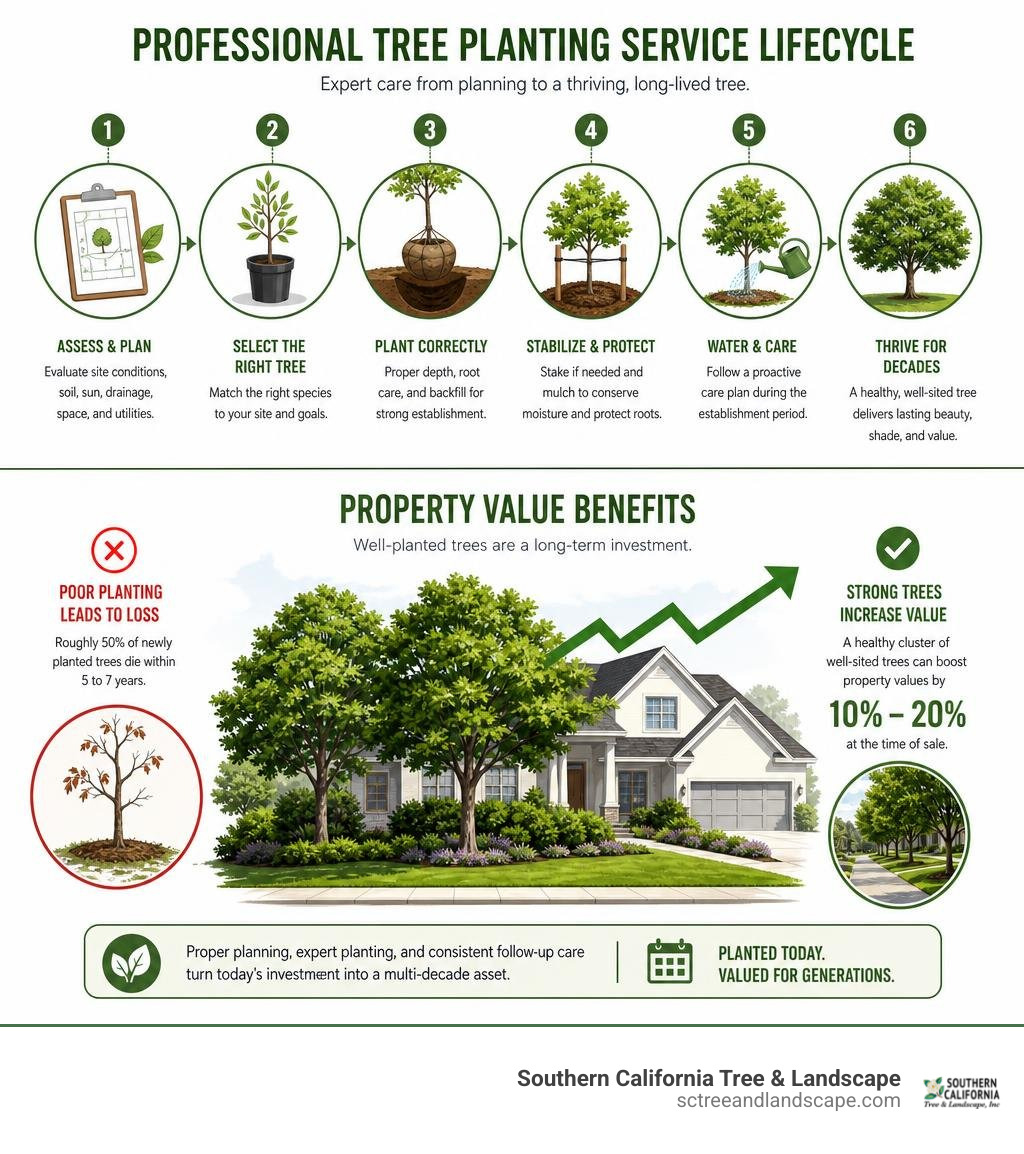
Industry studies show that roughly 50% of newly planted trees die within 5 to 7 years because of poor species selection, improper planting technique, or a complete lack of follow-up care. Conversely, a healthy cluster of well-sited trees can boost property values by 10% to 20% at the time of sale. Bridging the gap between an early loss and a multi-decade asset requires planning, arboricultural science, and proper execution.
Why Hiring a Professional Tree Planting Service Outperforms DIY
Planting a tree looks deceptively simple: dig a hole, drop the root ball in, shovel dirt back over it, and turn on the hose. In practice, improper installation accounts for the vast majority of urban tree mortality across Southern California communities like Torrance, Covina, and Harbor City.
Professional arborists adhere strictly to ANSI A300 Part 6 transplanting standards. These standards govern everything from root preparation and hole excavation geometry to staking thresholds and moisture retention protocols.
| Installation Factor | DIY Approach | Professional Arborist Approach |
|---|---|---|
| Site & Utility Verification | Often skipped; risks cutting private irrigation or utility lines | Mandatory underground utility locates and structural clearance reviews |
| Excavation Geometry | Deep, narrow, bowl-shaped hole with compacted sides | Saucer-shaped hole 2–3x wider than root ball with scarified edges |
| Root Flare Alignment | Flare buried beneath soil or hidden by nursery soil pack | Root flare carefully identified and set 1–2 inches above final grade |
| Root Ball Handling | Dropped into hole; roots torn; wire cages left intact | Strapped and lifted safely; wire/burlap trimmed; circling roots corrected |
| Establishment Support | Rigid over-staking; improper watering formulas | Dynamic flexible ties (removed within 1 year); tailored watering plan |
| Failure Protection | 100% homeowner financial risk if tree fails | Backed by clear replacement warranties and follow-up inspections |
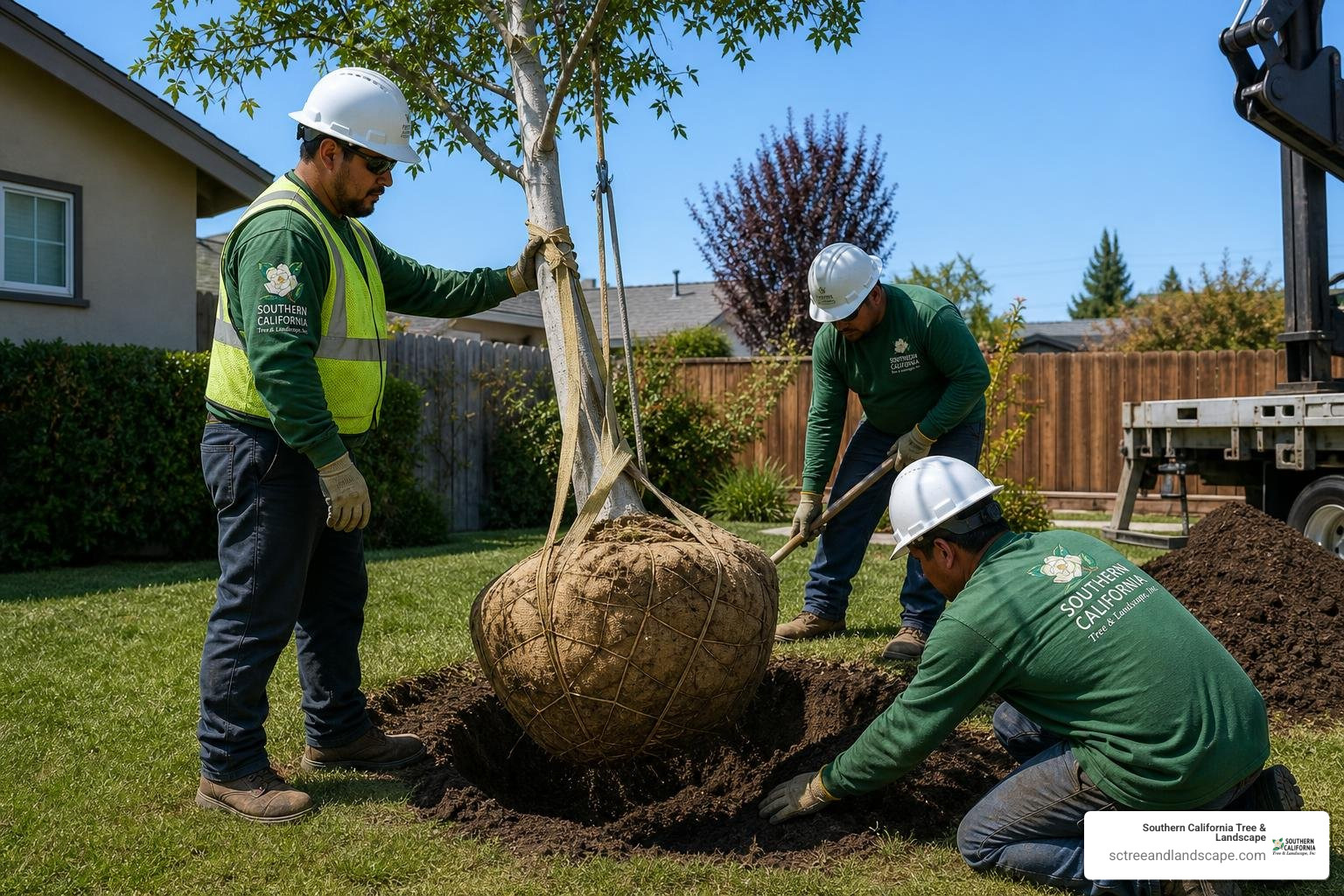
Large trees are exceptionally heavy. A standard 24-inch or 36-inch boxed specimen tree can weigh anywhere from 500 to over 1,200 pounds. Trying to wrestle that weight into a hole by hand without specialized machinery frequently damages the fragile root-to-soil interface. Reviewing The Homeowner Guide to Local Tree Service Companies and Arborists will help you understand how certified crews safely mobilize equipment to protect your turf, hardscape, and underground lines.
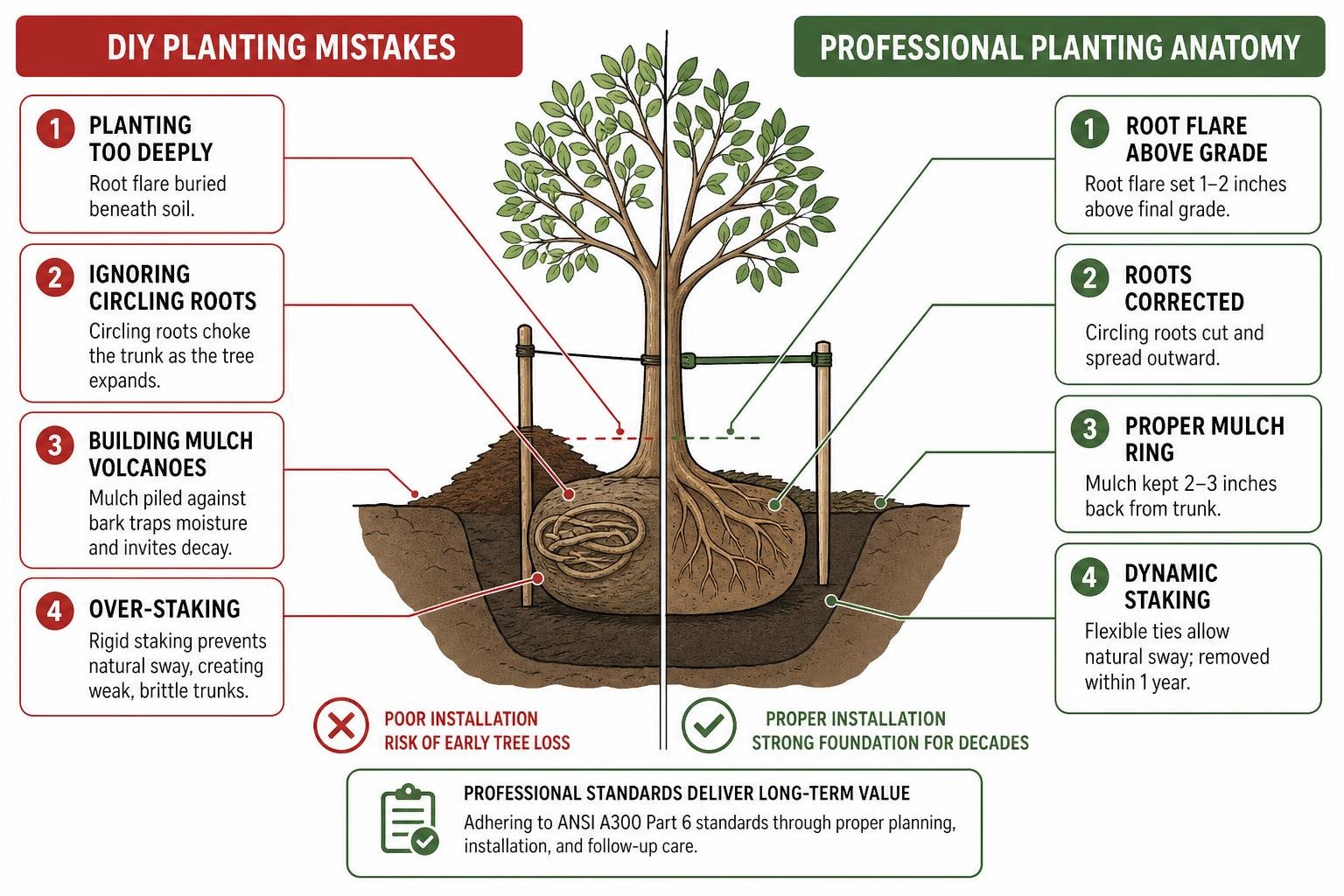
Critical Mistakes in DIY Tree Installation
When homeowners attempt tree planting without professional guidance, several structural errors tend to occur:
- Planting Too Deeply: Placing the root ball too low deprives surface roots of oxygen and invites crown rot.
- Ignoring Circling Roots: Nursery-grown container trees often develop circling roots that choke the trunk (stem-girdling roots) as the tree expands.
- Building Mulch Volcanoes: Piling mulch directly against the bark traps moisture, inviting fungal decay, wood-boring pests, and rodent nesting.
- Over-Staking: Tying a sapling down too tightly prevents natural wind sway, resulting in a weak, pencil-thin trunk that snaps once stakes are removed.
What to Expect from a Full-Service Tree Planting Service
When you partner with our crew, the service encompasses the complete lifecycle of installation:
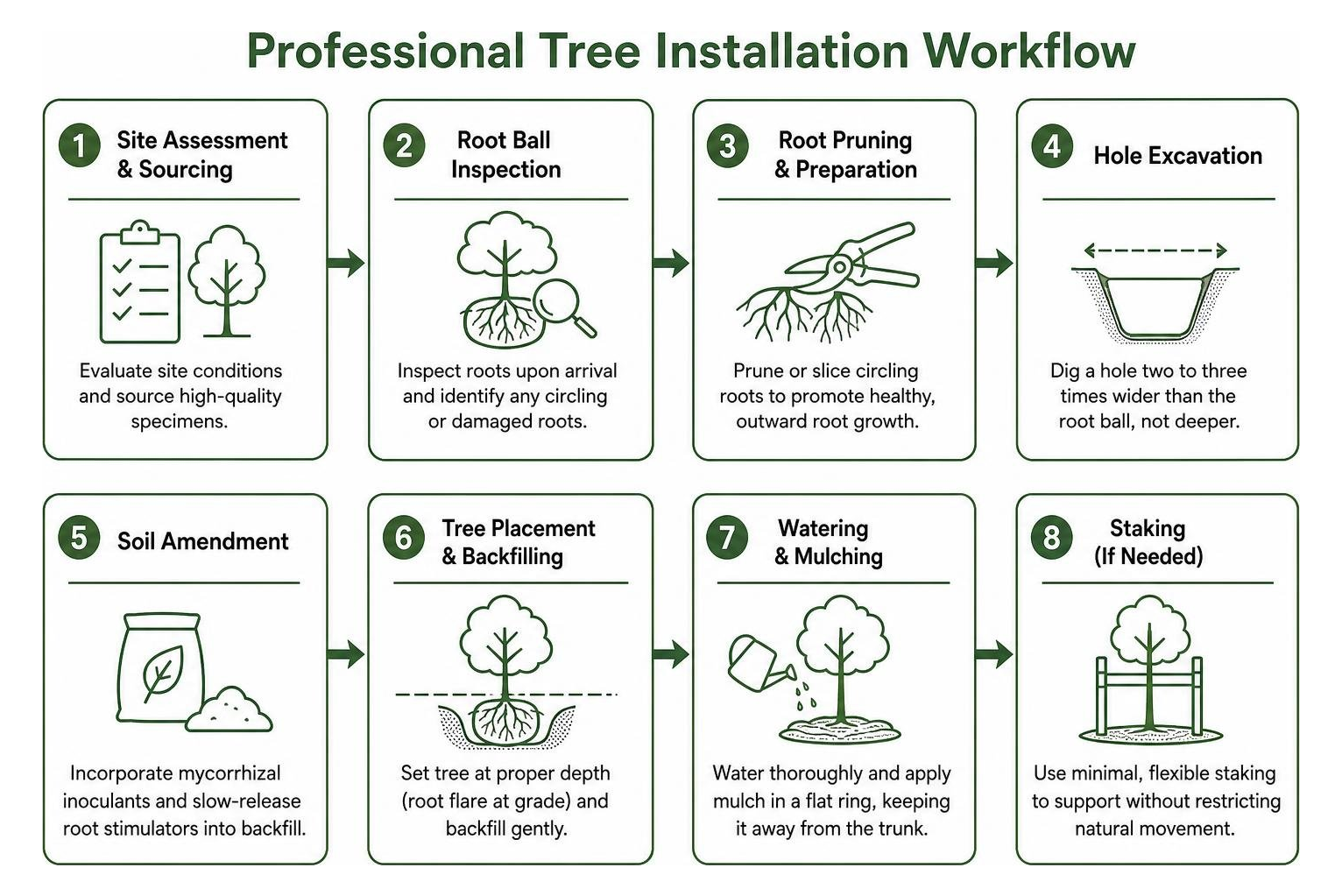
- Site Assessment & Sourcing: We inspect microclimates, soil texture, sun exposure, and municipal setbacks. We source high-grade specimens from reputable growers rather than big-box clearance racks.
- Root Ball Preservation: We inspect root systems upon arrival, carefully teasing out or slicing circling roots to prevent future girdling.
- Biological Soil Support: We integrate mycorrhizal inoculants and slow-release root stimulators into the native backfill to accelerate root development.
- Dedicated Protection: We back our work with warranties that give property owners peace of mind throughout the initial growing seasons.
Before breaking ground, scheduling The Real Value of a Certified Arborist Tree Inspection ensures you choose the ideal location while identifying any pre-existing soil pathogens or pest pressures across your property.
The Science-Backed Professional Tree Installation Process
A successful planting project follows a clear, repeatable process governed by plant biology rather than guesswork. Integrating your tree installation into a broader plan, as outlined in A Comprehensive Guide to Landscape Installation, ensures long-term harmony between turf, planting beds, hardscapes, and irrigation systems.
Soil Preparation and Excavation Standards
Digging a narrow, deep hole creates a “flowerpot effect” where water pools at the bottom, suffocating roots while surrounding hard soil blocks outward expansion.
- Excavation Width: The hole must be dug two to three times wider than the root ball’s diameter.
- Saucer Shape: Sloping the edges of the hole creates a saucer shape, allowing fine feeder roots to run horizontally through aerated topsoil.
- Excavation Depth: The hole should never be deeper than the root ball itself. The base of the hole must rest on undisturbed, compacted soil to keep the tree from sinking over time.
- Soil Conditions: Heavy clay soils across the South Bay and compacted urban subsoils require roughing up (“scarifying”) the hole walls with a hand tool so root tips can penetrate the surrounding earth.
Root Ball Handling and Proper Depth Alignment
Transplanting is stressful for any woody plant. A large spaded or containerized tree can lose up to 90% of its fine root structure prior to installation. Preserving what remains is paramount.
- Expose the Root Flare: The root flare (where the trunk visibly widens before entering the root system) must remain completely visible at or 1 to 2 inches above the finished grade.
- Remove Hardware: We cut away the top half to two-thirds of metal wire baskets, burlap, and container netting once the tree sits in the hole so roots can expand unobstructed.
- Backfill with Native Soil: We backfill predominantly with the pulverized native soil rather than heavy artificial potting mixes, preventing water from clinging exclusively to an amended pocket.
- Eliminate Air Pockets: Soil is settled with gentle manual tamping and water saturation rather than forceful mechanical compaction.
Strategic Species Selection, Climate, and Timing
Choosing the right tree means balancing aesthetics with local climate realities. Across Southern California, urban forestry guidelines—such as the urban forestry guidelines from the City of Torrance—help maintain a sustainable canopy while minimizing infrastructure damage from aggressive root systems.

Regional Planting Windows and Seasonal Timing
While Southern California’s mild Mediterranean climate allows for planting throughout most of the year, timing plays a critical role in minimizing transplant shock:
- Fall (Late September – November): The gold standard for planting in our region. Cooler ambient air temperatures reduce canopy transpiration while warm soil promotes root establishment all winter long before the summer heat arrives.
- Late Winter to Early Spring (February – April): An excellent secondary window. Trees break dormancy and channel spring energy into balanced root and shoot flushes.
- Mid-Summer: Planting during high-heat periods requires specialized irrigation regimens to prevent rapid moisture loss and crown stress.
How Commercial and Residential Tree Planting Service Needs Differ
Commercial properties, HOA communities, and residential estates require distinct approaches:
- Residential Landscapes: Priorities center on personal privacy screens, shade over patios to lower home cooling costs, and ornamental aesthetics. Homeowners frequently combine tree planting with comprehensive upgrades, as detailed in Landscape Design Installation Transform Your Outdoor Space.
- Commercial and HOA Streetscapes: Focus shifts to windbreaks, noise abatement along roadways, line-of-sight compliance, non-invasive root profiles near sidewalks, and uniform canopy spacing.
- Municipal Plantings: Emphasize storm-water retention, native pollinator habitats, and high-durability species that withstand traffic emissions and urban heat islands.
Essential Post-Planting Care for Long-Term Establishment
The installation day is simply the starting line. A newly installed specimen requires one to three years of attentive care to establish its root architecture. Following principles covered in Tree Service Essential Care for Your Property’s Green Giants guarantees your investment matures safely.
First-Year Irrigation and Moisture Management
Watering a newly planted tree is not about frequent light surface sprinkling; it requires slow, deep saturation of the root ball and surrounding backfill.
- Frequency: For the first two to three months, apply water two to three times per week (roughly 5 to 10 gallons per caliper inch of trunk diameter).
- Delivery Method: Use dedicated drip emitters, slow-release irrigation bags, or a garden hose on a very slow trickle placed directly over the root ball.
- Moisture Testing: Check the top 4 to 6 inches of soil with a moisture meter or your finger before irrigating. The soil should feel cool and moist, not waterlogged or powder-dry.
Mulching, Staking, and Structural Maintenance
- The Donut Method: Apply a 2- to 3-inch layer of organic coarse wood mulch in a wide circle over the entire root zone. Maintain a 3- to 4-inch gap between the mulch and the trunk base to prevent bark rot.
- Non-Invasive Staking: Stake only when necessary (e.g., windy sites or tall, top-heavy canopies). Use two opposing stakes with broad, flexible arborist ties positioned at the lowest point on the trunk that keeps the tree upright.
- Tie Removal: Remove all stakes and ties within one year to prevent trunk girdling and encourage strong trunk taper.
- Early Pruning Restraint: Avoid aggressive structural pruning during the first year. Retain temporary lower branches to produce energy for root development, pruning only dead, diseased, or broken limbs.
Frequently Asked Questions About Tree Planting
How much does professional tree planting cost?
On average, professional tree planting runs between $300 and $700 for a typical 15- to 24-inch boxed tree. Exact costs vary depending on:
- Specimen Size and Caliper: Small saplings cost significantly less to transport and handle than 36-inch, 48-inch, or mature specimen trees requiring cranes.
- Site Accessibility: Tight backyard gates, steep slopes, or rocky soils requiring specialized trenching machinery increase labor time.
- Materials Included: Turnkey services include professional sourcing, soil amendments, root stimulators, staking hardware, organic mulch, and initial deep soaking.
What warranties do professional tree planters provide?
Reputable professional tree services provide a 1- to 3-year limited warranty on trees they source and install. These warranties guarantee that the tree will establish and produce healthy foliage through the initial growing seasons, provided the property owner maintains the recommended watering protocols. Guarantees typically cover specimen replacement if a tree fails due to transplant shock or nursery defects.
Can a new tree be planted where an old stump was removed?
Yes, but it requires proper site rehabilitation. When an old tree is removed and its stump ground down, the surrounding soil is typically stripped of nitrogen and packed with wood shavings that deplete soil nutrients during decomposition.
Our team clears out excess sawdust, incorporates clean organic soil, and often offsets the new planting hole 2 to 3 feet from the old core. If you need complete removal, grinding, and site prep before installing your next tree, explore our full suite of Tree Service options.
Building a Greener Tomorrow for Your Property
A newly planted tree is an investment in your property’s future, delivering shade, character, and lasting curb appeal for decades to come. By pairing certified arborist oversight with meticulous soil preparation, proper root alignment, and consistent post-planting care, you avoid common pitfalls and give your trees the foundation they need to thrive.
Whether you are adding a single shade tree to your backyard or upgrading an entire commercial campus across Southern California, our team is here to help. Explore our expert landscape installation services to schedule an on-site consultation with our certified arborists today.