
When Trees Are Under Attack: What You Need to Know About Tree Borer Treatment
Effective tree borer treatment starts with catching the problem early — before wood-boring insects tunnel too deep to reach.
Quick answer: How to treat tree borers
- Assess the damage. Trees with more than 40% canopy loss are often beyond saving.
- Apply a contact insecticide (bifenthrin or permethrin) as a bark spray to kill active adults and newly hatched larvae.
- Follow up with a systemic insecticide (imidacloprid, dinotefuran, or emamectin benzoate) via soil drench or trunk injection for long-term protection.
- Time treatments carefully. Apply during adult emergence windows — typically late spring through summer depending on species.
- Support tree recovery with deep watering, mulching, and proper pruning.
- Remove the tree if the infestation is severe, the structure is compromised, or treatment has failed.
Tree borers are not a single pest. They’re a broad group of wood-boring insects — mostly beetle and moth larvae — that tunnel beneath bark and feed on the cambium layer. That’s the living tissue that moves water and nutrients through the tree. Once it’s damaged, the tree can’t recover that section.
The frustrating part? By the time you see the damage, it’s often been happening for months.
Most borers don’t target healthy trees. They go after stressed ones — trees dealing with drought, compacted soil, recent transplanting, or physical injuries. That makes Southern California’s landscape, with its dry summers and dense urban soils, a prime environment for infestations.
The emerald ash borer alone has killed hundreds of millions of ash trees across North America. And that’s just one species. Bark beetles, flatheaded borers, clearwing moths, bronze birch borers, and peachtree borers are all active threats depending on what you’re growing.
I’m Troy Basmajian, President of Southern California Tree & Landscape, Inc., and over the past decade I’ve seen how quickly a borer infestation can turn a thriving tree into a liability. Our team works with HOAs, commercial properties, and residential estates throughout Southern California on exactly this kind of tree borer treatment and prevention — and early intervention always makes the difference.
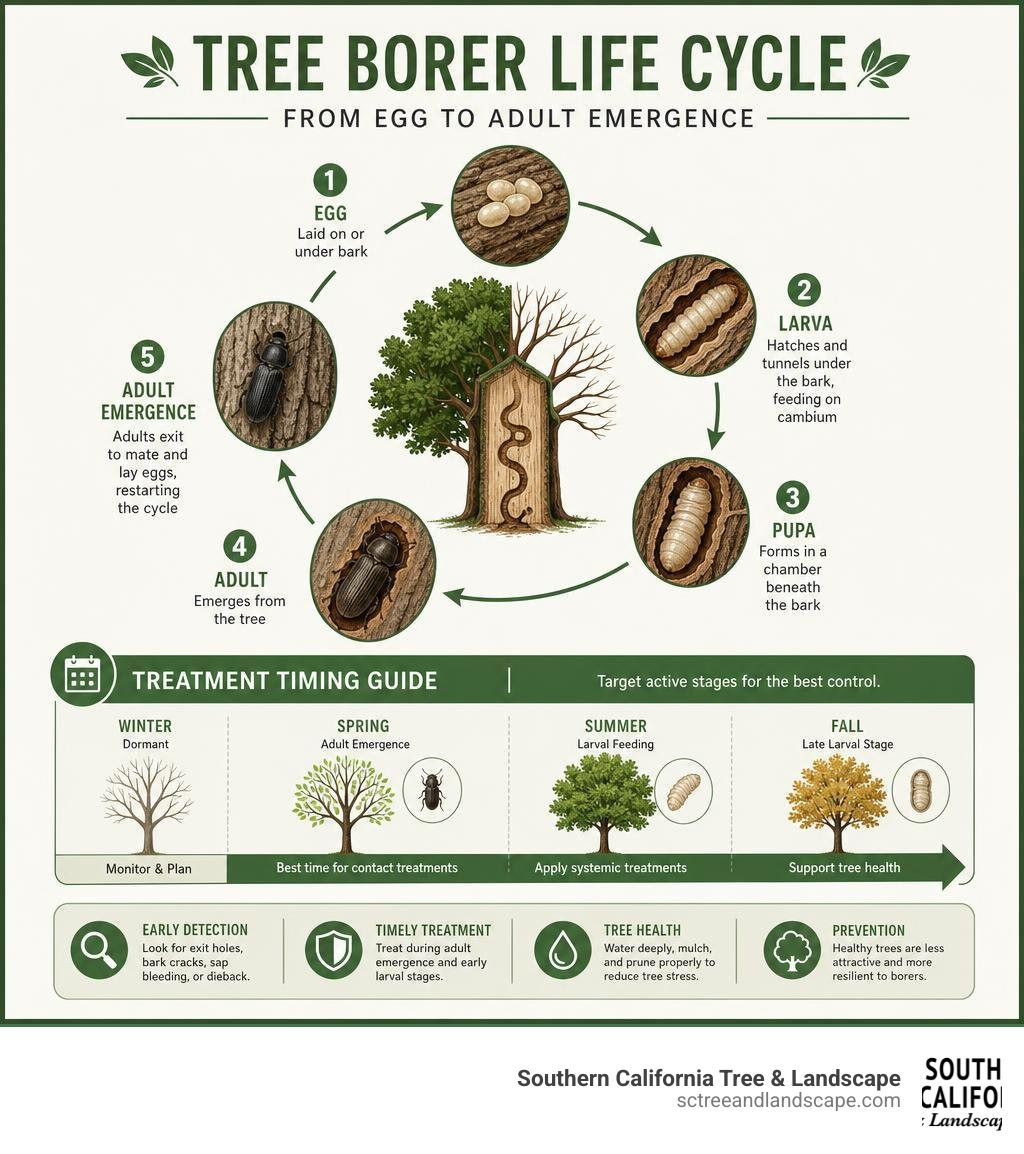
Related content about tree borer treatment:
Understanding Tree Borers and Susceptible Species
To protect your landscape, we must first understand what we are fighting. Wood-boring insects are among the most destructive pests of ornamental trees and shrubs. The term “tree borer” is actually a catch-all category for several different insect species. The vast majority of these pests do their damage during their larval stages.
Beetle larvae and moth larvae hatch from eggs laid on or inside bark crevices. Once hatched, they immediately begin chewing their way into the tree. As they feed, they target the cambium layer—the critical vascular system of the tree that transports water from the roots to the leaves and sugars back down.
While most borers do their worst damage as larvae, some species, like certain bark beetles, also cause severe structural and vascular damage as adults. When these pests tunnel through the wood, they disrupt the flow of sap, effectively girdling the tree from the inside out.
It is a well-established horticultural fact that tree borers rarely infest healthy, vigorous trees. Instead, they are highly attracted to trees experiencing environmental stress. In our local Southern California microclimates—spanning from the coastal breezes of Torrance CA and the South Bay CA to the warmer inland areas like Covina CA—the primary stressor is drought. When a tree lacks water, its internal sap pressure drops. Healthy trees can literally push boring insects out using a strong, sticky flow of sap. Stressed trees lose this natural defense mechanism, leaving them completely vulnerable.
Other common stress factors include compacted soil, root damage from construction, sunscald, and improper pruning cuts. When a tree is weakened, it emits chemical distress signals that borers can detect from miles away.
For detailed regional insights on how specific borer species behave, home and property owners can consult the Bronze Birch Borer Guide or review the biological profiles in the Locust Borer Info sheet.
Common Wood-Boring Insect Species
The wood-boring insects we encounter most frequently on local properties fall into three major biological groups:
- Flatheaded Borers (Family Buprestidae): Also known as metallic wood-boring beetles or jewel beetles due to their iridescent, shiny bodies. The adults are fast-moving, sun-loving beetles. Their larvae are cream-colored, legless grubs with a distinctively flattened area right behind the head (hence “flatheaded”). When they emerge as adults, they leave characteristic D-shaped exit holes in the bark. You can read more about managing these pests in fruit trees and ornamental cultivars in the guide on Flatheaded Borers in Orchards.
- Roundheaded Borers (Family Cerambycidae): These are the larval stage of longhorned beetles, named for their exceptionally long antennae. The larvae are cylindrical, deeply segmented, and have rounded heads. They tend to bore deeper into the heartwood than flatheaded borers, severely compromising the structural integrity of large limbs. Their exit holes are perfectly round or slightly oval.
- Clearwing Moths (Family Sesiidae): Unlike the beetles, these are moths, but you wouldn’t know it by looking at them. The adults are day-flying wasp mimics, sporting bright yellow and black bands to scare off predators. Their larvae are pale caterpillars with tiny legs that target the lower trunk and root collar of stone fruit trees, birches, and ashes. Their exit holes are round and often have the papery, empty pupal case sticking out of the bark.
Vulnerable Trees and Environmental Stressors
Different borer species have specific host plants. For instance, the Greater Peachtree Borer focuses almost exclusively on stone fruits in the Prunus genus (peaches, plums, cherries), while the bronze birch borer targets birch trees.
In our Southern California service areas, we frequently see native oaks under threat from the goldspotted oak borer, and ornamental ash trees devastated by both native ash borers and the invasive emerald ash borer.
Because stressed trees are attacked repeatedly, they often require successive, expensive insecticide treatments unless the underlying environmental issues are resolved. The absolute best first line of defense is keeping your trees healthy through proactive care. To learn how to establish a strong health foundation for your trees, check out our Essential Tree Care Guide.
How to Identify a Tree Borer Infestation
Because borers spend the majority of their lives hidden deep inside the wood, identifying an infestation early requires a sharp eye. If you wait until whole branches are completely bare of leaves, the internal damage may already be too severe to treat.
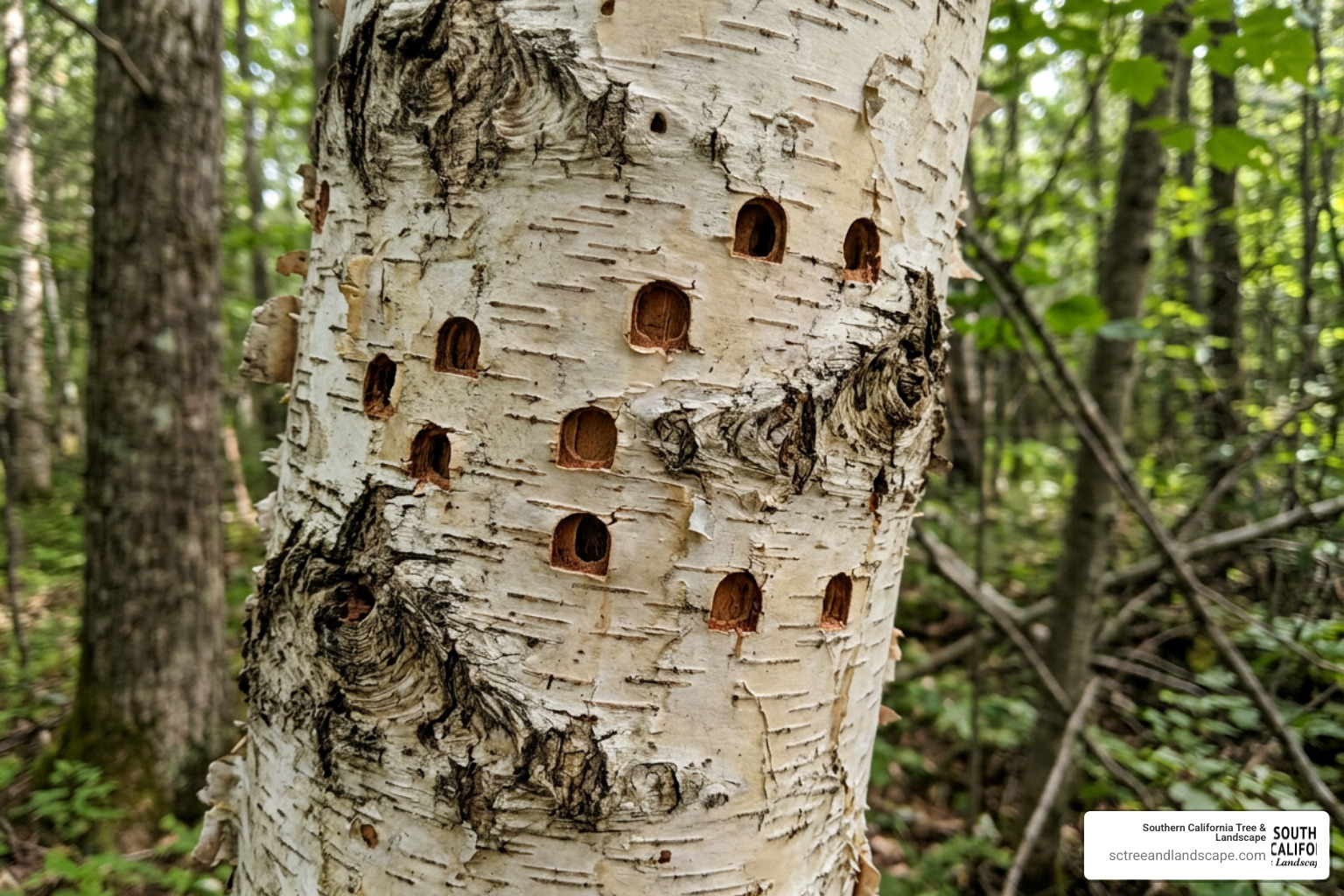
The most common signs of a tree borer infestation include:
- Exit Holes: As mature larvae pupate and transform into adults, they must chew their way out of the tree. Look closely at the bark on the trunk and main branches for tiny holes. Flatheaded borers leave D-shaped holes, roundheaded borers leave round or oval holes, and bark beetles leave tiny, shot-sized holes.
- Frass: This is a polite term for insect waste. As borer larvae tunnel through the wood, they push a mixture of sawdust and excrement out of their entry holes. You will often find this fine, light-brown sawdust accumulating in bark crevices or piling up at the base of the tree trunk.
- Gummosis and Sap Oozing: When a tree is wounded by a boring insect, it tries to defend itself by bleeding sap. In stone fruit trees, this shows up as “gummosis”—a thick, amber-colored, jelly-like gum oozing from the lower trunk. In pines and other conifers, you may see white, crusty pitch tubes.
- Canopy Dieback: Because the larvae destroy the tree’s water-transporting cambium, leaves on affected branches will wilt, turn yellow, and drop prematurely. Typically, dieback starts at the very top of the canopy and moves downward over several seasons.
- Structural Weakness: In severe cases, the internal wood becomes so riddled with galleries that branches lose their structural strength. Affected limbs may snap easily during our seasonal windstorms.
Signs of Active Boring Activity
To confirm that the pests are actively working inside the tree right now, look for wet, dark, water-soaked patches on the bark. This indicates that the tree is currently weeping sap in response to active feeding. If you gently scrape away the outer bark in these water-soaked areas, you will often reveal winding, sawdust-filled larval galleries snaking through the white wood beneath.
Woodpeckers are also excellent natural indicators. If you notice woodpeckers suddenly showing an intense interest in a specific tree trunk, they are likely hammering away to feast on active borer larvae hidden just beneath the bark. For a deep dive into recognizing these symptoms on stone fruit trees, you can refer to the Peachtree Borer Symptoms database.
Distinguishing Borers from Other Tree Diseases
It is easy to confuse borer damage with other issues, such as fungal infections or extreme drought stress. For example, many fungal pathogens cause oozing sap and canopy dieback.
However, fungal infections will not leave behind sawdust-like frass or geometric exit holes. Additionally, some invasive pests, like the polyphagous and kuroshio shothole borers, actually carry symbiotic fungi into the tree. They cultivate this “ambrosia” fungus inside their galleries to feed their larvae, which causes a complex mix of beetle damage and fungal wilt. For help identifying these specific, high-threat pests in Southern California, refer to the Invasive Shothole Borers resource page.
Selecting the Right Tree Borer Treatment
Once an infestation is confirmed, we must act quickly to design an Integrated Pest Management (IPM) plan. The right tree borer treatment depends heavily on the specific insect species, the size and health of the tree, and whether the tree is food-producing.
| Treatment Type | Active Ingredients | Application Method | Efficacy & Best Use Case |
|---|---|---|---|
| Systemic Insecticides | Imidacloprid, Dinotefuran, Emamectin Benzoate | Soil drench, soil injection, trunk injection | Highly effective against beetle larvae (flatheaded/roundheaded). Takes weeks to translocate. Unreliable for clearwing moth caterpillars. |
| Contact Sprays | Bifenthrin, Permethrin | Topical bark and branch spray | Targets adult beetles and newly hatched larvae before they chew into the bark. Requires precise timing. |
| Organic Options | Neem Oil, Parasitic Nematodes | Trunk spray, soil/wound application | Best for minor infestations, stone fruit trees, or sensitive urban landscapes. |
Systemic Insecticides vs. Contact Sprays for Tree Borer Treatment
Systemic insecticides work from the inside out. When applied as a soil drench or injected directly into the trunk, the tree absorbs the chemical and distributes it throughout its vascular tissue. When the larvae feed on the cambium, they ingest the pesticide and die.
- Imidacloprid is excellent as a preventative soil drench for flatheaded borers, but it requires adequate soil moisture and takes 2 to 3 weeks to move up into the canopy.
- Dinotefuran is highly water-soluble, meaning the tree absorbs it much faster, making it great for active infestations.
- Emamectin benzoate is the gold standard for trunk injections, providing up to two years of protection against aggressive pests like the emerald ash borer and goldspotted oak borer.
However, systemic insecticides are generally unreliable against clearwing moth larvae. For those, we rely on properly timed contact sprays.
Contact sprays like bifenthrin or permethrin are applied directly to the bark of the trunk and lower branches. The goal is to leave a protective residue that kills adult moths as they try to lay eggs, or newly hatched larvae as they attempt to chew through the bark. Once a larva successfully enters the wood, contact sprays are completely useless. To see how these chemical options are applied to protect historical oak trees, read through the Two-Lined Chestnut Borer Management guide.
Organic and Environmentally Friendly Tree Borer Treatment Options
If you prefer to avoid synthetic chemicals—especially on backyard fruit trees in Covina CA or Harbor City CA—there are several highly effective organic alternatives:
- Neem Oil: A 1% active neem oil solution sprayed thoroughly on the trunk from late June through September can deter adult egg-laying and disrupt the development of young larvae.
- Parasitic Nematodes: Beneficial nematodes (Steinernema carpocapsae or Steinernema feltiae) can be sprayed onto the trunk or injected directly into active borer holes using a syringe. These microscopic organisms seek out and destroy borer larvae inside their galleries without harming the tree or beneficial insects.
- Companion Planting: Planting members of the Allium family, such as garlic chives, around the root flare of vulnerable trees can naturally deter adult borers from visiting.
- Pheromone Traps: These traps use synthetic female scents to capture male clearwing moths, effectively disrupting the mating cycle and reducing the local pest population.
- Physical Barriers: Wrapping the lower 12 to 18 inches of young tree trunks with fine window screen mesh can physically prevent adult moths and beetles from depositing eggs on vulnerable bark.
Timing and Application of Borer Treatments
In tree borer treatment, timing is everything. If you apply a contact spray too early, the sun and rain will degrade the chemical before the pests arrive. If you apply it too late, the larvae are already safely insulated inside the wood.

Because Southern California has mild winters, insect life cycles can be highly unpredictable. Generally, adult emergence and egg-laying windows run from late spring through late summer.
To achieve maximum control, we must align our treatments with the adult flight periods of the specific target pest. For example, the lilac/ash borer emerges early in spring (April to June), while the peachtree borer peaks much later (mid-July through August).
Aligning Treatments with the Borer Life Cycle
Understanding how temperature triggers pest development is crucial. Larvae overwinter inside the tree’s heartwood. As spring temperatures rise and tree buds begin to swell, the larvae resume feeding before pupating and emerging as adults.
To time contact sprays perfectly, we often use pheromone traps to monitor when the first adult males begin to fly. We then schedule our bark sprays approximately 10 to 14 days after the first catch, which perfectly coincides with when the first round of eggs begins to hatch on the bark. For a detailed breakdown of how to time treatments for orchard and shade trees, refer to the Cherry-Shothole Borer Timing guidelines.
Safety Precautions and Legal Pesticide Use
When using chemical insecticides, safety and legal compliance are paramount. Always read and follow the product label exactly—the label is federal law.
- Pollinator Protection: Systemic neonicotinoids like imidacloprid can translocate into the pollen and nectar of flowering trees, posing a severe risk to honeybees. To protect our local pollinators, never apply systemic insecticides to bee-attractive trees while they are in bloom. Always wait until after the flower petals have completely fallen.
- Runoff and Drift Prevention: Avoid spraying contact insecticides on windy days to prevent chemical drift onto neighboring properties or sensitive garden plants. When performing a soil drench, ensure the soil is moist but not saturated to prevent the chemical from washing away into local storm drains.
Cultural Practices and Preventive Care
As the old saying goes, “an ounce of prevention is worth a pound of cure.” Because wood-boring insects are secondary invaders that target weakened hosts, the most effective tree borer treatment is a robust cultural care routine.
To keep your trees healthy and naturally resistant to pests:
- Water Deeply: Shallow, frequent watering encourages weak, surface-level roots. Instead, water established trees deeply—to a depth of about two feet—every two to four weeks during dry periods.
- Mulch Correctly: Apply a 2-to-4-inch layer of organic wood mulch over the root zone to conserve soil moisture and regulate root temperatures. Always keep the mulch a few inches away from the trunk flare to prevent bark rot.
- Fertilize Based on Need: Only fertilize based on a professional soil analysis. Excess nitrogen can cause a flush of weak, watery growth that is highly attractive to sucking and boring pests.
- Prune at the Right Time: Avoid pruning susceptible tree species during the active flight window of adult borers (typically late spring through summer). Fresh pruning cuts release volatile compounds that act as a beacon for egg-laying females. Always make clean cuts just outside the branch collar, and avoid using wound dressings or paints, which can trap moisture and encourage decay.
Maintaining Tree Vigor to Resist Attacks
In urban areas like Torrance CA and Harbor City CA, soil compaction from foot traffic or lawn mowers is a major source of tree stress. Compacted soil starves tree roots of oxygen and prevents water penetration. We recommend regular soil aeration and vertical mulching to keep root zones loose and healthy.
Proper canopy management is also essential. Overcrowded branches block sunlight and reduce air circulation, making the tree more susceptible to disease. For professional techniques on managing your tree’s canopy, read our Tree Thinning Guide and explore our Crown Reduction Secrets.
When to Remove an Infested Tree
Unfortunately, not every tree can be saved. If a tree has suffered extensive structural damage or has lost a massive portion of its living tissue, attempting to treat it is a waste of resources and can create a major safety hazard.
As a general rule of thumb, if a tree has lost more than 40% of its canopy due to borer damage, it is highly unlikely to recover. At this stage, the cambium layer has been completely girdled, and the tree can no longer transport the water and nutrients required to rebuild its canopy.
Furthermore, trees with extensive internal tunneling become structurally hollow and brittle. These trees pose an immediate hazard of falling or dropping large limbs onto homes, cars, or power lines—especially during our seasonal Santa Ana wind events.
If a tree is deemed unsalvageable, it must be professionally removed. However, the job doesn’t end when the tree hits the ground. Infested wood is a breeding ground for remaining larvae. If you leave the wood piled in your yard or transport it to another area, you will spread the infestation to healthy neighboring trees.
To safely dispose of infested wood:
- Chip it: Chipping wood into small pieces (less than 1 inch in diameter) instantly kills any larvae living inside.
- Solarize it: If you want to keep the wood for firewood, pile it in a sunny location and cover it tightly with a heavy, clear plastic tarp. Seal the edges of the tarp with soil to trap heat. Leave it covered from mid-May through mid-July; the extreme heat will solarize the wood and kill any emerging beetles.
- Keep it local: Never transport un-treated firewood out of your local area.
If you suspect a tree on your property has crossed the line from treatable to hazardous, we can help. Explore our Emergency Tree Removal Services and learn about our clean, efficient Stump Removal and Grinding options.
Frequently Asked Questions about Tree Borers
Can a heavily infested tree be saved?
Generally, no. If a tree has lost more than 40% of its canopy or shows severe bark splitting and structural cracking along the main trunk, the vascular system is too damaged to recover. In these cases, systemic insecticides cannot distribute through the tree effectively, and the tree should be removed for safety.
Are systemic insecticides safe for flowering trees?
They can be highly toxic to bees and other beneficial pollinators if applied incorrectly. To protect pollinators, never apply systemic neonicotinoids (like imidacloprid) to flowering trees right before or during their bloom cycle. Always wait until the tree has completely finished flowering and the petals have dropped before applying soil drenches or trunk injections.
How do I dispose of wood from an infested tree?
To prevent the pests from spreading to healthy trees in your neighborhood, you must destroy or treat the wood immediately. You can run the branches through a commercial wood chipper, solarize the wood under a tightly sealed clear plastic tarp in the sun for several months, or burn it locally (where permitted). Never move untreated firewood to other regions.
Conclusion
Dealing with wood-boring pests can be incredibly frustrating, but you don’t have to face it alone. Successful tree borer treatment requires a careful balance of accurate pest identification, precise chemical or organic applications, and—most importantly—proactive cultural care to keep your trees strong enough to fight back naturally.
At Southern California Tree & Landscape, we have been helping property owners throughout Torrance, Covina, Harbor City, and the wider South Bay area protect their valuable green assets since 1991. Our family-owned company features ISA-certified arborists, highly experienced crews, and the specialized equipment needed to handle everything from preventative soil drenches to large-scale emergency tree removals.
If you are worried about the health of your trees or want to set up a preventative health plan, contact us today to schedule a professional consultation. Let’s work together to keep your landscape healthy, beautiful, and safe for years to come. Explore our full range of Professional Tree Services to get started.