
Why Pruning a Eucalyptus Tree the Right Way Matters
Pruning a eucalyptus tree correctly can be the difference between a beautiful, manageable garden feature and a 25-metre hazard towering over your property.
Here’s what you need to know at a glance:
- Best time to prune: Late winter to early spring (February–March), just before active growth begins
- Main methods: Formative pruning, coppicing, pollarding, hedge pruning, and crown reduction
- Best species for hard pruning: E. gunnii, E. globulus, E. dalrympleana, and E. pauciflora
- Key rule: Never remove more than one-third of the canopy in a single session (unless coppicing or pollarding)
- When to call a pro: Any time the tree is tall, leaning, near structures, or near power lines
Eucalyptus trees are fast growers. Left alone, some species can reach 25 metres tall and 15 metres wide. That’s a serious issue for Southern California homeowners and HOA managers trying to keep properties safe, attractive, and within bounds.
The good news? Eucalyptus responds exceptionally well to pruning. With the right timing, the right method, and a little ongoing maintenance, you can keep even a vigorous gum tree at a manageable size — and it’ll often look better for it.
This guide covers everything: timing, techniques, tools, aftercare, and the mistakes that can cost you a tree.
Best Time of Year for Pruning a Eucalyptus Tree
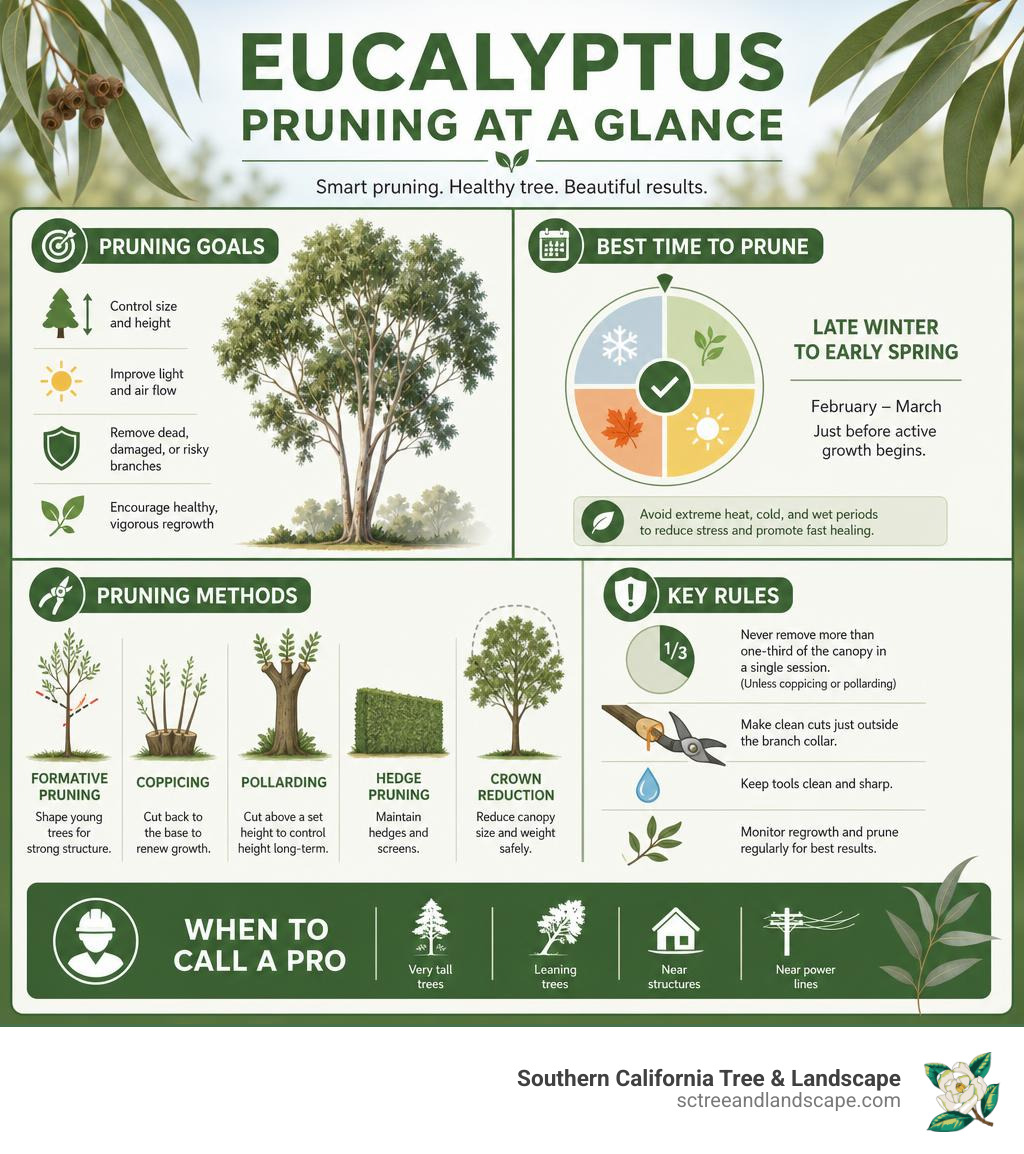
The best time for pruning a eucalyptus tree is late winter to early spring, usually February through March. This lines up with the period just before the tree pushes strong new growth.
That timing matters because eucalyptus trees are vigorous, but they are not indestructible. Pruning during the wrong weather can lead to stress, weak regrowth, torn bark, pest activity, or slow-healing wounds.
For general eucalyptus timing guidance, the Eucalyptus pruning timing guidance from the RHS also points to late winter and early spring as the preferred window for major pruning work.
Why Late Winter to Early Spring Works Best
Late winter to early spring is ideal because the tree is preparing for active growth. When cuts are made at this stage, the tree can respond quickly with fresh shoots and better wound closure.
This season offers several advantages:
- Sap flow is increasing, but the tree is not yet in full growth mode.
- New growth can develop soon after pruning.
- Pest pressure is generally lower than in warm seasons.
- Disease risk is reduced when cuts are made in dry weather.
- The tree avoids the worst stress of summer heat.
- Regrowth has time to mature before the next cool season.
For eucalyptus, timing is not just about the calendar. It is also about conditions. A dry, mild day in late February is usually better than a wet, windy, or unusually hot day in March.
When to Prune in Southern California
In Southern California, our mild winters give us a little more flexibility than colder climates. Coastal areas like Torrance, Harbor City, and the South Bay often have gentle winter conditions, while inland areas such as Covina can heat up faster in spring and summer.
A smart local pruning schedule looks like this:
- Routine pruning: February to March
- Light cleanup: Late winter through early spring
- Deadwood removal: Any time if safety is involved
- Storm-damaged limb removal: As soon as it is safe
- Major crown work: Before heat waves and drought stress arrive
Safety pruning is the exception to seasonal rules. If a branch is cracked, hanging over a driveway, pressing on a roof, or threatening people or property, do not wait for the “perfect” month. If you are dealing with urgent storm damage, our guide to Emergency tree help explains when fast action is needed.
Times You Should Avoid Pruning
Even tough eucalyptus trees have bad pruning days. Avoid pruning when the tree is already under stress or when weather conditions make wounds harder to recover from.
Try not to prune during:
- Extreme summer heat
- Drought stress
- Santa Ana wind events
- Wet or rainy conditions
- Late autumn, when tender regrowth may not harden properly
- Rare deep winter freezes in colder inland pockets
- Periods when the tree is newly planted and still establishing
- Days when wind makes ladder or pole work unsafe
If the tree looks wilted, scorched, heavily pest-damaged, or recently disturbed by construction, pause before cutting. Sometimes the best pruning cut is the one you delay.
Eucalyptus Pruning Methods and Which One to Choose
Not every eucalyptus needs the same type of pruning. A young tree in a front yard, a screening hedge, and a large old gum near a structure all call for different methods.
| Method | Main Goal | Typical Cut Height | Regrowth Style | Best Tree Age | Maintenance Frequency | Small-Garden Fit |
|---|---|---|---|---|---|---|
| Formative pruning | Build strong structure | Selective branch cuts | Balanced canopy | Young trees | Yearly for first 3-5 years | Good |
| Coppicing | Keep shrub-like and produce juvenile foliage | 5-7.5 cm or 3-12 inches above ground | Multiple stems from base | Young, healthy trees | Annual or every 2 years | Excellent |
| Pollarding | Control height while keeping a trunk | About 1-2 m, 5-6 ft, or higher where appropriate | Shoots from pollard head | Started young | Annual or biennial | Good if maintained |
| Hedge pruning | Create dense screen | Side and top trimming | Dense side shoots | Young to semi-mature | Yearly or more | Good |
| Crown reduction | Reduce size and weight safely | Selective branch reduction | Natural canopy shape | Established trees | As needed | Good when done professionally |
Formative Pruning for Young Eucalyptus Trees
Formative pruning is the training phase. It guides a young eucalyptus into a safer, better-shaped tree before problems become expensive.
For a standard tree form, the goal is usually one strong central leader with well-spaced side branches. Avoid cutting the central leader unless you are intentionally creating a multi-stemmed form. Removing it accidentally can produce competing leaders and weak structure.
Good formative pruning includes:
- Keeping one dominant main stem
- Removing damaged or crossing branches
- Gradually clearing the lower trunk
- Creating a clear trunk of about 1-2 metres where appropriate
- Shortening side branches rather than stripping the trunk bare
- Cutting to outward-facing buds so new growth grows away from the center
- Spacing branches around the trunk instead of stacking them in one area
The first three to five years are especially important. Think of this as teaching the tree good manners while it is still young. Much easier than arguing with a 60-foot eucalyptus later.
Coppicing for Shrubby Regrowth and Juvenile Foliage
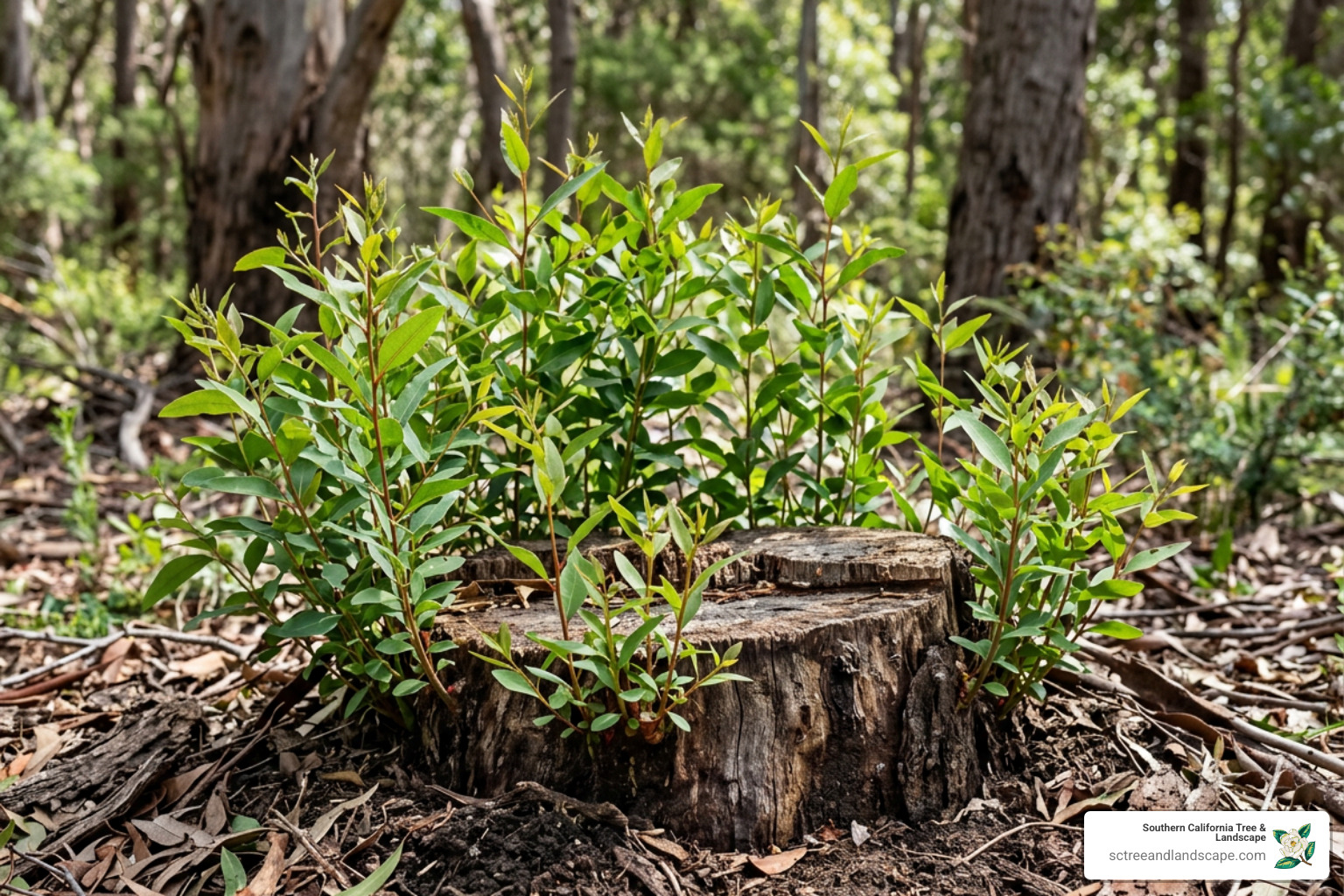
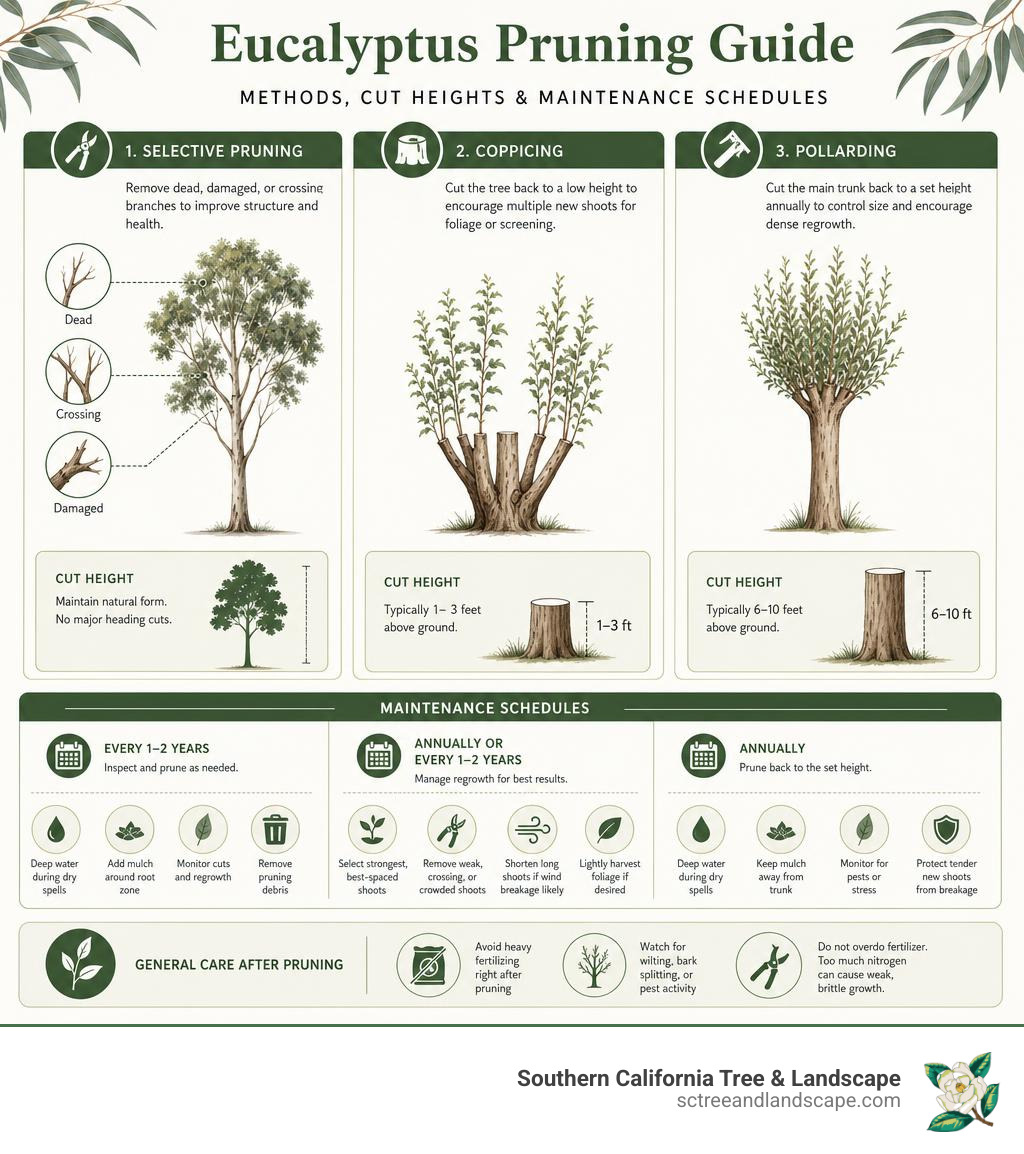
Coppicing means cutting the tree close to ground level so it regrows as a multi-stemmed shrub. For suitable species, this is one of the best ways to keep eucalyptus small in a garden.
Typical coppicing cuts are made:
- About 5-7.5 cm above the ground
- Or roughly 3-12 inches above soil level
- Slightly angled so water sheds off the cut
- With clean, sharp tools
Coppicing encourages vigorous juvenile foliage. These young leaves are often rounder, softer, and more decorative than adult leaves, which is why many homeowners love coppiced eucalyptus for cut foliage.
Coppicing can be done annually or every other year, depending on the growth rate and your size goals. One caution: new shoots can be long, soft, and vulnerable to snapping in strong winds. In Southern California, that matters during Santa Ana conditions. Thin and shorten regrowth as needed so the plant does not become a floppy eucalyptus fountain.
Pollarding for Height Control
Pollarding is a more controlled height-management method. Instead of cutting near the ground, the trunk is cut higher up to create a permanent pollard head. New shoots then grow from that point.
Common pollard heights include:
- About 1-2 metres
- Around 5-6 feet
- Sometimes 6-10 feet, depending on site goals and tree structure
Pollarding should be started early in the tree’s life. It is not the same as randomly topping a mature tree. A proper pollard is a planned system with repeated maintenance cuts.
The Coppicing and pollarding overview offers a helpful comparison of these two methods. In practice, pollarding is usually more technical than coppicing because cuts are higher, regrowth is heavier, and future structure matters more.
For large eucalyptus trees, pollarding should be handled by experienced professionals. Poor pollarding creates weak shoots attached around large wounds, which can become hazardous as they gain weight.
Hedge Pruning and Light Maintenance
Some eucalyptus trees can be managed as informal screens or hedges, especially when started young. Hedge pruning works best when you maintain a slightly tapered shape, wider at the bottom and narrower at the top. This lets light reach the lower foliage and helps prevent a bare-legged hedge.
A common approach is:
- Allow the young plant to establish first.
- At the end of the second season, reduce height by about one-third.
- Shape lightly into a pyramid or tapered form.
- In following years, reduce new growth by about one-quarter as needed.
- Remove dead, damaged, or inward-growing shoots.
Light maintenance pruning can also include:
- Deadwood removal
- Clearance from roofs, fences, and walkways
- Light thinning for airflow
- Removing rubbing branches
- Shortening overly long side shoots
Eucalyptus Species That Handle Hard Pruning Best
Some eucalyptus species respond especially well to coppicing and pollarding. The best-known strong responders include:
- Eucalyptus gunnii
- Eucalyptus globulus
- Eucalyptus dalrympleana
- Eucalyptus pauciflora
Other species often listed as suitable for hard pruning include:
- E. coccifera
- E. parvifolia
- E. pulverulenta
- E. urnigera
Many eucalyptus species regrow from dormant buds, and some have a lignotuber, a woody swelling near the base that stores energy and supports regrowth after fire, damage, or hard cutting. That natural survival strategy is one reason healthy eucalyptus trees can bounce back so strongly after coppicing.
Species and Situations Where Hard Pruning Is Riskier
Hard pruning is not equally safe for every eucalyptus. Some species are less reliable, and unknown species should be treated with caution. Eucalyptus neglecta, for example, is often noted as a species where pollarding should be researched carefully before making major cuts.
Hard pruning is also risky when the tree is:
- Mature and very large
- Drought-stressed
- Structurally weak
- Leaning significantly
- Hollow or decayed
- Recently storm-damaged
- Growing near structures or utility lines
- Showing major trunk wounds
- Already declining
Large wounds on mature eucalyptus trees can heal slowly and may invite decay. If you are unsure, have an arborist inspect the tree before cutting. Guessing is not a pruning strategy. It is a way to turn one problem into several.
How to Safely Prune Eucalyptus Step by Step
Pruning eucalyptus safely starts before the first cut. These trees can have heavy limbs, brittle wood, and fast regrowth. A casual “just take that branch off” approach can get dangerous quickly.

Tools Needed Before Pruning a Eucalyptus Tree
Use the right tool for the size of the cut:
- Bypass pruners: Small shoots and stems
- Loppers: Medium branches
- Pruning saw: Larger limbs
- Pole pruner: Small branches from the ground
- Chainsaw: Only for trained users and appropriate situations
- Disinfectant: For cleaning blades between diseased cuts
- Gloves: To protect hands from bark, sap, and sharp tools
- Eye protection: Essential when cutting overhead
- Hard hat: Recommended for larger trees and falling debris
- Stable footwear: Good traction matters
- Sharp blades: Clean cuts heal better
Be careful with ladders. Ladders and tree work are a classic “this looked easier on the ground” situation. If you need to climb, rig limbs, or use a chainsaw above shoulder height, call a professional.
Step 1: Inspect the Tree Before Cutting
Walk around the tree and look closely. Before pruning, identify:
- Species, if possible
- Approximate age and size
- Lean direction
- Deadwood
- Cracked or hanging branches
- Rubbing or crossing limbs
- Narrow branch angles
- Included bark
- Signs of pests or disease
- Cavities or decay
- Nearby roofs, fences, vehicles, and walkways
- Power lines or service drops
Also look at the root zone. Construction damage, compacted soil, trenching, irrigation changes, and root disturbance can all affect how well the tree handles pruning.
Step 2: Remove Dead, Diseased, or Damaged Wood First
Start with the obvious problems. Remove dead, broken, diseased, or storm-damaged limbs before shaping the tree.
When cutting damaged wood:
- Cut back to healthy wood or a proper branch union.
- Support heavy limbs so bark does not tear.
- Sanitize tools after cutting diseased material.
- Remove debris from the property.
- Do not leave hanging branches in the canopy.
Deadwood removal improves safety immediately and gives you a clearer view of the tree’s structure.
Step 3: Make Proper Cuts That Heal Well
Good cuts protect the tree. Bad cuts create problems that may not show up until months or years later.
Follow these rules:
- Cut just outside the branch collar.
- Do not make flush cuts against the trunk.
- Do not leave long stubs.
- Use the three-cut method for larger limbs.
- Make angled cuts on coppice or pollard stems to shed water.
- Cut just above outward-facing buds when shaping smaller shoots.
- Smooth ragged bark edges with a clean blade.
The three-cut method is especially important for heavier branches:
- Make a shallow undercut several inches away from the trunk.
- Make a second cut farther out to remove the branch weight.
- Make the final cut just outside the branch collar.
This prevents bark from ripping down the trunk.
Step 4: Shape Without Over-Pruning
For normal pruning, avoid removing more than one-third of the live canopy in one session. Eucalyptus can regrow aggressively, but over-pruning can still stress the tree and create weak, crowded shoots.
Good shaping may include:
- Light crown thinning
- Crown lifting for clearance
- Removing crossing limbs
- Reducing end weight on long branches
- Improving airflow
- Balancing the canopy
- Keeping foliage distributed along branches
Avoid lion-tailing, which means stripping the inner branches and leaving foliage only at the tips. It makes limbs more wind-prone and unnatural.
Also avoid topping. Topping is not crown reduction. Proper crown reduction uses selective cuts back to suitable lateral branches. For more on safe size reduction, see our guide to Crown reduction basics.
Step 5: Know When to Call an Arborist
Call an arborist if the eucalyptus is:
- Tall enough to require climbing
- Near a home, garage, fence, or pool
- Close to utility lines
- Leaning or cracked
- Dropping large limbs
- Too large for hand tools
- Showing decay or root problems
- In need of pollarding or major crown reduction
At Southern California Tree & Landscape, our Professional tree service includes experienced crews and an ISA-certified arborist. We handle pruning, trimming, removal, maintenance, and urgent tree hazards across Southern California locations including Torrance, South Bay, Covina, and Harbor City.
Aftercare, Size Control, and Mistakes to Avoid
Pruning is only half the job. Aftercare determines whether the tree regrows strong, balanced, and healthy.
Immediate Care After Pruning
After pruning, help the tree recover with simple, steady care:
- Deep water during dry spells.
- Add a mulch ring around the root zone.
- Keep mulch several inches away from the trunk.
- Avoid heavy fertilizing right after pruning.
- Monitor cuts and regrowth.
- Remove pruning debris.
- Watch for wilting, bark splitting, or pest activity.
- Protect tender new shoots from breakage where possible.
Do not overdo fertilizer. Eucalyptus trees often respond to hard pruning with plenty of growth already. Too much nitrogen can push soft, weak shoots that are more likely to snap.
Managing Regrowth After Coppicing or Pollarding
Coppiced and pollarded eucalyptus trees can produce a lot of new shoots. That is the point, but unmanaged regrowth can become crowded and weak.
After new shoots develop:
- Select the strongest, best-spaced shoots.
- Remove weak, crossing, or poorly attached shoots.
- Thin overcrowded clusters.
- Shorten long shoots if wind breakage is likely.
- Repeat annually or every two years.
- Harvest juvenile foliage lightly if desired.
Young shoots on recently coppiced eucalyptus can snap in strong winds. In Southern California, plan follow-up pruning before windy seasons if regrowth is tall and soft.
Can Eucalyptus Be Kept Small Long-Term?
Yes, eucalyptus can be kept small, but only with a long-term plan. This is not a “prune once and forget it” tree.
Options for size control include:
- Annual coppicing for a shrub-like plant
- Biennial coppicing for larger foliage stems
- Pollarding every year or two
- Hedge pruning for dense screening
- Formative pruning while young
- Periodic crown reduction for established trees
Without maintenance, many eucalyptus trees quickly outgrow small gardens. Some can reach about 25 metres tall and 15 metres wide if left alone. Species such as E. gunnii are popular because they respond well to hard pruning, but even they need regular attention.
Other smaller-garden candidates sometimes recommended include E. nicholii and E. gregsoniana, especially when managed early and consistently.
Risks of Pruning a Eucalyptus Tree Incorrectly
Incorrect pruning can do real damage. The biggest risks include:
- Structural weakness
- Unstable regrowth
- Large decay pockets
- Disease entry through poor cuts
- Bark tearing
- Sunscald from over-thinning
- Windthrow from unbalanced canopies
- Branch failure
- Severe stress or shock
- Death of a weak or unsuitable tree
Eucalyptus trees can also become hazardous when heavy limbs grow from poorly made cuts. A tree may look fine for a while, then fail during heat, wind, or storms.
For broader maintenance guidance, visit our tree care article: Tree care and maintenance.
Common Eucalyptus Pruning Mistakes to Avoid
Avoid these common mistakes when pruning eucalyptus:
- Topping a mature eucalyptus instead of using proper reduction or pollarding
- Pruning during heat waves or drought stress
- Cutting too late in the season and forcing weak regrowth
- Using dull or dirty tools
- Removing the central leader during formative pruning by accident
- Taking off more than one-third of the canopy during normal pruning
- Leaving long stubs
- Making flush cuts into the trunk
- Ignoring species differences
- Pollarding a mature tree that was never trained for it
- Leaving too much weak regrowth after coppicing
- Stripping inner branches and creating lion-tailed limbs
- Working near power lines
- Using ladders unsafely
- Forgetting that coppicing and pollarding require repeat maintenance
In short: eucalyptus is forgiving, but it is not a punching bag. Prune with a plan.
What If the Tree Is Too Far Gone?
Sometimes pruning is not the best answer. Removal may be safer if the tree has:
- Severe lean
- Major root damage
- A hollow trunk
- Repeated large limb failure
- Advanced decay
- Extensive storm damage
- Major cracks in the trunk
- Poor structure near a home or public area
- Dieback throughout the canopy
If removal is necessary, plan for the stump too. A large eucalyptus stump can interfere with new planting, hardscape, irrigation, and lawn areas. Our Stump removal guidance explains what to consider after a tree comes down.
Replacement planting is also a great opportunity. The right tree in the right place means less pruning, fewer hazards, and fewer neighborly “your tree is in my yard again” conversations.
Frequently Asked Questions About Pruning a Eucalyptus Tree
Here are quick answers to the questions we hear most often about pruning eucalyptus in Southern California.
Can I cut the top off a eucalyptus tree?
Usually, no. Cutting the top off a eucalyptus tree is topping, and topping creates weak, fast-growing shoots around a large wound. Those shoots may look manageable at first, but they can become unstable as they gain weight.
Better options include:
- Proper crown reduction
- Pollarding, if started correctly
- Coppicing, for suitable young trees
- Full removal and replacement, if the tree is unsafe or too large for the site
If the tree is already tall, have an arborist assess it before making major height cuts.
Will eucalyptus grow back after hard pruning?
Healthy eucalyptus trees often regrow strongly after hard pruning, especially species such as E. gunnii, E. globulus, E. dalrympleana, and E. pauciflora.
Regrowth depends on:
- Species
- Tree age
- Tree health
- Timing
- Soil moisture
- Amount of stored energy
- Whether the tree has dormant buds or a lignotuber
- Quality of aftercare
Coppicing and pollarding work best when started on young, vigorous trees. Older stressed trees are less predictable.
How often should eucalyptus be pruned?
It depends on the method:
- Formative pruning: Yearly during the first 3-5 years
- Coppicing: Annually or every 2 years
- Pollarding: Annually or every 2 years after the pollard head is established
- Hedge pruning: Usually yearly, sometimes more for a tight screen
- Light maintenance: As needed
- Safety pruning: Any time a hazardous limb appears
The main rule is consistency. Once you begin coppicing or pollarding, you need to keep it up.
Conclusion
Pruning eucalyptus is all about timing, method, and respect for the tree’s natural growth. Late winter to early spring is the best window for most work. Formative pruning builds strong young trees. Coppicing and pollarding can keep suitable species compact. Light maintenance keeps canopies safer and cleaner. And topping? Let’s leave that in the bad-ideas compost pile.
The big takeaways:
- Prune in February to March when possible.
- Avoid heat, drought, wet weather, and high winds.
- Choose the pruning method based on your goal.
- Know your species before hard pruning.
- Never remove too much canopy during routine pruning.
- Manage regrowth after coppicing or pollarding.
- Call a professional for large, leaning, hazardous, or hard-to-reach trees.
Southern California Tree & Landscape has been family-owned since 1991, serving Southern California with landscape design, installation, maintenance, irrigation repair, and expert tree services. With experienced crews, an ISA-certified arborist, and rapid emergency response, we help keep eucalyptus trees beautiful, safe, and in bounds.
Need help with pruning a eucalyptus tree on your property? Schedule expert tree service with our team today.