
What Crown Thinning Can Do for Your Trees (And Why It Matters)
Crown thinning tree service is one of the most effective ways to improve a tree’s health, safety, and appearance — without changing its natural shape or size.
Here’s a quick summary of what it involves:
- What it is: Selective removal of branches from inside the canopy to reduce density
- How much is removed: Typically 10–30% of live foliage per pruning cycle
- What it improves: Sunlight penetration, air circulation, and structural strength
- Best time to do it: Late winter to early spring, when trees are dormant
- Who should do it: A qualified, ISA-certified arborist
If you manage a property in Southern California, you’ve probably stood under a tree that felt dark, heavy, and crowded — even on a sunny day. Dense canopies block light to the ground below, trap moisture that encourages fungal growth, and put extra strain on branches during high winds or storms.
The fix isn’t always to cut the tree back or remove it. Often, the right answer is a carefully planned thinning of the crown.
Done correctly, it’s almost invisible. The tree keeps its natural silhouette. But suddenly, light filters through, air moves freely, and the whole canopy feels lighter and more balanced.
Done incorrectly — by removing too much, or stripping only the interior branches — it can actually weaken the tree and make it more vulnerable to damage.
This guide walks you through everything you need to know.
What is a Crown Thinning Tree Service?
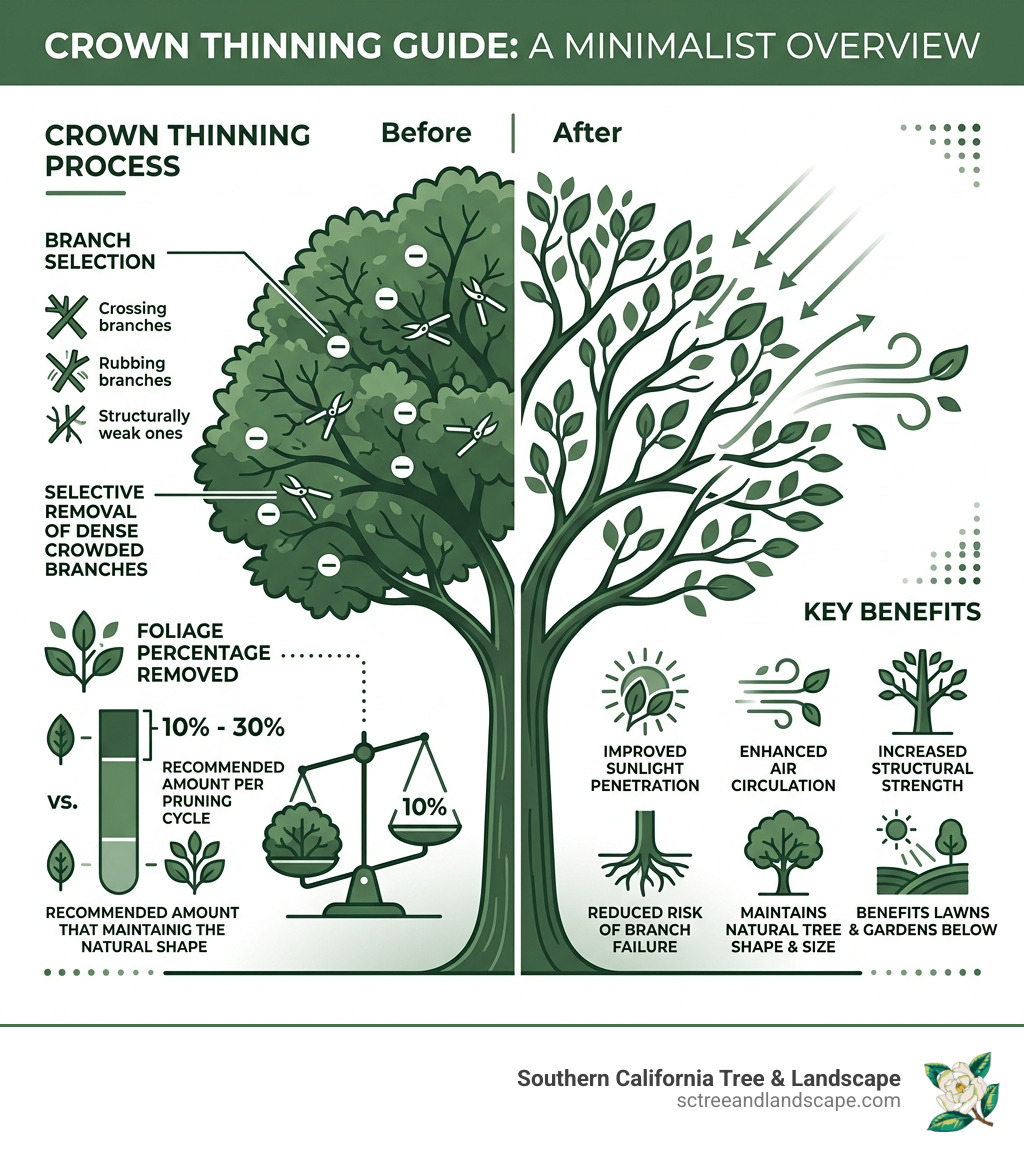
When we talk about a crown thinning tree service, we are referring to the surgical, selective removal of live branches within the tree’s canopy. Unlike other forms of pruning that might drastically alter the look of your landscape, thinning is the “invisible” service. When we finish, the tree shouldn’t look “shorter” or “smaller”—it should just look like a healthier, more vibrant version of itself.
The primary goal is to reduce the overall density of the foliage. We focus on removing smaller, secondary branches, usually ranging from one to four inches in diameter for larger trees. For smaller ornamental trees like a Japanese Maple or a Citrus tree, those cuts might be as small as a quarter-inch.
How Thinning Differs from Other Methods
It is easy to get confused by arborist jargon. If you’ve been searching for Tree Service, you’ve likely seen terms like reduction, lifting, and topping. Here is how they stack up:
| Method | Goal | Visual Result |
|---|---|---|
| Crown Thinning | Reduce density, improve light/air | Same height/width, but “dappled” light |
| Crown Reduction | Reduce overall size or height | Tree becomes smaller and more compact |
| Crown Lifting | Clear space under the tree | Lower branches are removed for clearance |
| Crown Cleaning | Remove dead or diseased wood | Healthier tree, no change to healthy limbs |
| Topping | Aggressive height removal | Avoid this! It creates weak, ugly stubs |
As we discuss in our guide on Tree Service: Essential Care for Your Property’s Green Giants, choosing the right technique is vital for the long-term survival of your landscape. While crown reduction is great for trees encroaching on power lines or roofs, crown thinning tree techniques are better suited for when you want to keep the tree’s majesty but lose the “heavy” feeling.

The Science of Airflow and Light Penetration
Why do we bother with all this selective cutting? It isn’t just for looks. There is a deep biological benefit to thinning out a crowded canopy.
Boosting Photosynthesis
It sounds counterintuitive—why remove leaves if they produce food? In a very dense tree, the inner leaves are often shaded out. They aren’t getting enough sunlight to contribute to the tree’s energy but still consume nutrients. By performing a crown thinning tree service, we allow sunlight to reach the interior of the canopy. This “dappled light” triggers photosynthesis in the inner branches, making the whole tree more efficient.
Fungal Prevention and Airflow
In humid pockets of Southern California, or even during our damp spring mornings in Torrance and the South Bay, moisture can get trapped in a thick canopy. This creates a playground for fungi like powdery mildew or leaf spot. Improved airflow helps leaves dry faster after rain or morning dew, significantly reducing the risk of disease. According to the Urban Tree Foundation, proper thinning is a proactive way to manage these health risks.
Reducing the “Wind Sail” Effect
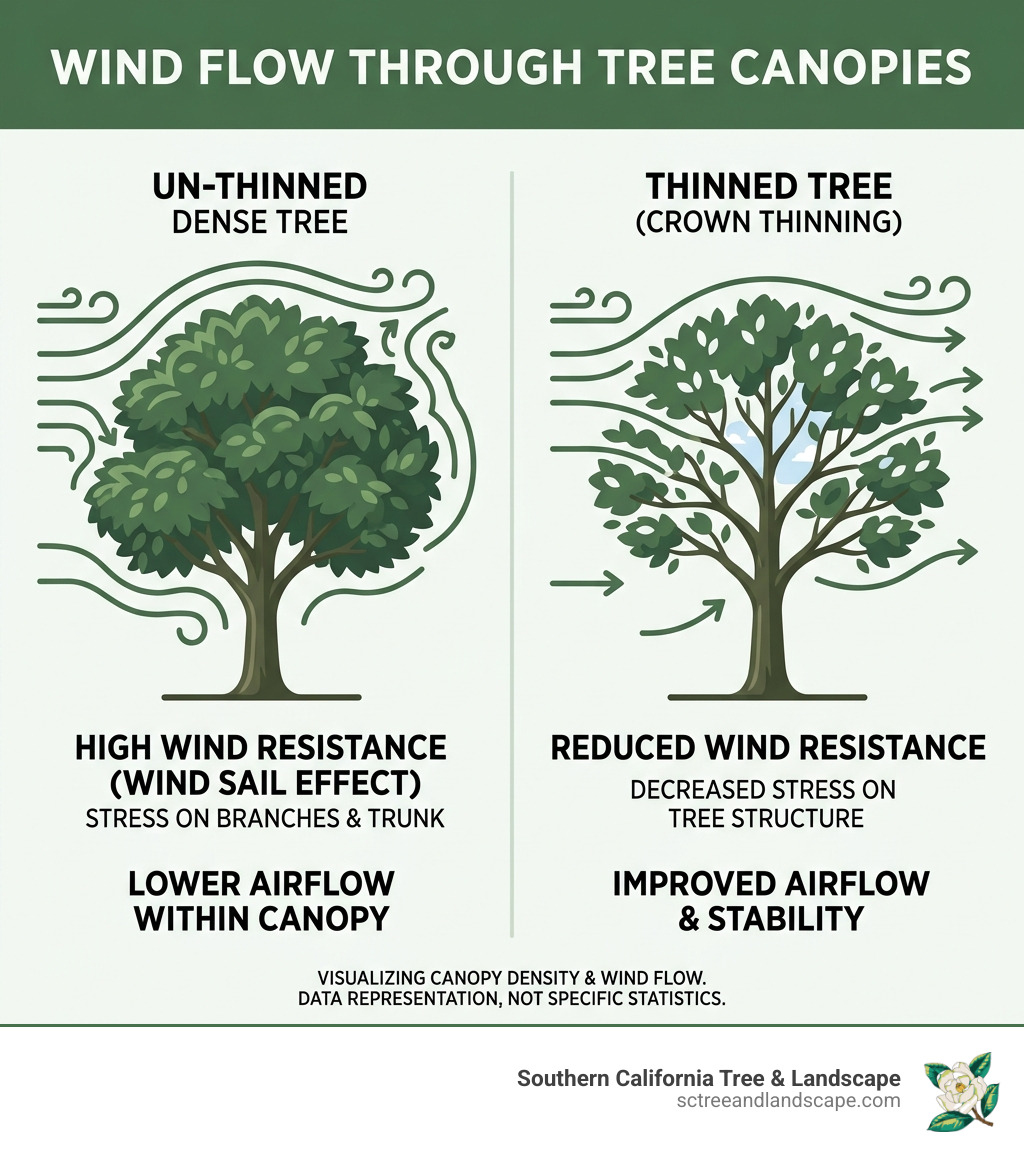
Think of a dense tree like a giant sail on a boat. When the Santa Ana winds kick up in Covina or Harbor City, a thick canopy catches all that force. This puts immense mechanical stress on the trunk and root system. By thinning the crown, we create “holes” for the wind to pass through. This reduces the wind load and makes the tree much more resistant to being uprooted or losing major limbs during a storm.
Best Practices for Proper Pruning
At Southern California Tree & Landscape, we follow strict standards to ensure we aren’t just “hacking” at your trees. Proper crown thinning tree work requires a plan. We don’t just start cutting from the bottom up; we evaluate the entire structure.
Structural Pruning First
Before we thin for aesthetics, we perform structural pruning. This means we look for:
- Crossing or rubbing branches: These create wounds that invite pests.
- Codominant stems: “V-shaped” unions that are prone to splitting.
- Weak attachments: Branches that aren’t securely “knitted” into the trunk.
By addressing these defects first, we ensure the tree is safe before we worry about how much light is hitting your lawn. You can learn more about these foundational steps on our Tree Service page.

The 25% Rule for a Crown Thinning Tree
One of the most important rules in arboriculture is the 25% Rule. You should never remove more than 25% to 30% of a tree’s live foliage in a single growing season.
Leaves are a tree’s solar panels. If we take too many, the tree goes into “panic mode.” It might produce “epicormic sprouts”—those thin, vertical suckers you see shooting out of the trunk—as it tries to replace its lost food source. These sprouts are weakly attached and look messy. By staying under the 30% threshold, we keep the tree’s stress levels low and its nutrient distribution balanced.
Avoiding the “Lion’s Tail” in Your Crown Thinning Tree
If there is one mistake that makes us cringe, it’s “Lion’s Tailing.” This happens when an inexperienced cutter removes all the inner branches and leaves only a tuft of foliage at the very end of the limb.
Why is this bad?
- Structural Weakness: All the weight is moved to the tips of the branches, making them much more likely to snap under their own weight or in a breeze.
- Sunscald: The interior bark, which has been shaded for years, is suddenly exposed to the harsh Southern California sun, which can kill the living tissue.
- Poor Weight Distribution: A healthy branch should have foliage distributed along its length to dampen the vibration from the wind. A “Lion’s Tail” branch acts like a whip.
Proper crown thinning tree work keeps foliage distributed evenly, ensuring the branch stays strong and the tree stays beautiful.
When and How to Thin Your Canopy
Timing is everything. While it’s currently April 2026, and you might be seeing your trees leafing out beautifully, the absolute best time for major thinning is during the dormant season.
The Winter/Spring Window
For most deciduous trees in Southern California, late winter to early spring is the sweet spot. Because the leaves are gone (or growth has slowed), we can see the “skeleton” of the tree clearly. This allows us to make much more precise cuts.
However, some species have different needs. For example, sap-heavy trees like Maples or Birches might “bleed” if cut in late winter, so we might wait until their leaves are fully expanded. Fruit trees are often thinned to improve light for the ripening fruit, which requires a different schedule entirely.
Tools of the Trade
While it might be tempting to grab a ladder and a hand saw, professional crown thinning tree work requires specialized gear:
- Bypass Pruners: For small, precision cuts.
- Loppers: For branches up to 2 inches.
- Pruning Saws: For those 1-to-4-inch secondary branches.
- Pole Saws: To reach high into the canopy without damaging lower limbs.
Using the wrong tool—like a dull chainsaw on a small branch—can crush the wood fibers and prevent the tree from healing properly.
Why Professional Arborists are Essential
We know what you’re thinking: “Can’t I just do this myself?” While you can certainly prune a small shrub, thinning a mature tree is a different beast. Since 1991, Southern California Tree & Landscape has been helping homeowners in Torrance, Covina, and the South Bay navigate the complexities of tree care.
The ISA-Certified Advantage
An ISA-certified arborist doesn’t just see “branches to be cut.” We see a living organism. We understand tree biology and how a cut made today will affect the tree in 2030. We also know the local regulations. In some areas, like those with Tree Preservation Orders (TPO), you may actually need a permit or a professional assessment before you can touch certain species.
Safety and Insurance
Climbing a tree with sharp tools is inherently dangerous. Our crews are trained in high-angle safety and use professional rigging to ensure that when a branch comes down, it doesn’t land on your roof or your neighbor’s fence. We provide rapid emergency response and carry the necessary insurance to protect your property and our workers.
Frequently Asked Questions about Crown Thinning
Which tree species benefit most from thinning?
Broad-leaf hardwood trees are the prime candidates for crown thinning tree services. In our region, this includes:
- Oaks: To reduce weight on long, heavy limbs.
- Maples and Elms: To improve light for the lawn below.
- Sycamores: To manage their rapid growth and dense shade.
- Fruit Trees: To ensure sunlight reaches the center of the tree for better fruit production.
How often should crown thinning be performed?
This depends on the growth rate of the species and the age of the tree. A young, fast-growing tree might need a light thinning every 2–3 years. A mature, slow-growing Oak might only need it once every 5–7 years. As of April 2026, the standard is to monitor the canopy density; if you can no longer see “bits of sky” through the leaves, it’s probably time for a check-up.
Does thinning prevent storm damage in Southern California?
Yes, but with a caveat. While thinning reduces the “wind sail” effect and removes heavy weight from the ends of branches, it isn’t a magic shield. However, compared to un-pruned trees, a thinned tree is significantly less likely to suffer from limb failure or uprooting during a high-wind event.
Conclusion
A crown thinning tree service is an investment in the longevity of your landscape. It isn’t just about making the backyard look “cleaner”—it’s about giving your trees the air they need to breathe, the light they need to grow, and the structural integrity they need to withstand the elements.
By following the 25% rule, avoiding the dreaded “Lion’s Tail,” and timing your pruning correctly, you can ensure your trees remain the “green giants” of your property for decades to come.
Whether you are in Torrance, Harbor City, or anywhere in the South Bay, we are here to help. Our family-owned business has the experience and the certified expertise to handle even the densest canopies.
Ready to let some light back into your life? Check out our Tree Service page or contact us today to schedule a consultation with an ISA-certified arborist. Let’s keep Southern California green, one tree at a time!