
Why Automatic Sprinkler System Installation Is Worth Every Drop
Automatic sprinkler system installation is one of the smartest upgrades you can make to any Southern California property. Done right, it saves water, cuts your workload, and keeps your landscape looking sharp year-round.
Here’s a quick overview of what’s involved:
- Plan your layout – Map your yard, measure water pressure (40-70 PSI is typical), and divide into hydrozones
- Gather tools and materials – PVC pipe, fittings, sprinkler heads, a trencher, and a controller
- Call 811 – Mark underground utilities before any digging
- Dig trenches – 6 to 12 inches deep for irrigation lines
- Install valves, pipes, and heads – Connect to your water supply with a backflow preventer
- Wire your controller – Set zones, schedules, and add smart sensors
- Test and adjust – Flush lines, check coverage, and fine-tune nozzle alignment
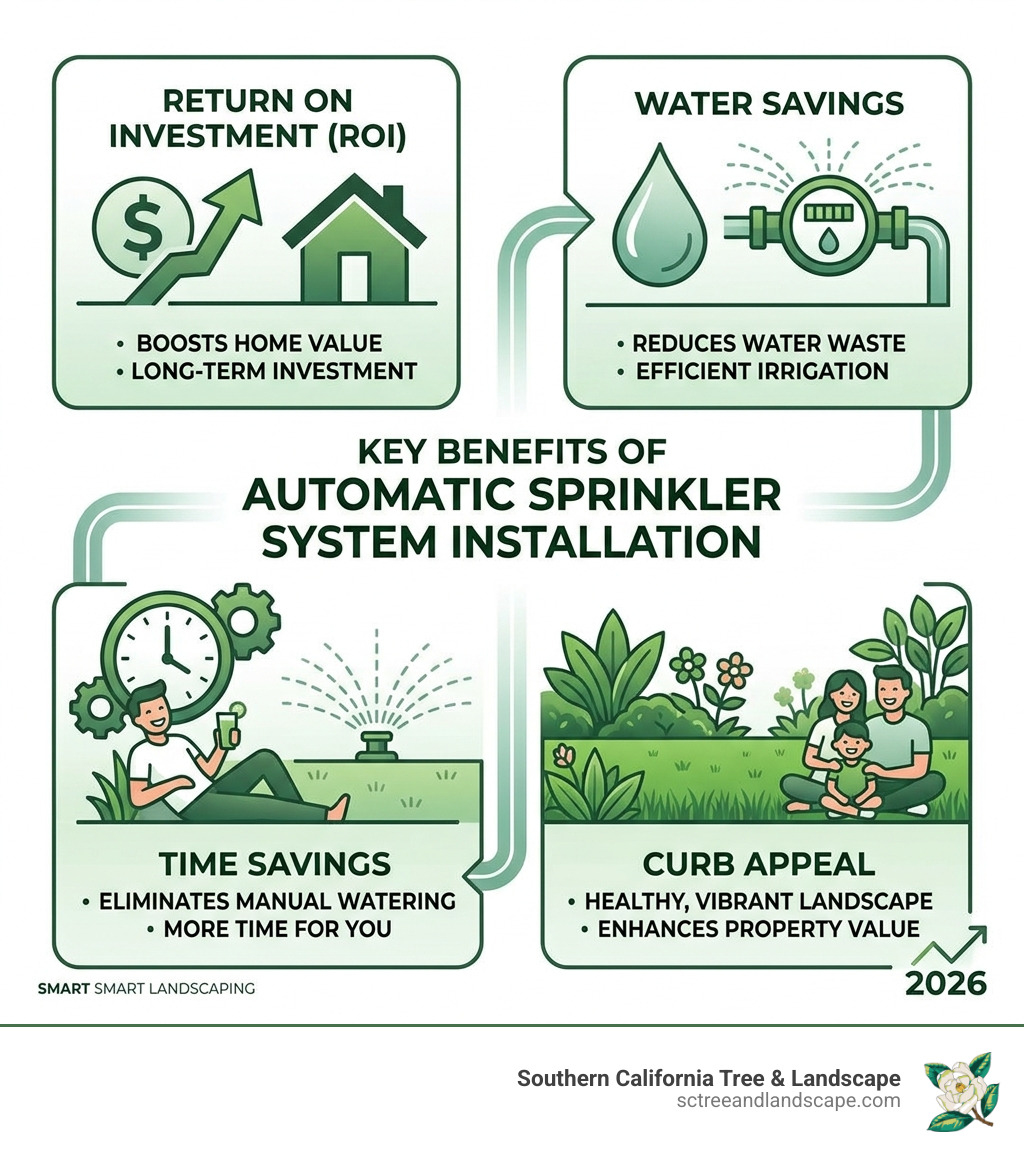
The payoff is real. A well-installed system delivers roughly an 86% return on investment on home value, lasts 20+ years with basic maintenance, and can meaningfully reduce water waste — a big deal in Southern California where drought restrictions are a way of life.
Whether you’re managing an HOA property or a single-family home, this guide walks you through everything: planning, installation, smart controls, maintenance, and when it makes sense to call a pro.
Planning Your Automatic Sprinkler System Installation
Success in automatic sprinkler system installation starts long before the first shovel hits the dirt. In our decades of experience serving the South Bay and Covina areas, we’ve seen that the most common reason for system failure isn’t a broken pipe—it’s a bad plan.
Proper landscape design & installation requires a detailed evaluation of your yard’s unique geography. You need to account for slopes, which can cause water to pool at the bottom, and drainage patterns that might lead to erosion. We recommend mapping your property on graph paper using a scale of 1 inch to 10 feet. This allows you to accurately place your sprinkler heads and calculate exactly how much pipe you’ll need.
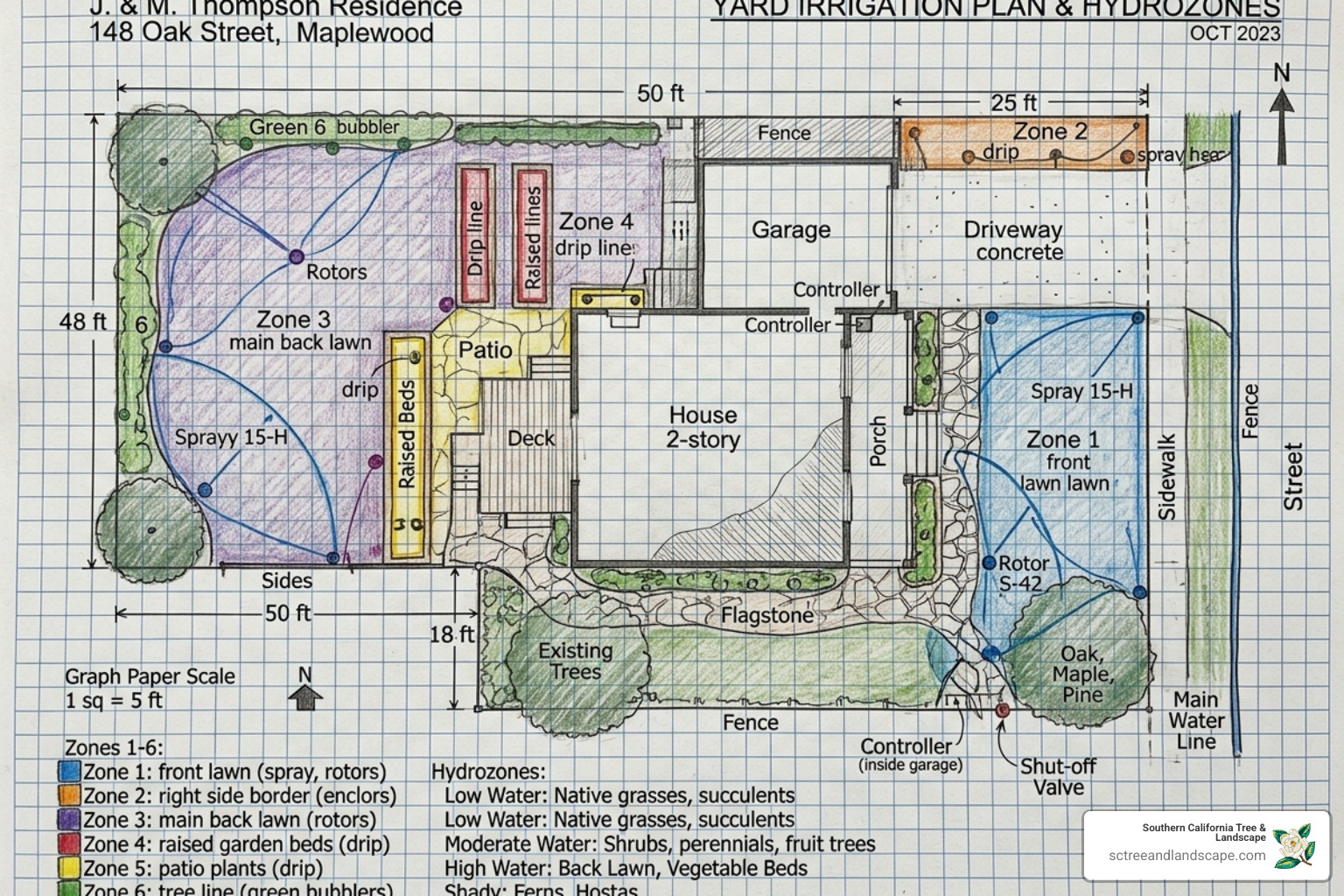
One of the most critical concepts is creating “hydrozones.” This means grouping plants with similar water needs together. Your thirsty turf should be on a different zone than your drought-tolerant succulents. You should also note sun exposure; the south-facing side of your Harbor City home will dry out much faster than the shaded areas under your trees. For more specialized advice, you can explore our irrigation services.
Determining Water Pressure and Flow Rate
Before you buy a single sprinkler head, you must know your “water budget.” Most homes in Southern California operate between 40 and 70 PSI (pounds per square inch). You can check this by attaching a simple pressure gauge to an outside faucet. Ensure all other water sources in the house are turned off to get an accurate “static pressure” reading.
Next, you need to find your flow rate in Gallons Per Minute (GPM). This is easily done with the “5-gallon bucket test.” Place a 5-gallon bucket under your outdoor spigot and time how long it takes to fill. Divide 300 by the number of seconds it took to fill the bucket to get your GPM. For example, if it takes 30 seconds, your flow rate is 10 GPM. This number dictates how many sprinkler heads you can run at once without the water pressure dropping so low that the heads fail to pop up.
Essential Tools for Automatic Sprinkler System Installation
Having the right gear makes the difference between a one-weekend project and a month-long headache. You’ll need a trenching shovel (specifically designed with a narrow blade), PVC pipe cutters, and high-quality PVC primer and cement.
| Sprinkler Head Type | Typical Spray Distance | Best Use Case |
|---|---|---|
| Fixed Pop-Up Heads | 5 – 15 feet | Small lawns or flower beds |
| Rotary Nozzles | 15 – 30 feet | Medium to large lawns; high efficiency |
| Impact Sprinklers | 25 – 40 feet | Very large open spaces |
| Drip Irrigation | N/A | Shrubs, trees, and potted plants |
For a detailed walkthrough on choosing the right components, This Old House offers excellent insights into professional-grade hardware.
The Physical Setup: Trenching and Plumbing
Once your plan is finalized, it’s time for the heavy lifting. But wait! Before you dig, you must call 811. This is a free service that marks your underground utility lines (gas, electric, water). Hitting a gas line in Torrance isn’t just expensive; it’s dangerous.

For the trenches, we recommend a depth of 6 to 12 inches. Main lines (the ones constantly under pressure) should be slightly deeper—around 10 to 12 inches—while lateral lines (the ones that only have water when the zone is on) can sit at 6 to 8 inches. If you have a large yard, consider renting a power trencher; it can dig 100 feet in an hour, whereas doing it by hand might take all day.
Step-by-Step Automatic Sprinkler System Installation
- Assemble the Valve Manifold: This is the “brain” of your plumbing. It’s a group of valves that distribute water to different zones. We suggest installing this in an accessible valve box lined with gravel for drainage.
- Install the Backflow Preventer: This is a legal requirement in most of Southern California. It prevents dirty irrigation water from being siphoned back into your clean drinking water.
- Lay the Pipe: Start from the manifold and work outward. Use Schedule 40 PVC for your main lines. When gluing, apply primer and cement, then give the pipe a 1/4 turn as you push it into the fitting to ensure a leak-proof seal.
- Install Swing Joints: Instead of connecting sprinkler heads directly to the lateral line, use “swing pipe” or flexible joints. This prevents the pipe from breaking if someone steps on a sprinkler head or runs over it with a mower.
- Flush the System: This is the most skipped step! Before you screw on the sprinkler nozzles, turn the water on to blow out any dirt or PVC shavings that fell into the pipes during installation.
For more technical details on assembly, Rain Bird’s step-by-step guide is a fantastic resource for DIYers.
Connecting the Controller and Smart Sensors
In May 2026, there’s no reason to use an old-fashioned “dial” timer. Modern Wi-Fi-enabled controllers are the standard. These smart systems connect to local weather stations in areas like Covina or Harbor City and automatically skip watering cycles if rain is in the forecast.
When wiring, use waterproof connectors and color-coded wires (e.g., red for Zone 1, blue for Zone 2). Always include a “common” wire (usually white) that connects to every valve. We also highly recommend installing a soil moisture sensor. This prevents the “watering during a downpour” scenario that makes neighbors roll their eyes and wastes your money.
Testing, Maintenance, and Water Efficiency
With everything in the ground, it’s time for the “Performance Review.” Turn on each zone one by one. You are looking for “head-to-head coverage.” This means the spray from one head should reach the base of the next head. This ensures 100% saturation and eliminates those frustrating brown “dry spots.”
If you see misting or a fine fog coming from your heads, your pressure is too high. You can fix this by installing pressure-regulating heads or adjusting the flow at the valve. Conversely, if the heads barely pop up, you likely have too many heads on one zone or a leak. For a deeper dive into achieving a healthy lawn through proper irrigation, check out this guide from Angi.
Troubleshooting and Seasonal Care
Your system is a “quiet employee,” but it still needs a performance review.
- Clogged Nozzles: If a head isn’t spraying correctly, unscrew the nozzle and rinse the small plastic filter inside.
- Leak Detection: Watch for unusually soggy spots or a sudden spike in your water bill.
- Winterization: While we don’t deal with deep freezes in the South Bay, it’s still wise to “blow out” the lines or drain them if you’re in higher elevation areas of Southern California during a cold snap to prevent pipe fatigue.
- Spring Tune-Up: Every year, walk your zones. Over time, heads can sink or tilt. Straighten them up so they spray level across the grass.
If you’re looking to refresh your entire yard, our landscape design services can help integrate your new irrigation with beautiful, water-wise plantings.
Professional vs. DIY: Costs and Considerations
Is automatic sprinkler system installation a DIY project? For a small, rectangular yard and a homeowner with plumbing experience, yes. However, for complex landscapes, it can be daunting.
The Cost Breakdown:
- DIY: Typically costs between $1,500 and $2,000 for materials and tool rentals.
- Professional: Average residential costs range from $2,540 to $3,581.
- Labor: Expect to pay $50 to $100 per hour for professional crews.
The “Pro” advantage comes down to efficiency and longevity. At Southern California Tree & Landscape, we understand local drought regulations and permit requirements that can vary between Torrance and Covina. We also use professional-grade components that often outlast the “big box store” versions. Plus, we handle the backflow certification—a task that requires a licensed professional in many municipalities.
Frequently Asked Questions about Sprinkler Installation
How deep should I dig my sprinkler trenches?
In Southern California, you don’t have to worry about a deep frost line, but you do have to worry about shovels and aerators. Dig your trenches 6 to 12 inches deep. This provides enough “cover” to protect the pipes from most gardening activities while keeping them accessible enough for future repairs.
Do I need a permit for automatic sprinkler system installation?
In many parts of the South Bay and Southern California, a permit is required when you are tapping into the main water line or installing a backflow preventer. Municipal codes are designed to protect the city’s water supply from contamination. It is always best to check with your local building department first.
How many sprinkler heads can I have on one zone?
This depends entirely on your GPM and the “consumption” rate of your heads. If your home provides 10 GPM and your chosen heads use 2 GPM each, you can safely put 5 heads on that zone. If you add a 6th, the pressure will drop, and none of the heads will spray effectively.
Conclusion
Installing an automatic sprinkler system is an investment in your home’s future and your own free time. No more dragging hoses on Saturday mornings or worrying about your lawn while you’re on vacation. Since 1991, Southern California Tree & Landscape has been helping families across the South Bay, Torrance, and Covina achieve the lush, efficient landscapes they deserve.
As a family-owned business with ISA-certified arborists on staff, we don’t just look at the pipes; we look at the health of your entire ecosystem. Whether you need a simple irrigation repair or a complete system design and installation, we are here to provide rapid, expert service.
Ready to stop hosing around? Contact us today to transform your outdoor space with a professional irrigation solution tailored to the Southern California climate. Let’s make your lawn the envy of the neighborhood—efficiently.