
When Your Tree Is Too Big for Its Space: What Crown Reduction Actually Does
Tree crown reduction is the process of selectively pruning a tree’s outer branches to reduce its overall height and spread — while keeping its natural shape intact.
If you’re managing a property in Southern California and a tree is creeping toward a roofline, blocking a view, or brushing power lines, here’s what you need to know quickly:
Tree crown reduction at a glance:
- What it is: Selective pruning of branch tips back to healthy lateral (side) branches
- How much is removed: No more than 20–25% of the tree’s live foliage in a single session
- What it’s NOT: Tree topping — which removes large chunks of the crown indiscriminately and causes serious long-term damage
- Best time to do it: Late fall through early spring, when the tree is dormant
- Who should do it: An ISA-certified arborist, especially for large or mature trees
- Typical cost range: $250–$2,200+, depending on tree size and site conditions
The goal isn’t just to make a tree smaller. It’s to make it healthier, safer, and more manageable — without triggering the decay, disease, and weak regrowth that bad pruning causes.
For HOA managers and property owners, an overgrown tree isn’t just an eyesore. It’s a liability. Branches over a roof, near power lines, or shading out an entire courtyard can become urgent problems fast. Crown reduction, done right, solves those problems without sacrificing the tree — or your property value.
But “done right” is the key phrase. The difference between a skilled reduction cut and a hack job can mean the difference between a thriving 80-year-old oak and a decaying stump within a decade.
This guide walks you through exactly how it works, what it costs, and how to make sure it’s done correctly.
What is Tree Crown Reduction and Why It Beats Topping
At Southern California Tree & Landscape, we often hear property owners say, “I love this tree, but it’s just getting too big for the yard.” The instinct is to just “chop the top off.” However, in professional arboriculture, that’s a cardinal sin.
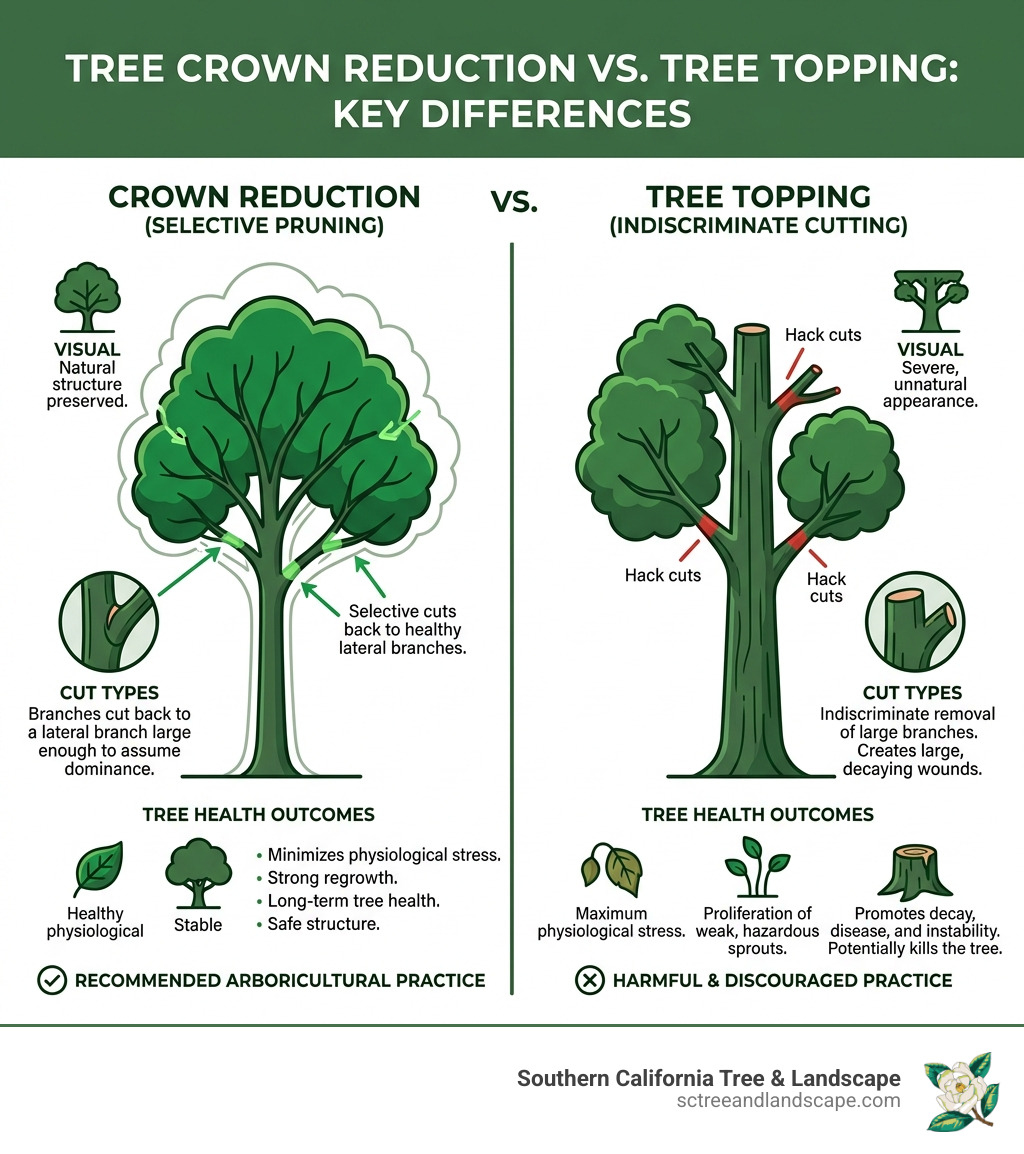
Tree crown reduction is a sophisticated method of Tree Service: Essential Care for Your Property’s Green Giants that uses “drop-crotch” pruning. This involves cutting a branch back to a lateral (side) branch that is large enough to take over the role of the lead branch. This preserves the tree’s natural structure and minimizes physiological stress.
In contrast, “heading cuts”—the hallmark of topping—involve cutting branches to random stubs. This ignores the tree’s natural growth nodes and leaves it vulnerable. According to Everything You Need to Know About Crown Reduction, proper reduction ensures the tree can still transport nutrients and seal its wounds effectively.
Tree Crown Reduction vs. Tree Topping: The Health Verdict
Topping, also known as “hat-racking,” is perhaps the most harmful thing you can do to a mature tree. When you top a tree, you remove 50–90% of its leaf-bearing crown. This shocks the tree into a “survival mode” where it rapidly produces “water sprouts”—spindly, weak branches that grow straight up. These sprouts are poorly attached and prone to breaking in our South Bay winds.
Furthermore, topping creates large, flat wounds that don’t heal. These become “decay pockets,” allowing fungi and pests to eat the tree from the inside out. Professional Tree Crown Services | SoCal Tree Care emphasizes that while topping might seem cheaper today, the cost of managing a dying, hazardous tree tomorrow is much higher. Crown reduction maintains structural integrity, ensuring your tree remains an asset rather than a liability.
The Science of Selective Branch Removal
Why does crown reduction work so well? It’s all about apical dominance. The tip of a branch (the terminal leader) produces hormones that control the growth of the buds below it. By using a reduction cut to move that lead role to a healthy lateral branch, we redirect nutrients and water to a part of the tree that is already established.
This keeps the tree’s energy focused on healthy, controlled growth rather than the chaotic, bushy regrowth seen after bad pruning. We aren’t fighting the tree’s biology; we’re working with it.
Mastering the Art of Tree Crown Reduction Pruning
Pruning a large tree isn’t a DIY weekend project. It requires an understanding of tree physics and biology. When we perform a tree crown reduction, we follow the “1/3 diameter rule.” This means the lateral branch we cut back to must be at least one-third the diameter of the parent stem being removed. This ensures the remaining branch is strong enough to handle the nutrient load and assume the “leader” position.

Proper cuts must be made just outside the branch collar—the swollen area where the branch meets the trunk. This area contains special “chemically-defended” cells that help the tree seal the wound. If you cut too close (a flush cut) or too far away (leaving a stub), the tree cannot heal properly, leading to rot. You can learn more about these technical nuances at Mastering Crown Reduction Techniques for Thriving Trees | Culibloom Blog.
Step-by-Step Guide to Tree Crown Reduction
How do our crews handle a typical job in Covina or Torrance? We follow a strict protocol:
- Assessment: We evaluate the tree’s species, age, and health. Is it a “weak compartmentalizer” (prone to rot)? If so, we are even more conservative with our cuts.
- Pruning Plan: We identify the specific terminals that need shortening to achieve the desired height and spread.
- The Three-Cut Method: To prevent heavy branches from tearing the bark down the trunk, we use three cuts: an undercut, a top cut to remove the weight, and a final finish cut at the collar.
- Jagged Periphery: A “perfectly round” tree looks unnatural. We aim for a slightly jagged, natural-looking edge that hides the cuts from view. As noted by Edward F. Gilman at UF/IFAS, keeping the outer edge natural helps the tree maintain its aesthetic value.
Essential Tools for Precision Pruning
We don’t just show up with a chainsaw. For a high-quality tree crown reduction, we use:
- Bypass Shears & Loppers: For smaller, precise cuts on outer branches.
- Pole Saws: To reach high terminals without unnecessary climbing.
- Climbing Gear: Professional harnesses and ropes to navigate the canopy safely.
- Disinfected Blades: We clean our tools between trees to prevent the spread of diseases like Fusarium wilt, which is common in Southern California.
The High Stakes of Canopy Management: Benefits and Risks
Why go through the trouble? Safety is the number one reason. An overgrown canopy acts like a giant “wind sail” during Santa Ana wind events. By reducing the crown, we allow wind to pass through the branches more easily, reducing the risk of the whole tree toppling.
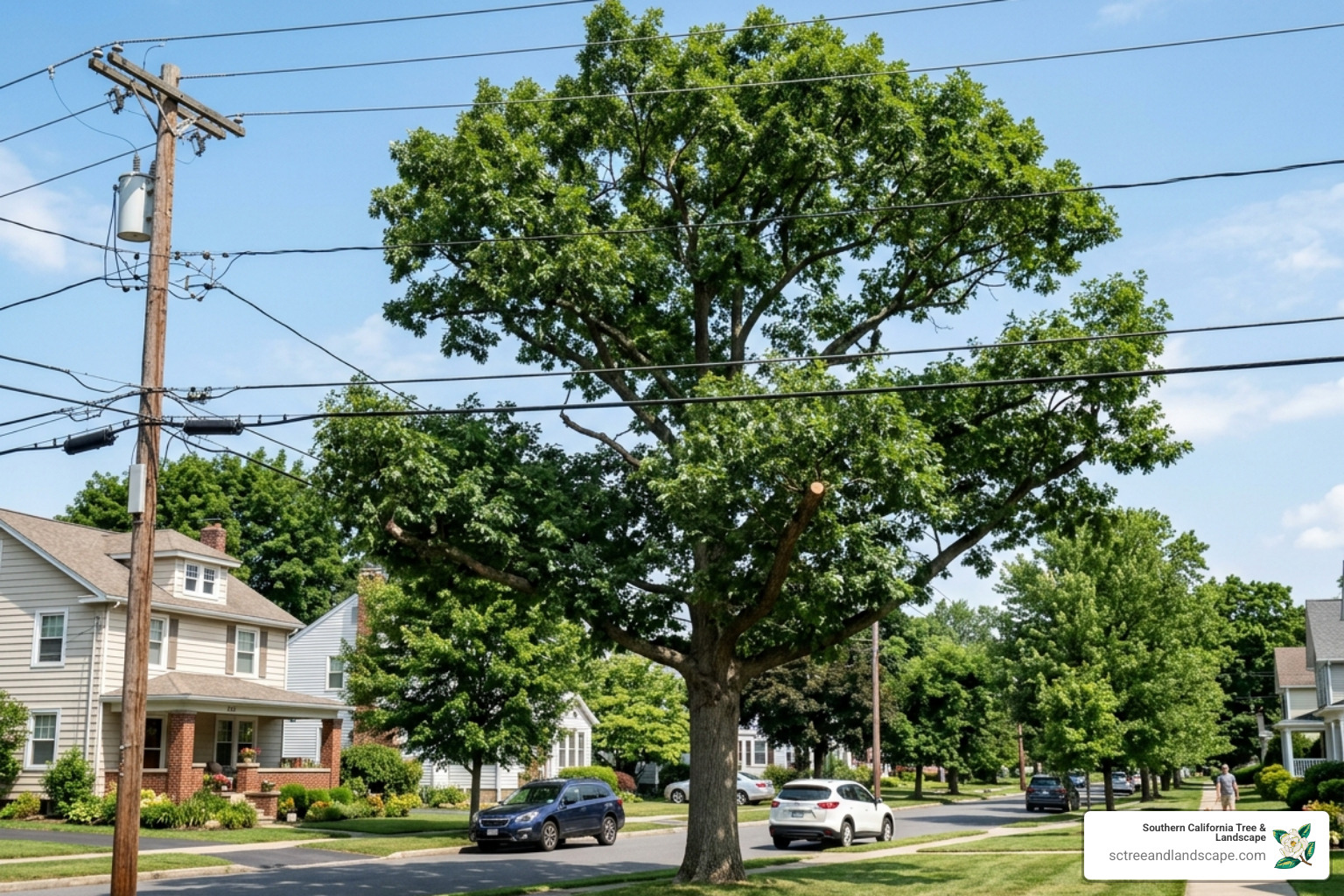
Beyond safety, there are huge health benefits. Proper thinning and reduction increase sunlight penetration and airflow to the inner parts of the tree and the landscape below. This prevents fungal diseases that thrive in damp, stagnant shade. For more on the long-term philosophy of these treatments, check out the research from UF/IFAS Landscape Plants.
Mitigating Risks of Improper Pruning
Even “good” pruning has risks if taken too far. If you remove too much foliage at once, you expose the inner branches to “sunscald” or bark necrosis. Think of it as a tree sunburn; without the shade of the outer leaves, the bark can literally cook in the Southern California sun.
Additionally, every leaf removed is a loss of energy reserves. Mature trees store starch in their wood; removing too many branches at once can starve the tree. That is why we never exceed the 25% removal rule in a single season.
Clearance Solutions for Property Owners
For many of our clients in Harbor City and the South Bay, crown reduction is a practical necessity. We use it to:
- Clear Power Lines: Maintaining a safe distance from utility lines without “V-cutting” the tree into an ugly shape.
- Roof Encroachment: Stopping branches from scraping shingles or dropping debris into gutters.
- View Preservation: Lowering the height of a tree to restore a coastal or city view without killing the tree.
- Street Light Clearance: Ensuring neighborhood safety by keeping street lights unobstructed.
Timing, Frequency, and the Cost of Tree Crown Reduction in 2026
Pricing for tree services has shifted slightly as we move through 2026, largely due to equipment and insurance costs. However, crown reduction remains a cost-effective alternative to full tree removal, which can cost upwards of $5,000 for large specimens.
Factors Influencing Your 2026 Service Quote
Several variables determine the final price on your estimate:
- Tree Height: Taller trees require more climbing time and specialized safety rigging.
- Site Accessibility: Can we get a lift into the yard, or does everything have to be done by hand and carried through a small gate?
- Species Density: A dense, multi-trunked oak takes much longer to prune than a sparser sycamore.
- Debris Hauling: The volume of “green waste” we have to chip and haul away affects the labor hours.
Here is a look at the typical cost ranges we are seeing in the Torrance and South Bay areas for 2025–2026:
| Tree Size | Height | Estimated Cost Range (2025-2026) |
|---|---|---|
| Small | 20–30 ft | $250 – $600 |
| Medium | 30–50 ft | $600 – $1,350 |
| Large | 50–80 ft | $1,300 – $2,300 |
| Extra Large | 80+ ft | $1,900 – $3,600+ |
Note: These are averages. Prices in Torrance, CA may vary based on specific local conditions.
Recommended Maintenance Intervals
How often should you do this? It depends on the tree.
- Fast-growers (e.g., Willows, Poplars): May need a “touch-up” every 1–2 years.
- Moderate-growers (e.g., Maples, Sycamores): Every 3–5 years.
- Slow-growers (e.g., Coast Live Oaks): Every 5–7 years.
We always recommend annual inspections. It is much cheaper to prune a few small branches every year than to wait a decade and have to perform a massive, stressful reduction.
Frequently Asked Questions about Tree Crown Reduction
How much of the tree’s foliage can be safely removed?
The industry standard is the 25% rule. You should never remove more than one-quarter of the living crown in a single growing season. For very old or stressed trees, we often drop that to 10–15%. If a tree needs a 50% reduction to meet your goals, we recommend a “staged pruning” approach—doing half now and the other half two growing seasons later.
When is the best time of year for crown reduction in Southern California?
While we can prune dead wood year-round, the best time for a major tree crown reduction is during the dormant season—late fall through early spring (roughly November to March). Pruning while the tree is dormant reduces sap loss and minimizes the risk of attracting pests like bark beetles.
Why should I hire an ISA-certified arborist for this service?
Anyone with a truck and a chainsaw can call themselves a “tree trimmer,” but only an ISA-certified arborist has the biological training to ensure your tree survives the process. Certification ensures the crew follows ANSI A300 pruning standards, carries the proper liability insurance (usually $1 million minimum), and understands local Southern California species. When looking for the best tree services in South Bay, always ask for an arborist’s certification number.
Conclusion
Your trees are some of the most valuable assets on your property. They provide shade, lower your cooling bills, and increase your home’s curb appeal. Don’t let an overgrown canopy turn a beautiful tree into a property hazard.
At Southern California Tree & Landscape, we’ve been family-owned since 1991. Our ISA-certified arborists and experienced crews understand the unique needs of Southern California landscapes, from the coastal breezes of the South Bay to the inland heat of Covina. We specialize in precision tree crown reduction that keeps your trees healthy and your property safe.
Ready to give your “green giants” the care they deserve?
Explore Our Services: Tree Service or Book your professional tree crown reduction today for a free estimate from our expert team. Let’s keep Southern California beautiful, one tree at a time.